


A Comprehensive Review of Contemporary Literature for Epidermal Growth Factor Receptor Tyrosine Kinase Inhibitors in Non-Small Cell Lung Cancer and Their Toxicity
- PMID: 33117017
- PMCID: PMC7548332
- DOI: 10.2147/LCTT.S258444
A Comprehensive Review of Contemporary Literature for Epidermal Growth Factor Receptor Tyrosine Kinase Inhibitors in Non-Small Cell Lung Cancer and Their Toxicity
Abstract
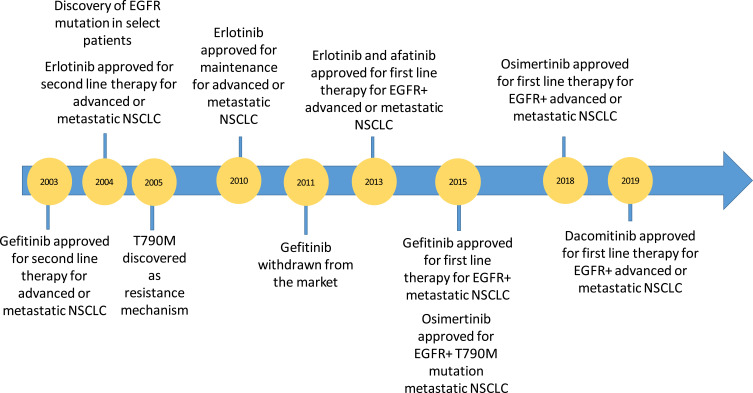
Mutations in the epidermal growth factor receptor (EGFR) are common amongst those with non-small cell lung cancer and represent a major factor in treatment decisions, most notably in the advanced stages. Small molecule tyrosine kinase inhibitors (TKIs) that target the EGFR, such as erlotinib, gefitinib, icotinib, afatinib, dacomitinib and osimertinib, have all shown to be effective in this setting. Osimertinib, a third-generation EGFR TKI, is a favorable option, but almost all patients develop resistance at some time point. There are no effective treatment options for patients who progress on osimertinib, but ongoing trials will hopefully address this unmet need. The aim of this review is to provide a comprehensive review of the data with EGFR TKIs, management of the toxicities and the ongoing trials with this class of agents.
Keywords: epidermal growth factor receptor; non-small cell lung cancer; tyrosine kinase inhibitor.
© 2020 Lee et al.
Conflict of interest statement
Nagashree Seetharamu has served on the advisory boards for Genentech, Amgen, Takeda and Astra-Zeneca in the last year outside the submitted work. The authors report no other conflicts of interest in this work.
Figures
References
-
- Howlader N, Noone AM, Krapcho M, et al. SEER Cancer Statistics Review, 1975-2014. Bethesda, MD: National Cancer Institute; https://seer.cancer.gov/csr/1975_2014/.
Publication types
LinkOut - more resources
Full Text Sources
Research Materials
Miscellaneous
