


Perspective for Precision Medicine for Tuberculosis
- PMID: 33117351
- PMCID: PMC7578248
- DOI: 10.3389/fimmu.2020.566608
Perspective for Precision Medicine for Tuberculosis
Abstract
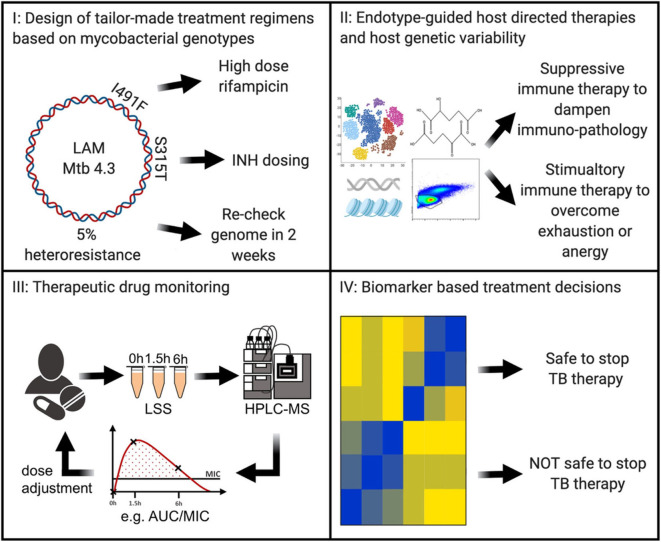
Tuberculosis is a bacterial infectious disease that is mainly transmitted from human to human via infectious aerosols. Currently, tuberculosis is the leading cause of death by an infectious disease world-wide. In the past decade, the number of patients affected by tuberculosis has increased by ~20 percent and the emergence of drug-resistant strains of Mycobacterium tuberculosis challenges the goal of elimination of tuberculosis in the near future. For the last 50 years, management of patients with tuberculosis has followed a standardized management approach. This standardization neglects the variation in human susceptibility to infection, immune response, the pharmacokinetics of drugs, and the individual duration of treatment needed to achieve relapse-free cure. Here we propose a package of precision medicine-guided therapies that has the prospect to drive clinical management decisions, based on both host immunity and M. tuberculosis strains genetics. Recently, important scientific discoveries and technological advances have been achieved that provide a perspective for individualized rather than standardized management of patients with tuberculosis. For the individual selection of best medicines and host-directed therapies, personalized drug dosing, and treatment durations, physicians treating patients with tuberculosis will be able to rely on these advances in systems biology and to apply them at the bedside.
Keywords: endotypes; mycobacterial genotypes; precision medicine; tailor-made regimen; tuberculosis.
Copyright © 2020 Lange, Aarnoutse, Chesov, van Crevel, Gillespie, Grobbel, Kalsdorf, Kontsevaya, van Laarhoven, Nishiguchi, Mandalakas, Merker, Niemann, Köhler, Heyckendorf, Reimann, Ruhwald, Sanchez-Carballo, Schwudke, Waldow and DiNardo.
Figures
References
-
- World Health Organization Global Tuberculosis Report 2019 Geneva. (2019).
-
- Salzer HJ, Wassilew N, Kohler N, Olaru ID, Gunther G, Herzmann C, et al. Personalized medicine for chronic respiratory infectious diseases: tuberculosis, nontuberculous mycobacterial pulmonary diseases, and chronic pulmonary aspergillosis. Respiration. (2016) 92:199–214. 10.1159/000449037 - DOI - PubMed
Publication types
MeSH terms
Substances
LinkOut - more resources
Full Text Sources
Medical
Miscellaneous
