


Alternative air-liquid interface method for inhalation toxicity testing of a petroleum-derived substance
- PMID: 33117658
- PMCID: PMC7581970
- DOI: 10.1016/j.mex.2020.101088
Alternative air-liquid interface method for inhalation toxicity testing of a petroleum-derived substance
Abstract
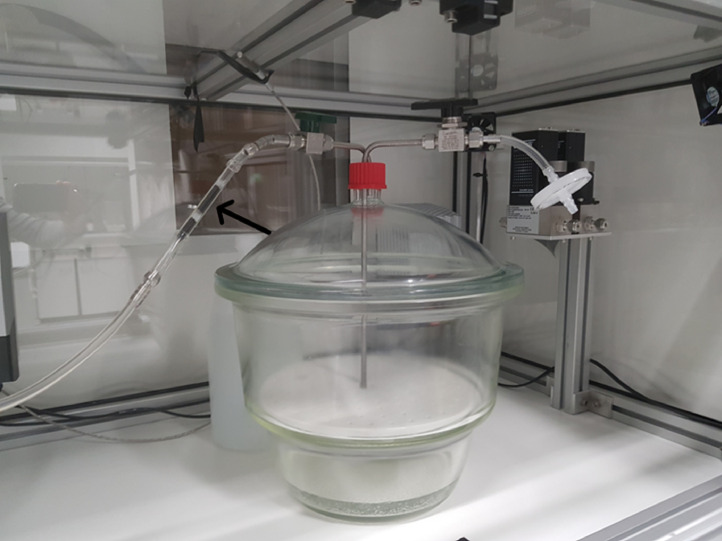
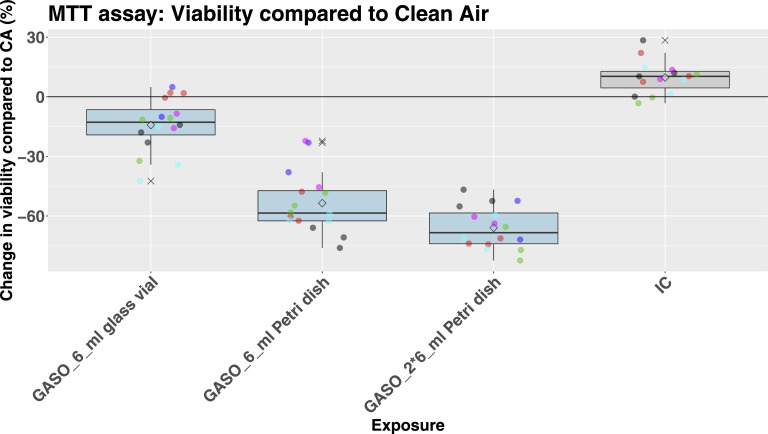
In vitro-based new approach methodologies (NAMs) provide a pragmatic solution to animal testing of petroleum substances and their constituents. A previous study exposed an in vitro model (A549 cells) at the air-liquid interface (ALI) to assess inhalation toxicity of a single compound, ethylbenzene. Experimental conditions using VITROCELLⓇ 24/48 exposure system were optimized to achieve a deposition efficiency that resulted in dose-dependent biological changes. The feasibility of this set-up was evaluated for testing the complex substance gasoline, which, at only high concentrations, can induce mild respiratory irritation in animals and cough in humans.•Results showed that perpendicular ALI exposure flow systems (VITROCELL® 6/4 and 24/48) may not be appropriate for testing gasoline because it was not possible to achieve enough deposition onto the cells and in the culture medium to measure dose and to determine dose-dependent biological changes (more information can be found in 'Supplementary material and/or Additional information' section).•Structural features (e.g. aromatic or saturated hydrocarbon structure) and high hydrophobicity, together with the low concentrations of individual components in gasoline, may have caused the low deposition.•To achieve a higher deposition on the cells, A549 cells were exposed to gasoline at the ALI by passive dosing.The results demonstrate that the presented methodology is a promising NAM for inhalation toxicity testing of (semi-)volatile complex substances with low aqueous solubility.
Keywords: Gasoline; In vitro inhalation testing; Passive dosing.
© 2020 The Author(s). Published by Elsevier B.V.
Conflict of interest statement
The authors declare that they have no known competing financial interests or personal relationships that could have appeared to influence the work reported in this paper. [Include at least one reference, to the original publication of the method you customized.]
Figures



References
-
- R Core Team (2018). R: A language and environment for statistical computing. R Foundation for Statistical Computing, Vienna, Austria. Available online at https://www.R-project.org/.
-
- Bates D., Mächler M., Bolker B., Walker S. Fitting linear mixed-effects models using lme4. J. Stat. Softw. 2015;67(1):1–48.
-
- Kuznetsova A., Brockhoff P.B., Christensen R.H.B. lmerTest package: tests in linear mixed effects models. J. Stat. Softw. 2017;82(13):1–26.
-
- ISO 16200-1:2001: Workplace air quality — Sampling and analysis of volatile organic compounds by solvent desorption/gas chromatography - Part 1: Pumped sampling method.
-
- Steiner S., Diana P., Dossin E., Guy P., Vuillaume G., Kondylis A. Delivery efficiencies of constituents of combustion-derived aerosols across the air-liquid interface during in vitro exposures. Toxicol. In Vitro. 2018;52:384–398. - PubMed
LinkOut - more resources
Full Text Sources
