. 2020 Nov 25;83(11):3305-3314.
doi: 10.1021/acs.jnatprod.0c00648. Epub 2020 Oct 29.

Discovery of a Beetroot Protease Inhibitor to Identify and Classify Plant-Derived Cystine Knot Peptides

Affiliations

Discovery of a Beetroot Protease Inhibitor to Identify and Classify Plant-Derived Cystine Knot Peptides

Bernhard Retzl et al. J Nat Prod. .

Abstract

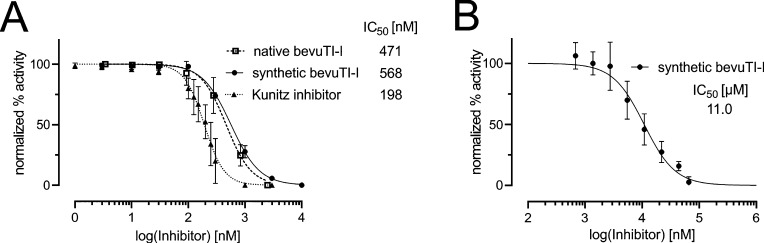
Plant peptide protease inhibitors are important molecules in seed storage metabolism and to fight insect pests. Commonly they contain multiple disulfide bonds and are exceptionally stable molecules. In this study, a novel peptide protease inhibitor from beetroot (Beta vulgaris) termed bevuTI-I was isolated, and its primary structure was determined via mass spectrometry-based amino acid sequencing. By sequence homology analysis a few peptides with high similarity to bevuTI-I, also known as the Mirabilis jalapa trypsin inhibitor subfamily of knottin-type protease inhibitors, were discovered. Hence, we assessed bevuTI-I for inhibitory activity toward trypsin (IC50 = 471 nM) and human prolyl oligopeptidase (IC50 = 11 μM), which is an emerging drug target for neurodegenerative and inflammatory disorders. Interestingly, using a customized bioinformatics approach, bevuTI-I was found to be the missing link to annotate 243 novel sequences of M. jalapa trypsin inhibitor-like peptides. According to their phylogenetic distribution they appear to be common in several plant families. Therefore, the presented approach and our results may help to discover and classify other plant-derived cystine knot peptides, a class of plant molecules that play important functions in plant physiology and are currently being explored as lead molecules and scaffolds in drug development.


Conflict of interest statement

The authors declare no competing financial interest.

Figures
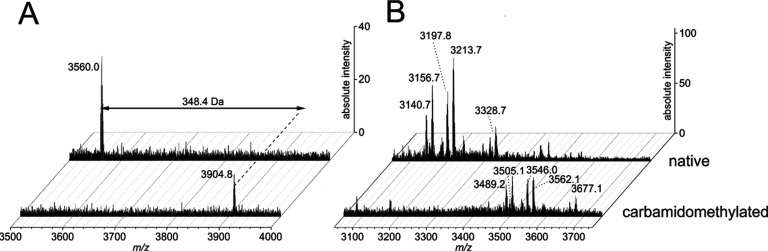
Figure 1
Figure 1
Mass spectrometry analysis of beetroot extracts. MALDI-TOF spectra of the crude extract (upper chromatograms) obtained after overnight extraction of beetroot pulp (A) and leaves (B) indicated the presence of one or several peptides containing six cysteine moieties, respectively, based on characteristic mass shifts of +348.4 ± 0.4 Da observed after reductive carbamidomethylation (lower chromatograms). All labeled m/z ions refer to monoisotopic [M + H]+ ions. Postacquisition processing of spectra was performed using baseline asymmetric least-squares filter (asymmetric factor: 0.001, threshold: 0.05, smoothing factor: 4, number of iterations: 10).
Figure 2
Figure 2
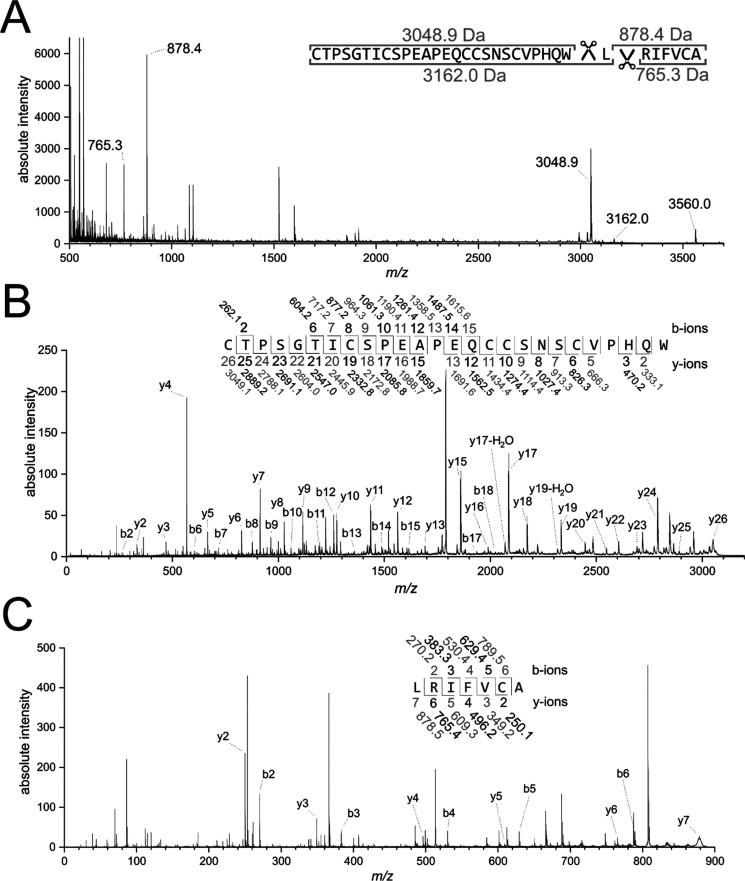
De novo sequencing of bevuTI-I. (A) MALDI-TOF spectrum of the carbamidomethylated full-length bevuTI-I peptide after chymotryptic proteolysis. In total, four fragments were detected indicating cleavage of the peptide at two distinct positions. (B) Annotated MS/MS spectrum of the m/z 3162.0 and (C) the m/z 878.4 precursor ions. The b- and y-ions are indicated by sequence number and m/z (monoisotopic [M + H]+). Annotated MS/MS spectra of bevuTI-I as well as of fragments obtained by digestion with trypsin and endoproteinase GluC are shown in Figures S2–4 (Supporting Information).
Figure 3
Figure 3
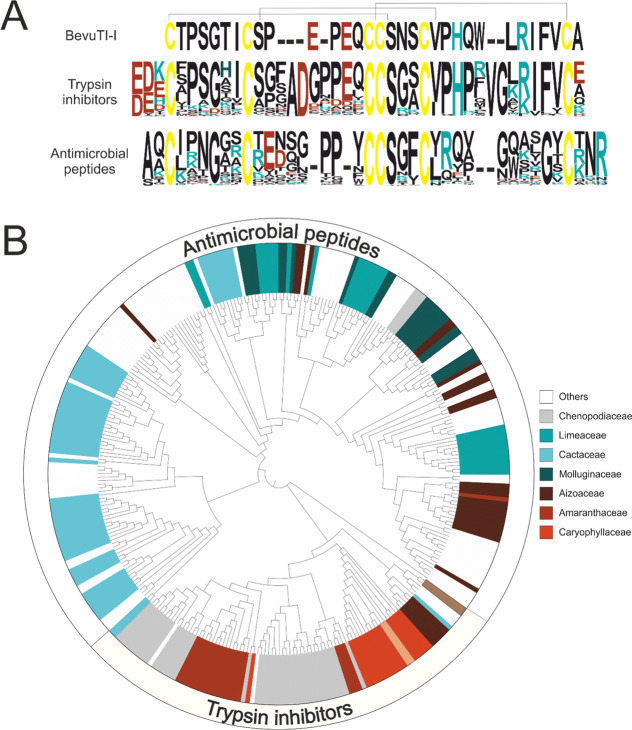
Genome mining of bevuTI-I-like peptides. (A) Pairwise alignment of the bevuTI-I sequence with a frequency plot of the predicted mature sequence of trypsin inhibitor-like and antimicrobial-like peptides found by a blastp search. Cysteines are colored in yellow, amino acids with positive charged side chains (at pH 7) are colored in red (H, K, R), and those with negative charged side chains (at pH 7) are colored in cyan (D, E). Gaps were introduced to maximize the alignment. The cysteine connectivity is based on PDB 4AOR(19) and Kowalska et al. (B) Phylogenetic maximum likelihood tree of unique hits found by a blastp search.
Figure 4
Figure 4
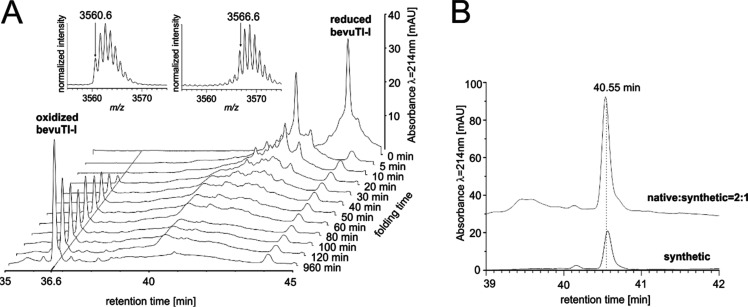
Oxidative folding of bevuTI-I. (A) The folding was initiated by addition of oxidation buffer and thiol shuffling reagents at a peptide concentration of 0.5 mg/mL. The reaction was stopped with 10% TFA at different time points, and analytical HPLC spectra (bottom) and MS spectra (top) were recorded. A loss of 6 Da for the monoisotopic mass signal was observed after 16 h of folding. (B) In a coelution experiment of native and synthetic bevuTI-I (2:1 ratio; upper chromatogram; offset: 35 mAU) a single peak was observed at 40.6 min indicating the identity of native and synthetic bevuTI-I (bottom chromatogram).
Figure 5
Figure 5
Protease inhibition activity of bevuTI-I. (A) Concentration–response curves of bevuTI-I isolated from beetroots (native) and chemically synthesized (synthetic bevuTI-I) and Glycine max Kunitz-type trypsin inhibitor (as control) in a trypsin inhibitory assay. (B) Concentration–response data were generated by incubating various concentrations of synthetic bevuTI-I with human POP (50 ng). Data were fitted with a three-parameter logistic regression model. Data of the POP inhibition assay are presented as mean ± SD of three biological replicates.

References

    1. Campos M. L.; de Souza C. M.; de Oliveira K. B. S.; Dias S. C.; Franco O. L. J. J. Exp. Bot. 2018, 69, 4997–5011. 10.1093/jxb/ery294. - DOI - PubMed
    1. Tam J. P.; Wang S.; Wong K. H.; Tan W. L. Pharmaceuticals 2015, 8, 711–57. 10.3390/ph8040711. - DOI - PMC - PubMed
    1. McDonald N. Q.; Hendrickson W. A. Cell 1993, 73, 421–4. 10.1016/0092-8674(93)90127-C. - DOI - PubMed
    1. Pallaghy P. K.; Nielsen K. J.; Craik D. J.; Norton R. S. Protein Sci. 1994, 3, 1833–9. 10.1002/pro.5560031022. - DOI - PMC - PubMed
    1. Craik D. J.; Daly N. L.; Waine C. Toxicon 2001, 39, 43–60. 10.1016/S0041-0101(00)00160-4. - DOI - PubMed

Publication types

LinkOut - more resources