


Undergraduate Medical Competencies in Digital Health and Curricular Module Development: Mixed Methods Study
- PMID: 33118935
- PMCID: PMC7661229
- DOI: 10.2196/22161
Undergraduate Medical Competencies in Digital Health and Curricular Module Development: Mixed Methods Study
Erratum in
-
Correction: Undergraduate Medical Competencies in Digital Health and Curricular Module Development: Mixed Methods Study.J Med Internet Res. 2020 Dec 7;22(12):e25738. doi: 10.2196/25738. J Med Internet Res. 2020. PMID: 33284785 Free PMC article.
Abstract
Background: Owing to an increase in digital technologies in health care, recently leveraged by the COVID-19 pandemic, physicians are required to use these technologies appropriately and to be familiar with their implications on patient care, the health system, and society. Therefore, medical students should be confronted with digital health during their medical education. However, corresponding teaching formats and concepts are still largely lacking in the medical curricula.
Objective: This study aims to introduce digital health as a curricular module at a German medical school and to identify undergraduate medical competencies in digital health and their suitable teaching methods.
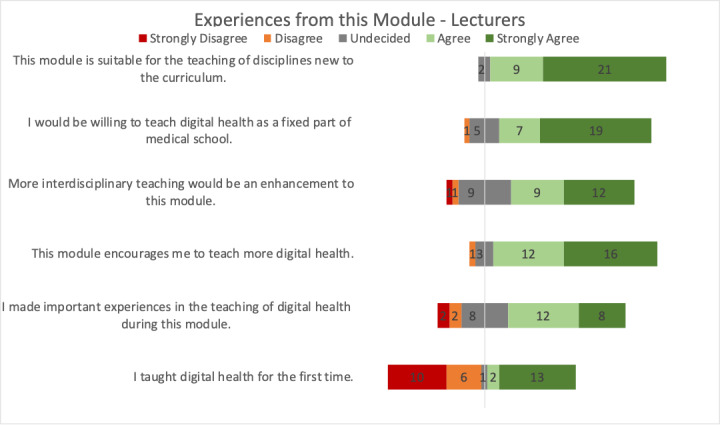
Methods: We developed a 3-week curricular module on digital health for third-year medical students at a large German medical school, taking place for the first time in January 2020. Semistructured interviews with 5 digital health experts were recorded, transcribed, and analyzed using an abductive approach. We obtained feedback from the participating students and lecturers of the module through a 17-item survey questionnaire.
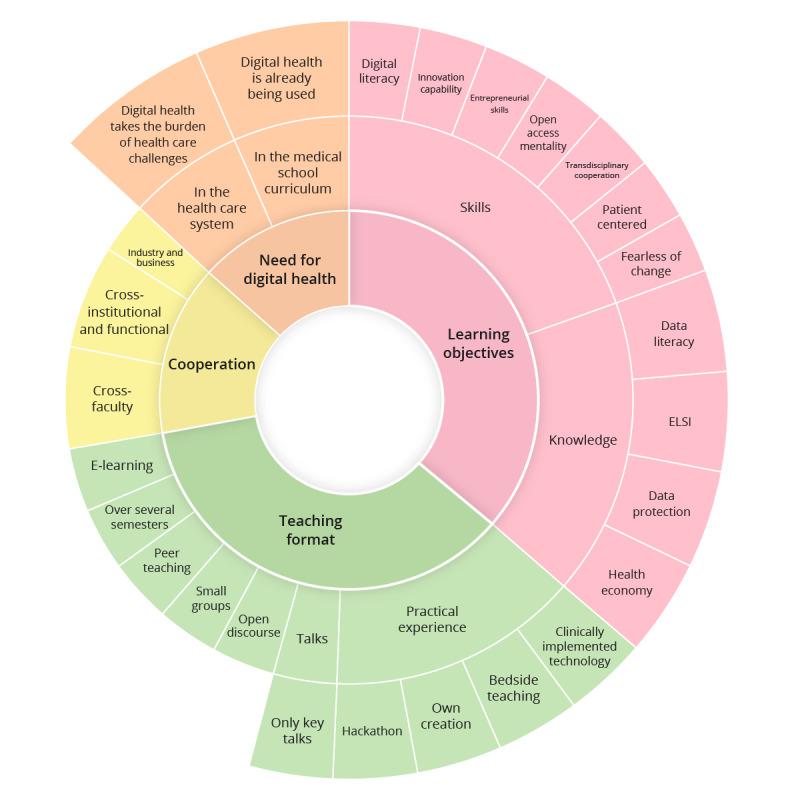
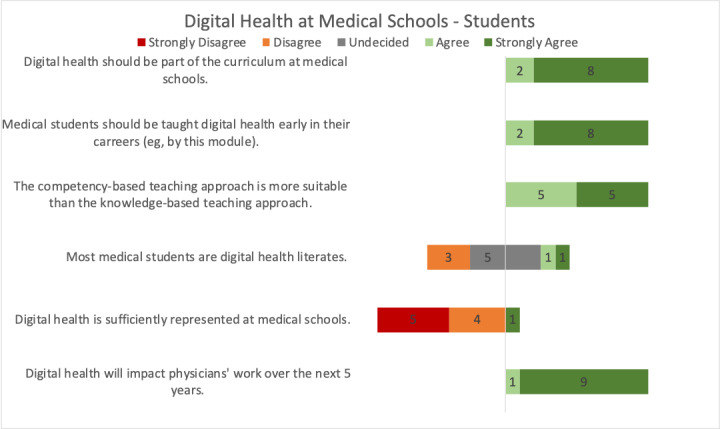
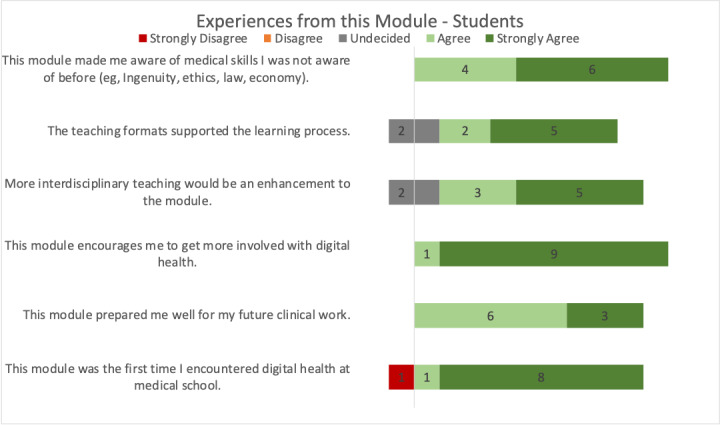
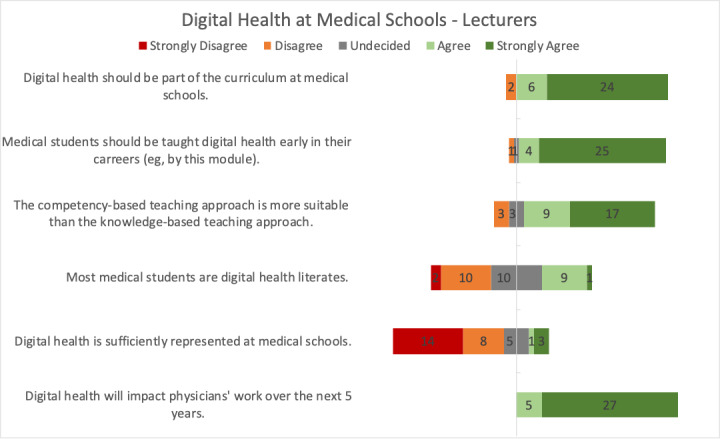
Results: The module received overall positive feedback from both students and lecturers who expressed the need for further digital health education and stated that the field is very important for clinical care and is underrepresented in the current medical curriculum. We extracted a detailed overview of digital health competencies, skills, and knowledge to teach the students from the expert interviews. They also contained suggestions for teaching methods and statements supporting the urgency of the implementation of digital health education in the mandatory curriculum.
Conclusions: An elective class seems to be a suitable format for the timely introduction of digital health education. However, a longitudinal implementation in the mandatory curriculum should be the goal. Beyond training future physicians in digital skills and teaching them digital health's ethical, legal, and social implications, the experience-based development of a critical digital health mindset with openness to innovation and the ability to assess ever-changing health technologies through a broad transdisciplinary approach to translate research into clinical routine seem more important. Therefore, the teaching of digital health should be as practice-based as possible and involve the educational cooperation of different institutions and academic disciplines.
Keywords: curriculum, medical school, digital health mindset; digital health; digital health education; eHealth; eHealth education; elective module; interview; mHealth; qualitative research; survey.
©Akira-Sebastian Poncette, Daniel Leon Glauert, Lina Mosch, Katarina Braune, Felix Balzer, David Back. Originally published in the Journal of Medical Internet Research (http://www.jmir.org), 29.10.2020.
Conflict of interest statement
Conflicts of Interest: None declared.
Figures
References
-
- Wald HS, George P, Reis SP, Taylor JS. Electronic health record training in undergraduate medical education: bridging theory to practice with curricula for empowering patient- and relationship-centered care in the computerized setting. Acad Med. 2014 Mar;89(3):380–6. doi: 10.1097/ACM.0000000000000131. https://Insights.ovid.com/pubmed?pmid=24448045 - DOI - PubMed
-
- Bundesgesundheitsministerium. Die Elektronische Gesundheitskarte. [2019-07-15]. https://www.bundesgesundheitsministerium.de/themen/krankenversicherung/e....
-
- Magrabi F, Ammenwerth E, McNair JB, De Keizer NF, Hyppönen H, Nykänen P, Rigby M, Scott PJ, Vehko T, Wong ZS, Georgiou A. Artificial intelligence in clinical decision support: challenges for evaluating AI and practical implications. Yearb Med Inform. 2019 Aug;28(1):128–34. doi: 10.1055/s-0039-1677903. http://www.thieme-connect.com/DOI/DOI?10.1055/s-0039-1677903 - DOI - PMC - PubMed
MeSH terms
LinkOut - more resources
Full Text Sources
Medical
