Review
. 2020 Oct 29;16(10):e1008931.
doi: 10.1371/journal.ppat.1008931. eCollection 2020 Oct.

The pneumococcal social network

Affiliations
Review

The pneumococcal social network

Surya D Aggarwal et al. PLoS Pathog. .

Abstract

Gram-positive bacteria employ an array of secreted peptides to control population-level behaviors in response to environmental cues. We review mechanistic and functional features of secreted peptides produced by the human pathogen Streptococcus pneumoniae. We discuss sequence features, mechanisms of transport, and receptors for 3 major categories of small peptides: the double-glycine peptides, the Rap, Rgg, NprR, PlcR, and PrgX (RRNPP)-binding peptides, and the lanthionine-containing peptides. We highlight the impact of factors that contribute to carriage and pathogenesis, specifically genetic diversity, microbial competition, biofilm development, and environmental adaptation. A recent expansion in pneumococcal peptide studies reveals a complex network of interacting signaling systems where multiple peptides are integrated into the same signaling pathway, allowing multiple points of entry into the pathway and extending information content in new directions. In addition, since peptides are present in the extracellular milieu, there are opportunities for crosstalk, quorum sensing (QS), as well as intra- and interstrain and species interactions. Knowledge on the manner that population-level behaviors contribute to disease provides an avenue for the design and development of anti-infective strategies.


Conflict of interest statement

The authors have declared that no competing interests exist.

Figures
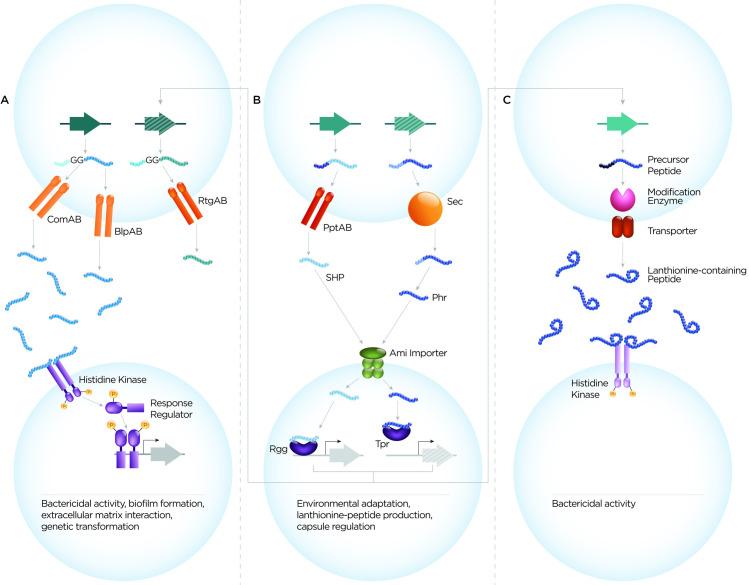
Fig 1
Fig 1. Schematic diagram of 3 main classes of pneumococcal secreted peptides.
Schematic diagram showing peptide features, processing and export, receptors, and phenotypic consequences of different families of peptides, namely (A) double-glycine peptides, (B) peptides signaling via the RRNPP superfamily of regulators, and (C) lanthionine-containing peptides. (A) The conserved N-terminal leader of double-glycine peptides guides them for processing and export via C39-peptidase domain containing ABC transporters, ComAB, BlpAB, or RtgAB. A combination of features in both the leader sequence and cargo peptide determine transporter-substrate specificity and efficiency of transport. Some peptides can be exported by multiple transporters. The secreted peptide can activate a response in the recipient cell either directly (e.g., fratricide by CibAB) or indirectly by inducing signaling upon binding a receptor (e.g., CSP and BIP). Double-glycine peptides lead to downstream phenotypes that include biofilm formation, extracellular matrix interaction, genetic diversity, and bactericidal activity. (B) Peptides that signal via the RRNPP superfamily of regulators include SHP and Phr peptides. Based on data for 1 pneumococcal SHP (RtgS) and from other species, we propose that SHPs are secreted outside the cell by the ABC transporter, PptAB. It is proposed that SHPs undergo processing and maturation either concomitant with (via the Eep membrane protease) or after their secretion (via an uncharacterized protease). The mechanisms of Phr peptide processing in pneumococcus remain unknown. Following maturation, both SHP and Phr peptides are imported into the recipient cell via an oligopeptide permease system, AmiACDEF. Once internalized, SHPs interact with their cognate Rgg regulators resulting in DNA binding and transcriptional activation. Phr peptides interact with their cognate Tpr regulators, releasing Tpr-mediated inhibition of gene expression. Signaling via SHP and Phr peptides facilitates environmental adaptation for the bacteria and can induce production of double-glycine and lanthionine-containing peptides. (C) The lanthionine-containing peptides undergo posttranslational modifications and cyclization by the action of intracellular lanthionine modification enzymes. Owing to their conserved leader sequence, these propeptides are directed for secretion by dedicated ABC transporters. While the targets and function (as signal or bacteriocins) of most lanthionine-containing peptides are unknown, pneumolancidin functions by activating a TCS system on the target cells, ultimately exerting bactericidal activity. ABC, ATP-binding cassette; BIP, bacteriocin-inducing peptide; CSP, competence-stimulating peptide; GG, double-glycine; Phr, phosphatase regulator; Rgg, Regulator gene of glycosyltransferase; RRNPP, Rap, Rgg, NprR, PlcR, and PrgX; SHP, short hydrophobic peptide; TCS, two component systems.
Fig 2
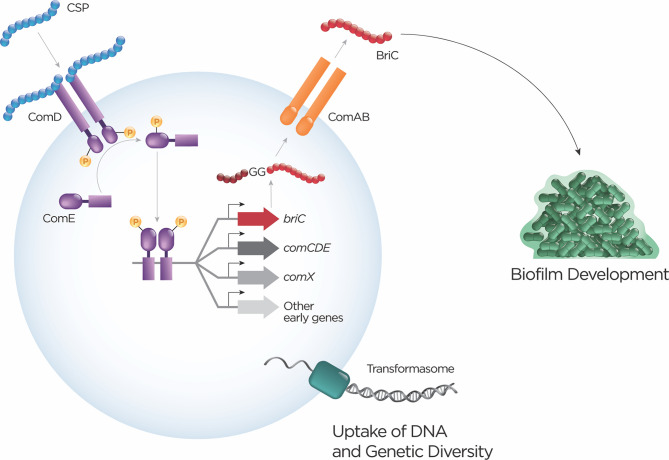
Fig 2. Hierarchical activation of multiple double-glycine peptides.
The competence pathway is turned on by activation of ComDE by the double-glycine peptide, CSP. Competence induction by CSP results in transcriptional activation of a number of double-glycine peptides including BIP, CibAB, and BriC, each of which have phenotypic consequences. Activation of the competence pathway also allows for uptake of DNA and generation of genetic diversity. The schematic diagram illustrates ComE-dependent induction of briC along with other early competence genes. Upon being exported through ComAB, intercellular communication via BriC promotes biofilm development. This highlights the interconnectedness of mechanisms that impart genetic and phenotypic diversity. The design architecture that allows for hierarchical activation of different intercellular communication peptides may provide an opportunity for alternative activation of subsets of genes without expending energy to turn on the entire pathway. BIP, bacteriocin-inducing peptide; BriC, biofilm-regulating peptide induced by competence; competence-induced bacteriocin; CSP, competence-stimulating peptide; GG, double-glycine; TCS, two component systems.
Fig 3
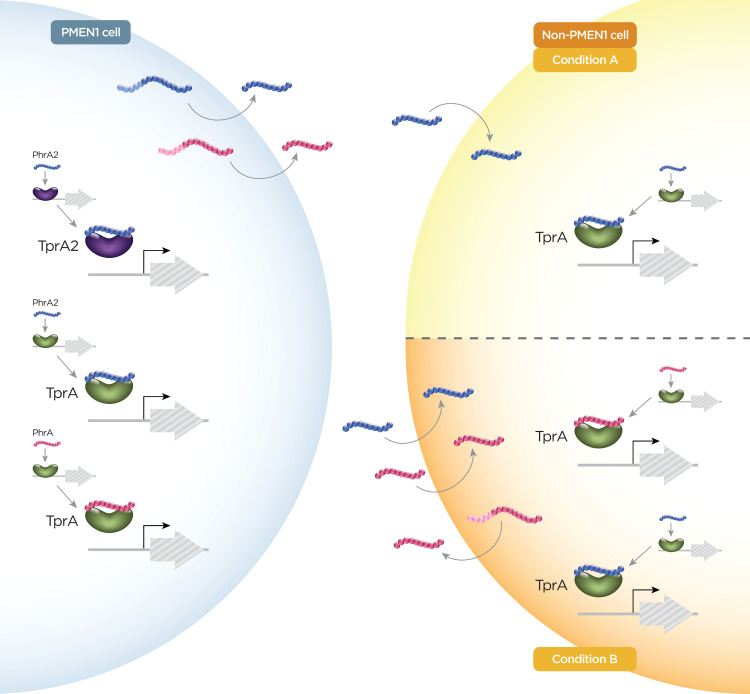
Fig 3. Example of peptide crosstalk, as seen for PhrA and PhrA2.
The blue cell on the left side of the diagram encodes both TprA/PhrA and TprA2/PhrA2. The yellow cell on the right side of the diagram encodes only for TprA/PhrA. The gene encoding PhrA is induced in galactose and repressed in glucose; its promoter encodes a site for CcpA catabolite repression. In contrast, phrA2 is not repressed by glucose. Thus, when PMEN1 is grown in glucose, PhrA2 is produced. Moreover, PhrA2 can bind TprA, partially overcoming repression of the TprA/PhrA system. In accordance, PhrA is also produced in PMEN1 cells grown in glucose. Because PhrA2 is secreted and imported by the ubiquitous oligopeptide permease system, AmiACDEF, PhrA2 can bind TprA in neighboring cells, independent of strain identity. In vitro, PhrA2 secreted by PMEN1 cells activates gene expression of tprA in both PMEN1 and non-PMEN1 cells. This figure illustrates cells in rich media, where signaling of non-PMEN1 cells is reduced. In the top panel (condition A), in the absence of input from the neighboring PMEN1 strain, TprA is bound to DNA, inhibiting gene expression. In the lower panel (condition B), in the presence of peptides from the neighboring PMEN1 strain, TprA/PhrA system is induced by exogenous peptides, ultimately inducing production of endogenous PhrA. PMEN1, pneumococcal molecular epidemiology network clone 1.

References

    1. Fuqua WC, Winans SC, Greenberg EP. Quorum sensing in bacteria: The LuxR-LuxI family of cell density- responsive transcriptional regulators. J Bacteriol. 1994;176:269–275. 10.1128/jb.176.2.269-275.1994 - DOI - PMC - PubMed
    1. Nealson KH. Autoinduction of Bacterial Luciferase. Arch Microbiol. 1977;112:73–79. 10.1007/BF00446657 - DOI - PubMed
    1. Kaiser D, Losick R. How and why bacteria talk to each other. Cell. 1993;73:873–885. 10.1016/0092-8674(93)90268-u - DOI - PubMed
    1. Kaiser D. Bacteria Also Vote Science. 1996;272:1598–1599. 10.1126/science.272.5268.1598 - DOI - PubMed
    1. Gray KM. Intercellular communication and group behaviour in bacteria. Trends Microbiol. 1997;5:184–188. 10.1016/S0966-842X(97)01002-0 - DOI - PubMed

Publication types

MeSH terms

Substances