


Transition to Dolutegravir Is Associated With an Increase in the Rate of Body Mass Index Change in a Cohort of Virally Suppressed Adolescents
- PMID: 33119739
- PMCID: PMC8326552
- DOI: 10.1093/cid/ciaa1652
Transition to Dolutegravir Is Associated With an Increase in the Rate of Body Mass Index Change in a Cohort of Virally Suppressed Adolescents
Abstract
Background: Antiretroviral therapy (ART) regimens that contain dolutegravir (DTG) have been associated with increases in body mass index (BMI) in adults. However, this relationship has not been well described in adolescents.
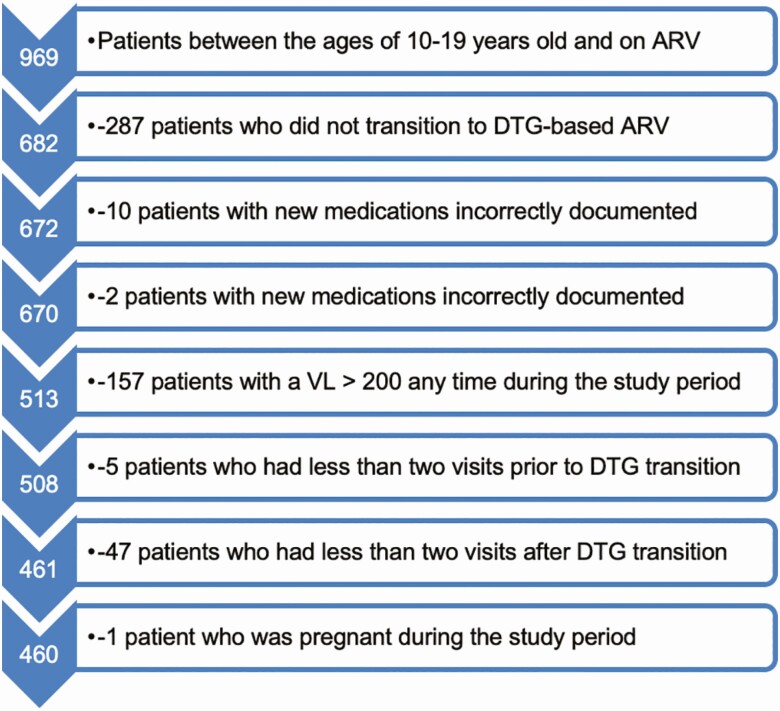
Methods: In a retrospective observational cohort of 460 virally suppressed (<200 copies/mL) adolescents living with human immunodeficiency virus at a clinical site in Eswatini, body mass index (BMI) measurements were analyzed between 1 year prior to the transition to DTG and up to 1 year after DTG transition. Random-effects linear spline models were used to describe the rate of change in BMI before and after the transition to DTG.
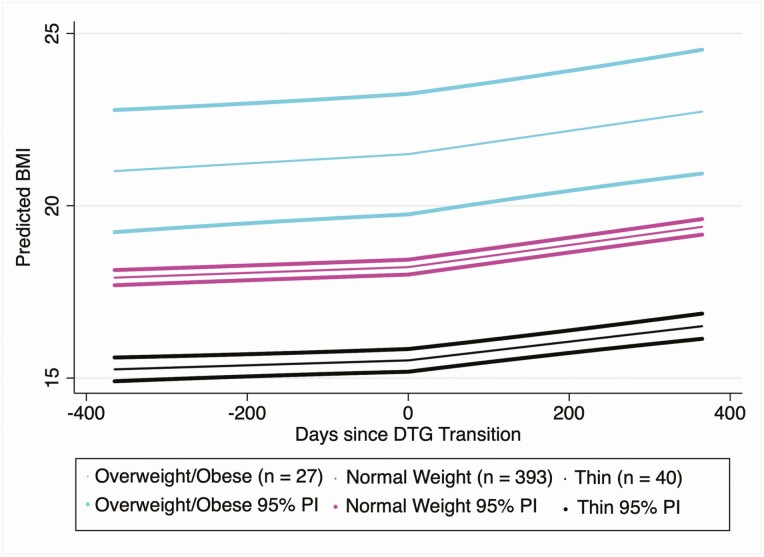
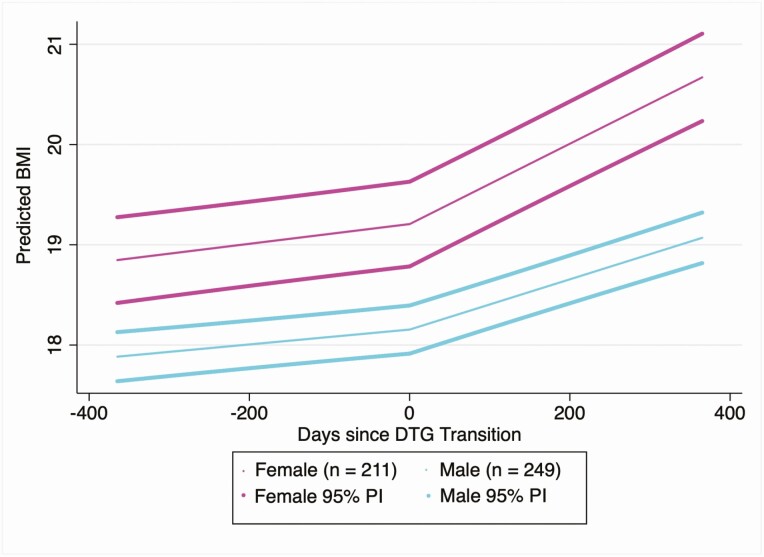
Results: In adolescents, BMI increased at a rate of 0.3 kg/m2 per year before DTG transition and increased to a rate of 1.2 kg/m2 per year after DTG transition. Sex of the adolescent modified the relationship between DTG and rate of BMI change: BMI rate of change after DTG transition was increased by 1.1 kg/m2 in females and 0.6 kg/m2 per year in males.
Conclusions: Transition to DTG in virally suppressed adolescents (aged 10-19 years) is associated with an increase in the rate of BMI change. Female adolescents may experience a larger change than males. Further investigation is required to elucidate the mechanism that underlies these observations and to assess how DTG impacts BMI in adolescents following longer durations of treatment.
Keywords: HIV; adolescent; adverse events; body mass index.
© The Author(s) 2020. Published by Oxford University Press for the Infectious Diseases Society of America.
Figures
References
-
- Van de Wijer L, Mchaile DN, de Mast Q, . et al. Neuropsychiatric symptoms in Tanzanian HIV-infected children receiving long-term efavirenz treatment: a multicentre, cross-sectional, observational study. Lancet HIV 2019; 6:e250–8. - PubMed
-
- Kanters S, Vitoria M, Doherty M, . et al. Comparative efficacy and safety of first-line antiretroviral therapy for the treatment of HIV infection: a systematic review and network meta-analysis. Lancet HIV 2016; 3:e510–20. - PubMed
-
- Venter WDF, Moorhouse M, Sokhela S, . et al. Dolutegravir plus two different prodrugs of tenofovir to treat HIV. N Engl J Med 2019; 381:803–15. - PubMed
-
- World Health Organization. Update of recommendations on first- and second-line antiretroviral regimens.2019. Available at: https://apps.who.int/iris/bitstream/handle/10665/325892/WHO-CDS-HIV-19.1.... Accessed 10 August 2020.
Publication types
MeSH terms
Substances
Grants and funding
LinkOut - more resources
Full Text Sources
Medical
