


Association for combined exposure to job strain, shift work on mental health among Chinese railway workers: a cross-sectional study
- PMID: 33122313
- PMCID: PMC7597467
- DOI: 10.1136/bmjopen-2020-037544
Association for combined exposure to job strain, shift work on mental health among Chinese railway workers: a cross-sectional study
Abstract
Objectives: The aim of this study was to assess the effects of coexposure to job strain and shift work on mental health in railway workers.
Design: Cross-sectional study.
Setting: One Railway Bureau Group in China.
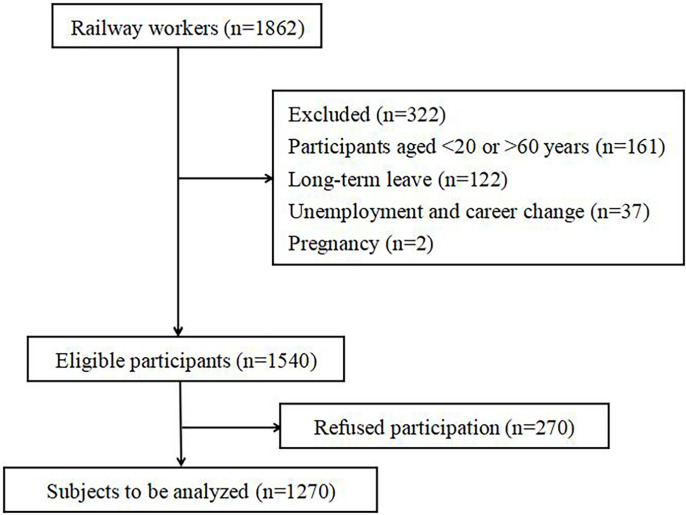
Participants: A total of 1270 front-line railway workers.
Outcome measures: The Symptom Checklist-90-Revised questionnaire was used to measure general mental health. Job strain variables were derived from the Job Content Questionnaire. Based on the records of the work schedule 3 months prior to the survey, the following three shift types were identified: fixed day, fixed night and rotating night shifts. Risks associated with mental health were assessed by carrying out logistic regression analysis which was adjusted for age, job tenure, smoking and exercise. Additionally, a crossover analysis was employed for the combined effects.
Results: High levels of job strain were linked to a higher risk of poor mental health (OR=1.53, 95% CI: 1.10 to 2.11). After adjusting for confounding factors, night shifts and rotating night shifts were significant risk factors for mental health (OR=2.21, 95% CI: 1.60 to 3.07; OR=2.36, 95% CI: 1.73 to 3.22). Compared with participants who experienced a low level of job strain and day shifts, those with a high level of job strain and who worked rotating shifts were at the highest risk of poor mental health (OR=4.68, 95% CI: 2.91 to 8.04), whereas the influence of a low level of job strain and rotating night shifts was not statistically significant.
Conclusion: Job strain and night shifts among workers were associated, both independently and in combination, with an increased risk of poor mental health. Our data suggest that job strain contributes to the risk of poor mental health by means of a combined effect with shift work.
Keywords: mental health; occupational & industrial medicine; public health.
© Author(s) (or their employer(s)) 2020. Re-use permitted under CC BY-NC. No commercial re-use. See rights and permissions. Published by BMJ.
Conflict of interest statement
Competing interests: None declared.
Figures
References
Publication types
MeSH terms
LinkOut - more resources
Full Text Sources
Medical
