


Leaf pigmentation, its profiles and radical scavenging activity in selected Amaranthus tricolor leafy vegetables
- PMID: 33122663
- PMCID: PMC7596228
- DOI: 10.1038/s41598-020-66376-0
Leaf pigmentation, its profiles and radical scavenging activity in selected Amaranthus tricolor leafy vegetables
Abstract
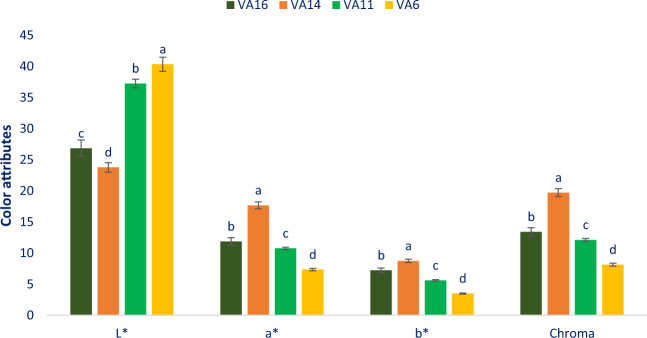
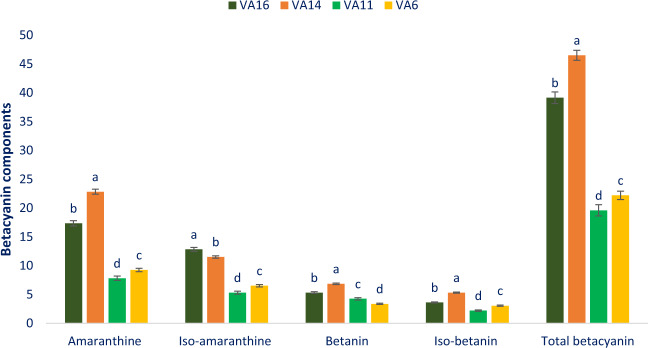
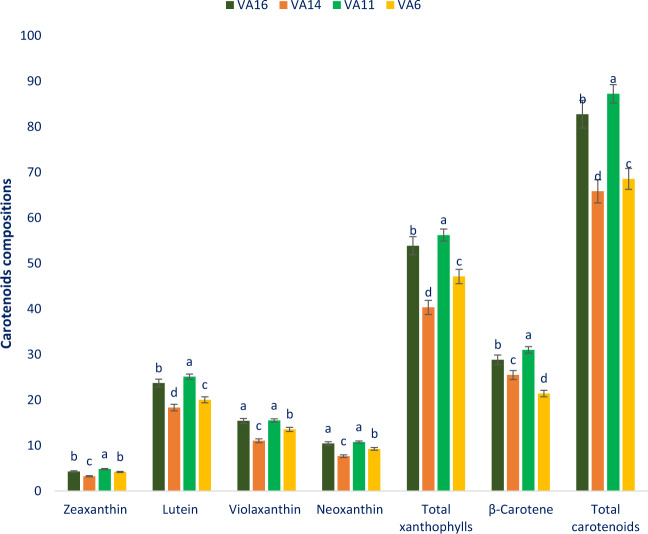
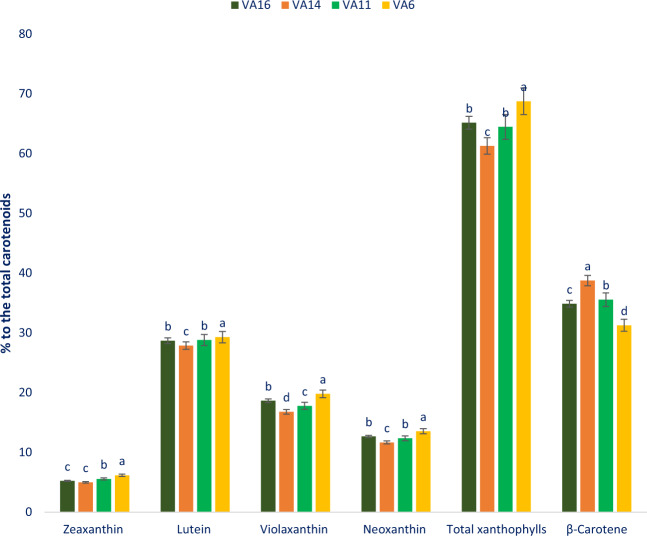
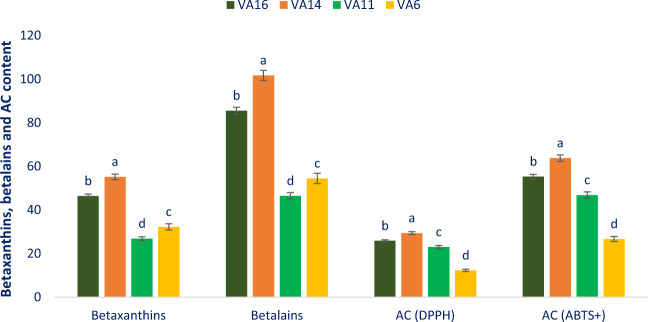
The selected A. tricolor accessions contained abundant color attributes, betacyanin, carotenoids, betalains, betaxanthins, and antioxidants potentiality that varied in terms of genotypes. For the first time, we identified 4 betacyanins, and 5 carotenoid compounds in A. tricolor genotypes. The genotype VA14 and VA16 had abundant color attributes, betacyanin such as amaranthine, iso-amaranthine, betanin, iso-betanin, and antioxidants potentiality. These two genotypes having an excellent source of color attributes, betacyanins, betalains, betaxanthins, and antioxidants potentiality could be used as potent antioxidant varieties. The genotype VA11 and VA16 had abundant carotenoid components, such as zeaxanthin, lutein, violaxanthin, neoxanthin, total xanthophylls, and beta-carotene. The genotype VA11 and VA16 had abundant carotenoid components that could be used as carotenoid enrich varieties. It revealed from the correlation study that pigment profiles of A. tricolor genotypes exhibited high quenching capacity of radicals. These accessions have high antioxidant potentials and great opportunity to make drinks, preservatives, and colorant of food products to feed the community deficient in antioxidants. The identified components of betacyanins and carotenoids in A. tricolor require comprehensive pharmacological study. The baseline data on color attributes, betacyanins profile, carotenoids profile, betaxanthins, betalains and antioxidant potentiality obtained in the present study could contribute to pharmacologists for evaluating these components scientifically in A. tricolor.
Conflict of interest statement
The authors declare no competing interests.
Figures
References
-
- Sarker U, Islam MT, Rabbani MG, Oba S. Genotypic variability for nutrient, antioxidant, yield and yield contributing traits in vegetable amaranth. J. Food Agri. Environ. 2014;12:168–174.
-
- Sarker U, Islam MT, Rabbani MG, Oba S. Variability, heritability and genetic association in vegetable amaranth (A. tricolor) Span. J. Agric. Res. 2015;13:1–8. doi: 10.5424/sjar/2015132-6843. - DOI
-
- Sarker U, Islam MT, Rabbani MG, Oba S. Genotype variability in composition of antioxidant vitamins and minerals in vegetable amaranth. Genetika. 2015;47:85–96. doi: 10.2298/GENSR1501085S. - DOI
-
- Sarker U, Islam MT, Rabbani MG, Oba S. Genetic variation and interrelationship among antioxidant, quality and agronomic traits in vegetable amaranth. Turk. J. Agric. For. 2016;40:526–535. doi: 10.3906/tar-1405-83. - DOI
-
- Sarker U, Islam MT, Rabbani MG, Oba S. Genotypic diversity in vegetable amaranth for antioxidant, nutrient and agronomic traits. Indian J. Genet. Plant Breed. 2017;77:173–176. doi: 10.5958/0975-6906.2017.00025.6. - DOI
MeSH terms
Substances
LinkOut - more resources
Full Text Sources
