. 2020 Oct 29;10(1):18614.
doi: 10.1038/s41598-020-75245-9.

Circadian misalignment increases mood vulnerability in simulated shift work

Affiliations

Circadian misalignment increases mood vulnerability in simulated shift work

Sarah L Chellappa et al. Sci Rep. .

Abstract

Night shift work can associate with an increased risk for depression. As night workers experience a 'misalignment' between their circadian system and daily sleep-wake behaviors, with negative health consequences, we investigated whether exposure to circadian misalignment underpins mood vulnerability in simulated shift work. We performed randomized within-subject crossover laboratory studies in non-shift workers and shift workers. Simulated night shifts were used to induce a misalignment between the endogenous circadian pacemaker and sleep/wake cycles (circadian misalignment), while environmental conditions and food intake were controlled. Circadian misalignment adversely impacted emotional state, such that mood and well-being levels were significantly decreased throughout 4 days of continuous exposure to circadian misalignment in non-shift workers, as compared to when they were under circadian alignment (interaction of "circadian alignment condition" vs. "day", mood: p < 0.001; well-being: p < 0.001; adjusted p-values). Similarly, in shift workers, mood and well-being levels were significantly reduced throughout days of misalignment, as compared to circadian alignment (interaction of "circadian alignment condition" vs. "day", mood: p = 0.002; well-being: p = 0.002; adjusted p-values). Our findings indicate that circadian misalignment is an important biological component for mood vulnerability, and that individuals who engage in shift work are susceptible to its deleterious mood effects.


Conflict of interest statement

C.J.M. reports receiving salary from Grünenthal Ltd., UK, and that this relationship is not related to the present article. F.A.J.L.S. has received lecture fees from Bayer HealthCare, Sentara HealthCare, Philips, Vanda Pharmaceuticals, and Pfizer Pharmaceuticals. S.L.C. has no competing interests.

Figures
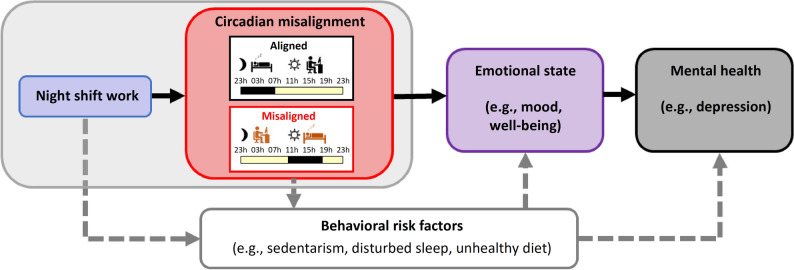
Figure 1
Figure 1
Linking shift work to mood vulnerability. Night shift work may affect emotional state and thereby mental health through circadian misalignment (black solid lines: potential direct effects). Here, circadian misalignment is illustrated by a large ~ 12-h inversion of the sleep/wake cycle and light–dark cycle (red box; aligned: top panel, misaligned: bottom panel), as can occur in night shift work. Shift work also indirectly affects emotional state and mental health through behavioral risk factors (indicated by grey dashed lines).
Figure 2
Figure 2
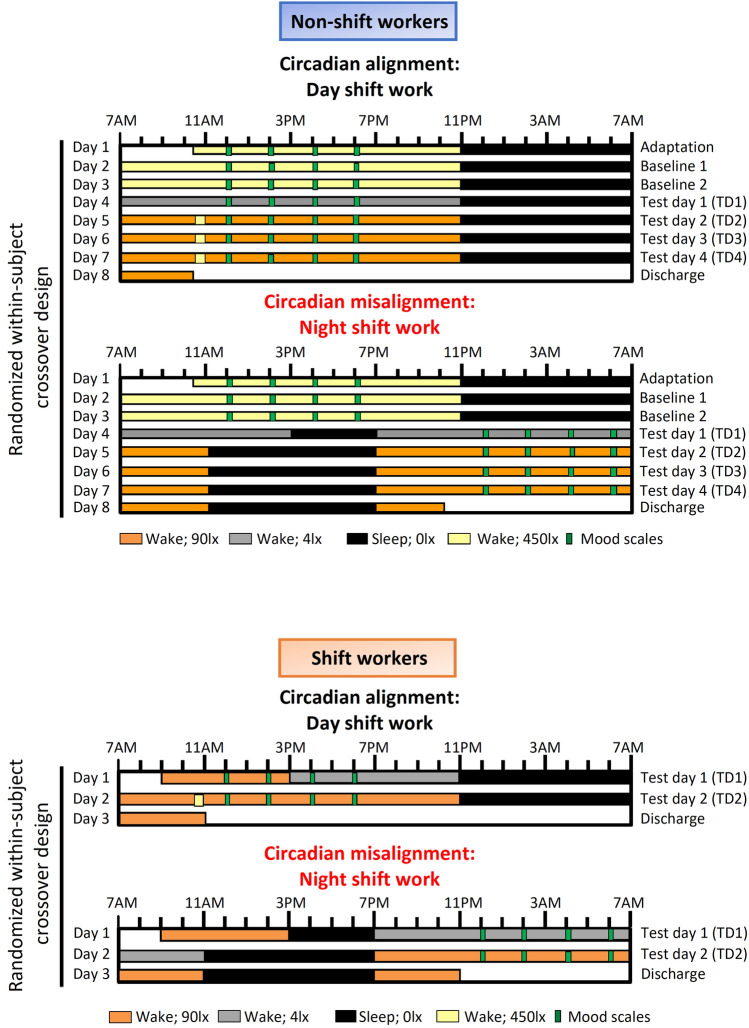
Within-subject, randomized, crossover study design. Upper panel: Non-shift workers underwent circadian alignment and misalignment. For alignment condition, scheduled sleep times remained 11 p.m. to 7 a.m. across all days, whereas for the misalignment these timings were inverted by 12 h after Baseline 2 (Day 3). T1–T4 corresponds to test days 1–4. During baseline days for both aligned and misaligned conditions, computerized mood scales were conducted at 12 p.m., 2 p.m., 4 p.m. and 6 p.m. These timings are: (1) outside of the window of sleep inertia effects following awakening; and (2) hours before participant’s scheduled sleep, when they are expected to be alert. While these times were the same throughout the aligned condition, in the misaligned condition the times were inverted by 12 h for T1–T4 relative to clock time, while maintaining the same time relative to the sleep/wake cycle. Bottom panel: Shift workers underwent circadian alignment and misalignment conditions that were conceptually similar to Experiment 1, such that scheduled sleep times were maintained between 11 p.m. to 7 a.m. in the alignment condition, whereas the times were inverted by 12 h in the misaligned condition. Both experiments had the same computerized mood scales.
Figure 3
Figure 3
Circadian misalignment affects emotional state in non-shift workers. Circadian misalignment (red circles) influences emotional state, as evidenced by the significantly lower (A) mood and (B) well-being profiles in non-shift workers (n = 14), as compared to when the same individuals were exposed to days of circadian alignment (black circles). Data correspond to mean and standard error of mean; *p < 0.05 (interaction of “circadian alignment condition” vs. “day”, following FDR adjustment; see “Results” for details).
Figure 4
Figure 4
Circadian misalignment affects emotional state in shift workers. Circadian misalignment (red circles) negatively affects emotional state, as evidenced by the significantly lower (A) mood and (B) well-being profiles in shift workers (n = 7), as compared to when the same individuals were exposed to days of circadian alignment (black circles). Data correspond to mean and standard error of the mean; *p < 0.05 (effect of “circadian alignment condition”, following FDR adjustment; see “Results” for details).
Figure 5
Figure 5
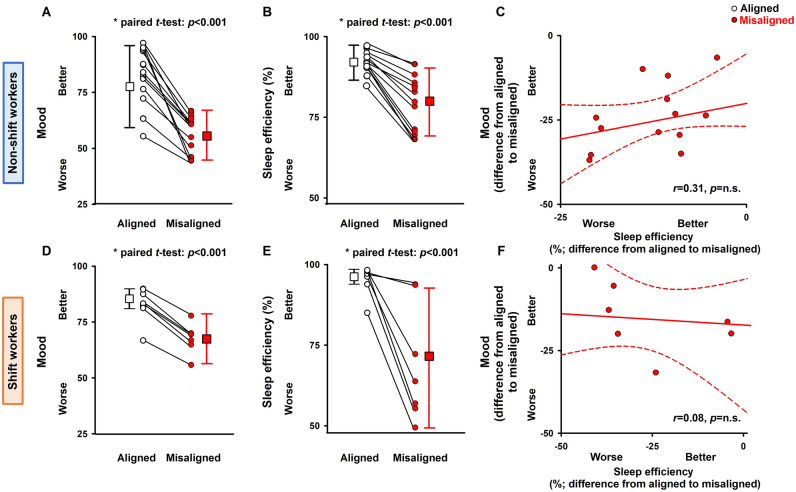
Sleep efficiency does not predict mood and well-being impairment during circadian misalignment. (AC) In non-shift workers (n = 14), mood levels (A) and sleep efficiency (B) were significantly reduced during circadian misalignment as compared to circadian alignment. (C) Linear regression models indicate that sleep efficiency did not predict mood levels in the circadian alignment or misalignment conditions. (DF) In shift workers (n = 7), mood levels (D) and sleep efficiency (E) were significantly reduced during circadian misalignment. (F) Linear regression models indicate that sleep efficiency did not predict mood levels in either circadian conditions (difference from circadian alignment to misalignment). Data presented as circles indicate individuals, and connecting lines correspond to results from the same individual for circadian alignment and misalignment. Squares and whiskers correspond, respectively, to median and interquartile ranges (minimum and maximum quartiles [1.5 × interquartile range]) to illustrate data dispersion; p-values: significance of the paired t-tests for A,B,D and E and for the linear regression analyses shown in C and F.

References

    1. Sartorius N. The economic and social burden of depression. J. Clin. Psychiatry. 2001;62(Suppl 15):8–11. - PubMed
    1. WHO, Mental health action plan 2013–2020. Public-use data file and documentation. Available from https://www.who.int/mental_health/publications/action_plan/en/. Accessed Sep 1 2020.
    1. NHIS, 2010 National Health Interview Survey. Public-use data file and documentation. Available from ftp.cdc.gov/pub/Health_Statistics/NCHS/Dataset_Documentation/NHIS/2010/s.... Accessed Feb 19 2020.
    1. Wyse CA, et al. Adverse metabolic and mental health outcomes associated with shiftwork in a population-based study of 277,168 workers in UK biobank. Ann. Med. 2017;49:411–420. doi: 10.1080/07853890.2017.1292045. - DOI - PubMed
    1. Torquati L, Mielke GI, Brown WJ, Burton NW, Kolbe-Alexander TL. Shift work and poor mental health: A meta-analysis of longitudinal studies. Am. J. Public Health. 2019;109:e13–e20. doi: 10.2105/AJPH.2019.305278. - DOI - PMC - PubMed

Publication types