


Shanghai Neisseria gonorrhoeae Isolates Exhibit Resistance to Extended-Spectrum Cephalosporins and Clonal Distribution
- PMID: 33123111
- PMCID: PMC7573285
- DOI: 10.3389/fmicb.2020.580399
Shanghai Neisseria gonorrhoeae Isolates Exhibit Resistance to Extended-Spectrum Cephalosporins and Clonal Distribution
Abstract
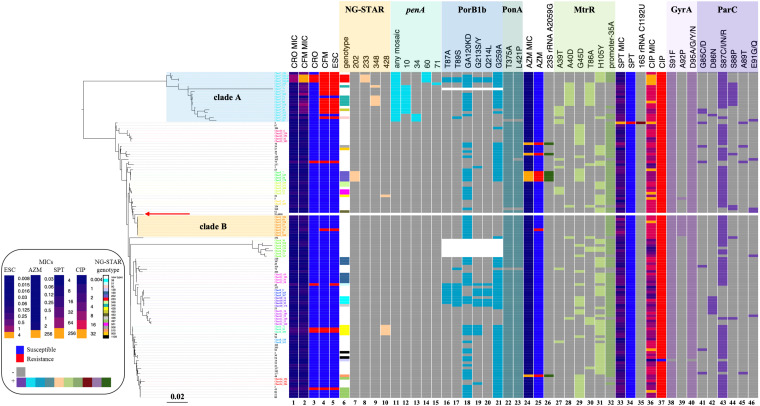
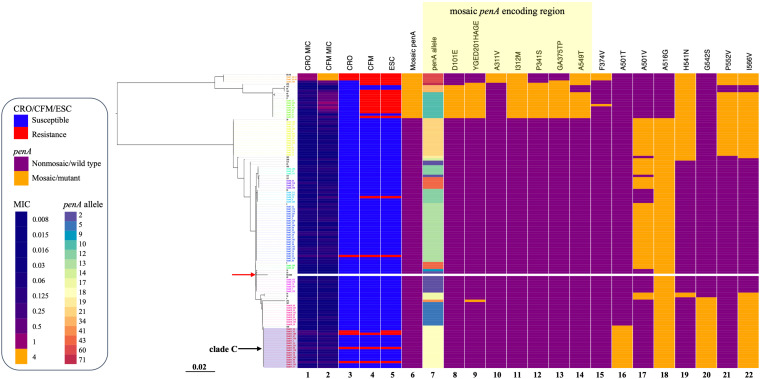
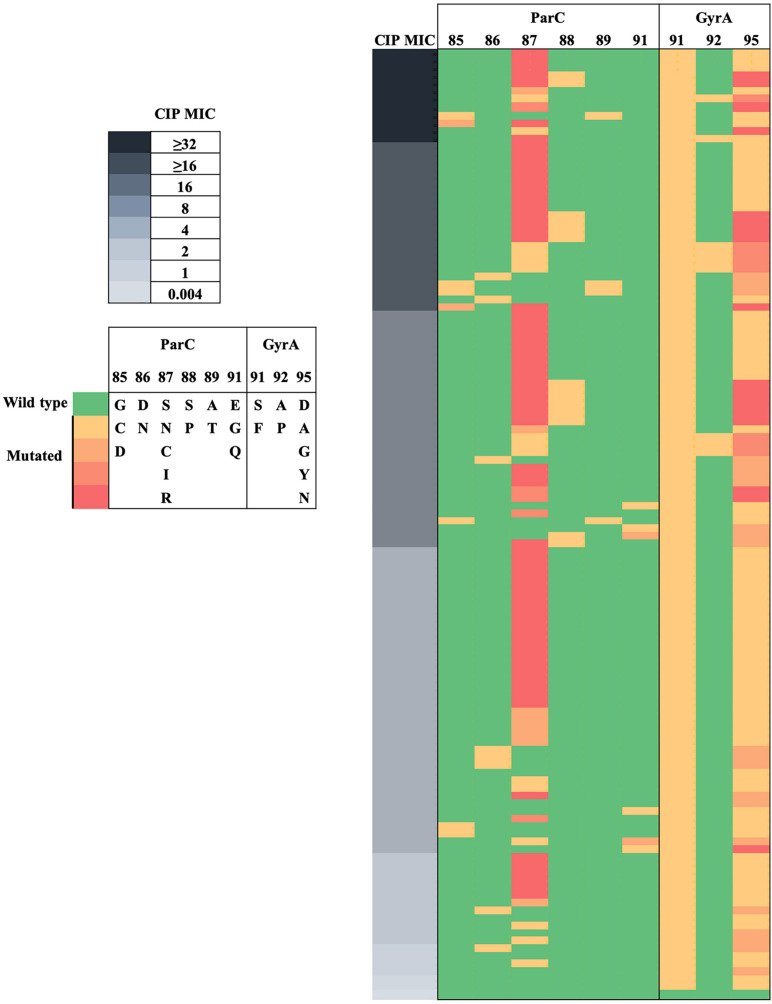
The emergence of Neisseria gonorrhoeae strains with resistance (R) to extended-spectrum cephalosporins (ESCsR) represents a public health threat of untreatable gonococcal infections. This study was designed to determine the prevalence and molecular mechanisms of ESCR of Shanghai N. gonorrhoeae isolates. A total of 366 N. gonorrhoeae isolates were collected in 2017 in Shanghai. Susceptibility to ceftriaxone (CRO), cefixime (CFM), azithromycin (AZM), ciprofloxacin (CIP), spectinomycin, penicillin, and tetracycline was determined using the agar dilution method. A subset of 124 isolates was subjected to phylogenetic analysis for nine antimicrobial resistance-associated genes, i.e., penA, porB, ponA, mtrR, 23S rRNA, gyrA, parC, 16S rRNA, and rpsE. Approximately 20.0% of the isolates exhibited CFMR [minimum inhibitory concentration (MIC) >0.125 mg/L], and 5.5% were CROR (MIC > 0.125 mg/L). In total, 72.7% of ESCR isolates were clonal and associated with mosaic penA 10 and 60 alleles. Non-mosaic penA 18 allele and substitutions of PenA A501T, G542S, and PorB1b G213S/Y were observed in non-clonal ESCR. Approximately 6.8% of the isolates showed AZM MIC above the epidemiological cutoff (ECOFF, 1 mg/L), were associated with 23S rRNA A2059G mutation, and did not exhibit clonal distribution. Almost all isolates were CIPR (resistance to ciprofloxacin) and associated with GyrA-91/92 and ParC-85/86/87/88/89/91 alterations. Isolates with ParC S88P substitution were clustered into the ESCR clade. The Shanghai isolates exhibited a high level of ESCR and distinct resistant patterns.
Keywords: Neisseria gonorrhoeae; extended-spectrum cephalosporins; multidrug resistance; phylogenetic analysis; resistance determinants.
Copyright © 2020 Dong, Yang, Wang, Martin, Demczuk and Gu.
Figures
References
-
- Ameyama S., Onodera S., Takahata M., Minami S., Maki N., Endo K., et al. (2002). Mosaic-like structure of penicillin-binding protein 2 Gene (penA) in clinical isolates of Neisseria gonorrhoeae with reduced susceptibility to cefixime. Antimicrob. Agents Chemother. 46 3744–3749. 10.1128/aac.46.12.3744-3749.2002 - DOI - PMC - PubMed
-
- Chisholm S. A., Unemo M., Quaye N., Johansson E., Cole M. J., Ison C. A., et al. (2013). Molecular epidemiological typing within the European gonococcal antimicrobial resistance surveillance programme reveals predominance of a multidrug-resistant clone. Euro. Surveill. 18:20358. - PubMed
-
- Cole M. J., Spiteri G., Jacobsson S., Woodford N., Tripodo F., Amato-Gauci A. J., et al. (2017). Overall low extended-spectrum cephalosporin resistance but high azithromycin resistance in Neisseria gonorrhoeae in 24 European countries, 2015. BMC Infect. Dis. 17:617. 10.1186/s12879-017-2707-z - DOI - PMC - PubMed
LinkOut - more resources
Full Text Sources
Molecular Biology Databases
