Network Structures of Social Functioning Domains in Schizophrenia and Bipolar Disorder: A Preliminary Study
- PMID: 33124589
- PMCID: PMC7609205
- DOI: 10.9758/cpn.2020.18.4.571
Network Structures of Social Functioning Domains in Schizophrenia and Bipolar Disorder: A Preliminary Study
Abstract
Objective: : This study used network analyses to examine network structures reflecting interactions between specific domains of social functioning in schizophrenia (SZ) and bipolar disorder (BD).
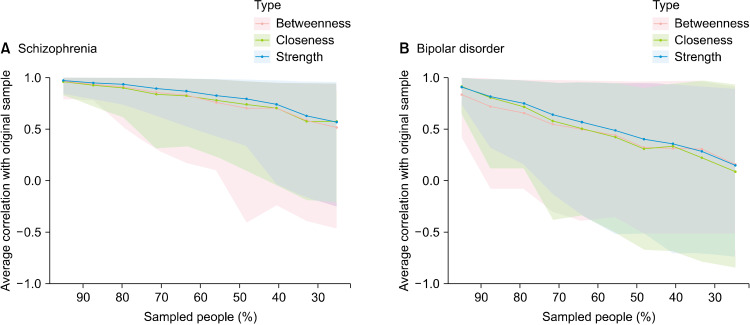
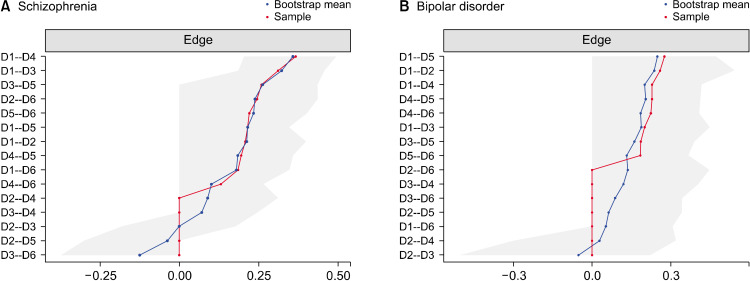
Methods: We used the World Health Organization Disability Assessment Schedule 2.0 (WHODAS 2.0) to assess six domains of social functioning ('cognition', 'mobility', 'self-care', 'getting along', 'life activities', and 'participation') in 143 patients with SZ, 81 patients with BD, and 106 healthy subjects. We constructed regularized partial correlation networks, estimated network centrality and edge strength, tested network stability, and compared SZ and BD network structures.
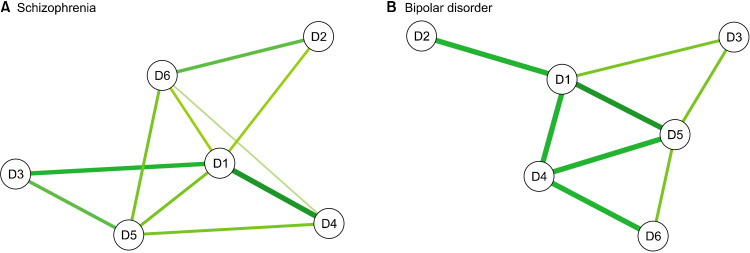
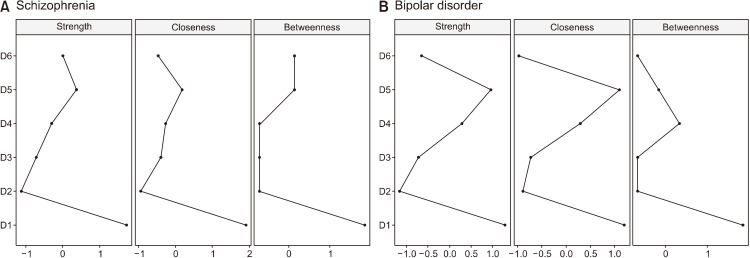
Results: Patients with SZ showed a significantly higher level of functional disability than patients with BD. In the networks we constructed, 'cognition' was the most central domain of social functioning in both SZ and BD. The 'cognition' domain was primarily associated with the 'getting along' domain in the SZ network and the 'life activities' domain in the BD network. We found no significant group-level differences in network structures for SZ vs. BD.
Conclusion: Our results suggest that cognition may play a pivotal role in social functioning in both SZ and BD. In addition, domains of social functioning in SZ and BD have similar network structures despite the higher level of disability in SZ compared to BD.
Keywords: Bipolar disorder; Cognition.; Network; Schizophrenia; Social abilities.
Conflict of interest statement
No potential conflict of interest relevant to this article was reported.
Figures
References
-
- Simons CJP, Bartels-Velthuis AA, Pijnenborg GHM Genetic Risk and Outcome of Psychosis (GROUP) Investigators, author. Correction: cognitive performance and long-term social functioning in psychotic disorder: a three-year follow-up study. PLoS One. 2018;13:e0208347. doi: 10.1371/journal.pone.0208347. - DOI - PMC - PubMed
-
- Lee RS, Hermens DF, Naismith SL, Lagopoulos J, Jones A, Scott J, et al. Neuropsychological and functional outcomes in recent-onset major depression, bipolar disorder and schizophrenia-spectrum disorders: a longitudinal cohort study. Transl Psychiatry. 2015;5:e555. doi: 10.1038/tp.2015.50. - DOI - PMC - PubMed
-
- Harvey PD, Reichenberg A, Bowie CR, Patterson TL, Heaton RK. The course of neuropsychological performance and functional capacity in older patients with schizophrenia: influences of previous history of long-term institutional stay. Biol Psychiatry. 2010;67:933–939. doi: 10.1016/j.biopsych.2010.01.008. - DOI - PMC - PubMed
LinkOut - more resources
Full Text Sources