


Clinically relevant updates of the HbVar database of human hemoglobin variants and thalassemia mutations
- PMID: 33125055
- PMCID: PMC7778921
- DOI: 10.1093/nar/gkaa959
Clinically relevant updates of the HbVar database of human hemoglobin variants and thalassemia mutations
Abstract
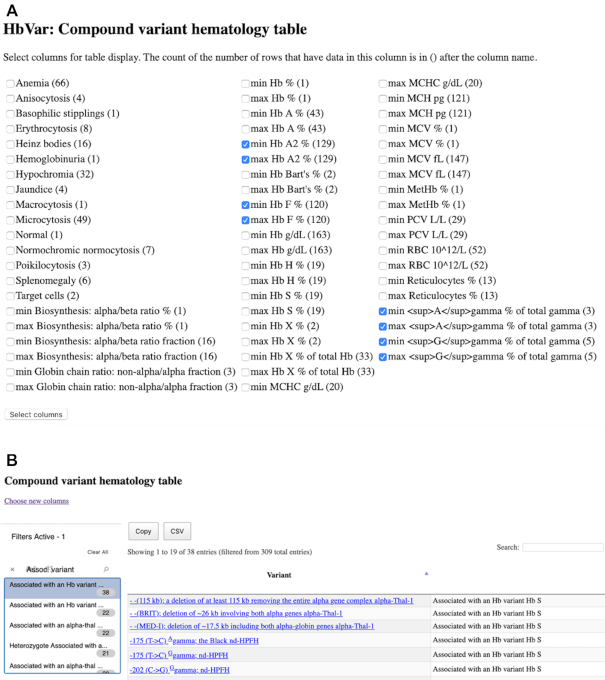
HbVar (http://globin.bx.psu.edu/hbvar) is a widely-used locus-specific database (LSDB) launched 20 years ago by a multi-center academic effort to provide timely information on the numerous genomic variants leading to hemoglobin variants and all types of thalassemia and hemoglobinopathies. Here, we report several advances for the database. We made clinically relevant updates of HbVar, implemented as additional querying options in the HbVar query page, allowing the user to explore the clinical phenotype of compound heterozygous patients. We also made significant improvements to the HbVar front page, making comparative data querying, analysis and output more user-friendly. We continued to expand and enrich the regular data content, involving 1820 variants, 230 of which are new entries. We also increased the querying potential and expanded the usefulness of HbVar database in the clinical setting. These several additions, expansions and updates should improve the utility of HbVar both for the globin research community and in a clinical setting.
© The Author(s) 2020. Published by Oxford University Press on behalf of Nucleic Acids Research.
Figures
References
-
- Weatherall D.J., Clegg J.B.. The Thalassaemia Syndromes. 4th ednWiley-Blackwell.
-
- Huisman T.H.J., Carver M.F., Baysal E.. A Syllabus of Thalassemia Mutations. 1997; Augusta: The Sickle Cell Anemia Foundation.
-
- Huisman T.H.J., Carver M.F., Efremov G.D.. A Syllabus of Human Hemoglobin Variants, 2nd edn. 1998; Augusta: The Sickle Cell Anemia Foundation.
-
- Mitropoulou C., Webb A.J., Mitropoulos K., Brookes A.J., Patrinos G.P.. Locus-specific databases domain and data content analysis: Evolution and content maturation towards clinical use. Hum. Mutat. 2010; 31:1109–1116. - PubMed
-
- Hardison R.C., Chui D.H., Giardine B., Riemer C., Patrinos G.P., Anagnou N., Miller W., Wajcman H.. HbVar: a relational database of human hemoglobin variants and thalassemia mutations at the globin gene server. Hum. Mutat. 2002; 19:225–233. - PubMed
Publication types
MeSH terms
Substances
Grants and funding
LinkOut - more resources
Full Text Sources
Other Literature Sources
Medical
