. 2021 Jan 8;49(D1):D1529-D1533.
doi: 10.1093/nar/gkaa947.

The international glycan repository GlyTouCan version 3.0

Affiliations

The international glycan repository GlyTouCan version 3.0

Akihiro Fujita et al. Nucleic Acids Res. .

Abstract

Glycans serve important roles in signaling events and cell-cell communication, and they are recognized by lectins, viruses and bacteria, playing a variety of roles in many biological processes. However, there was no system to organize the plethora of glycan-related data in the literature. Thus GlyTouCan (https://glytoucan.org) was developed as the international glycan repository, allowing researchers to assign accession numbers to glycans. This also aided in the integration of glycan data across various databases. GlyTouCan assigns accession numbers to glycans which are defined as sets of monosaccharides, which may or may not be characterized with linkage information. GlyTouCan was developed to be able to recognize any level of ambiguity in glycans and uniquely assign accession numbers to each of them, regardless of the input text format. In this manuscript, we describe the latest update to GlyTouCan in version 3.0, its usage, and plans for future development.


Figures

Figure 1.
Figure 1.
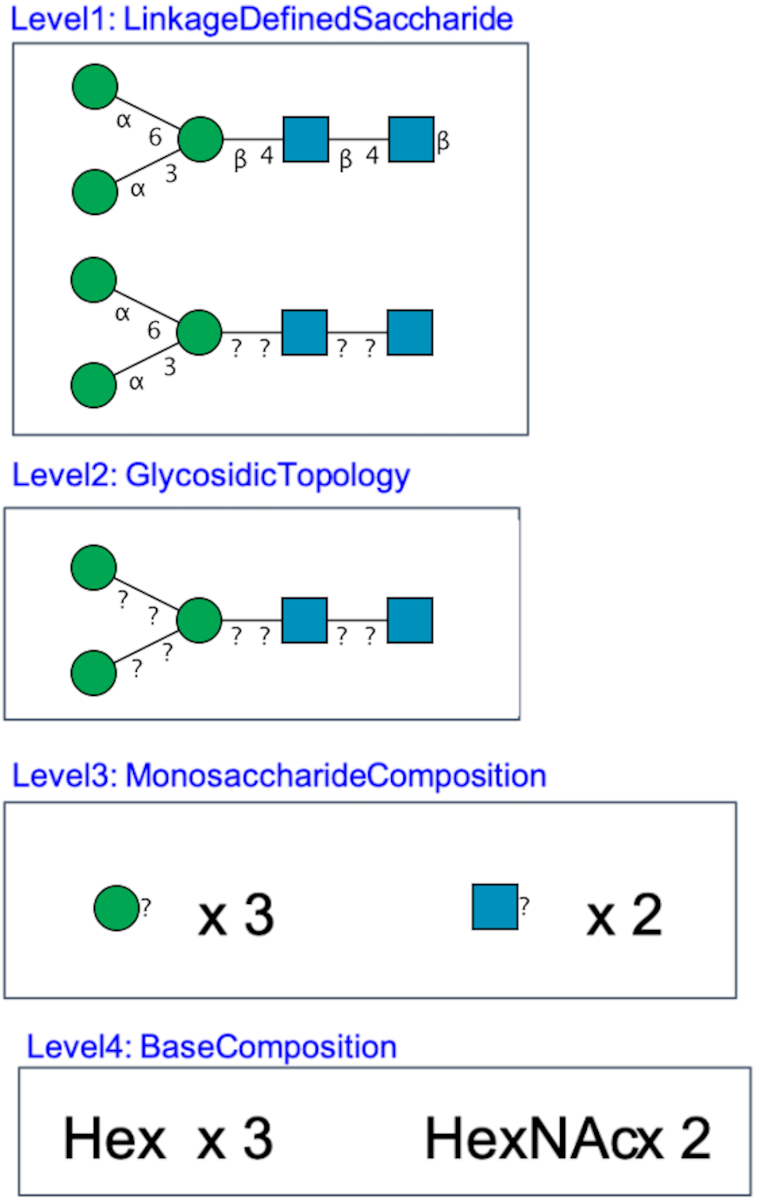
Examples of glycan that can be registered in GlyTouCan. Different levels of ambiguity can be defined.
Figure 2.
Figure 2.
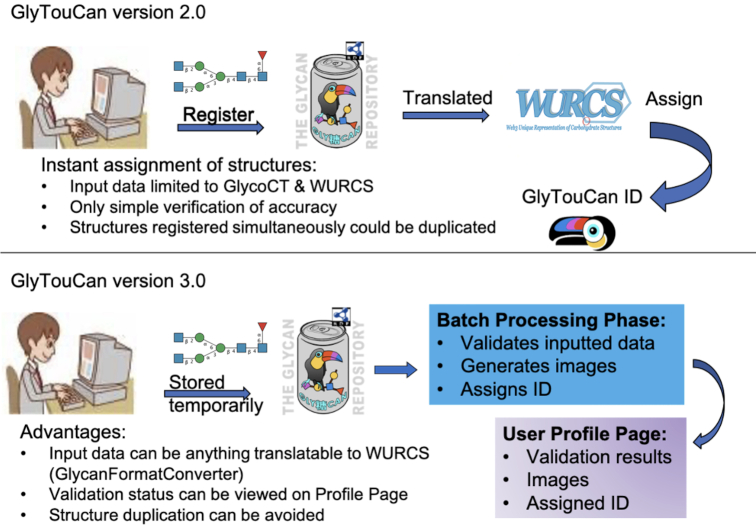
The new registration process in GlyTouCan. The top part represents the former version where registration, translation and assignment of IDs were performed immediately. The bottom represents the new system, where glycans registered are first assigned a hash key and stored in the User's Submissions. A periodic batch process will then validate inputted data, and once validated, generates the glycan image and assigns an accession number. All the inputted data, validation results, generated images and IDs will be listed in the new User's Submissions page.
Figure 3.
Figure 3.
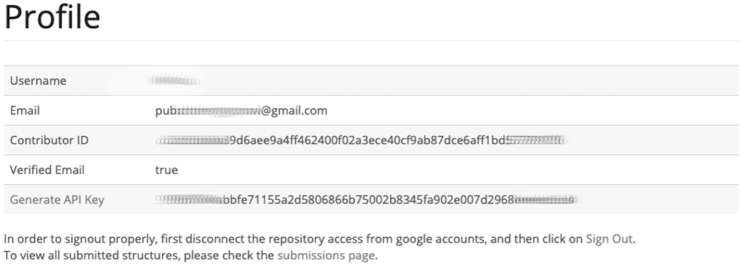
After user registration, the user can check the registration information such as the registered email address, Contributor ID and API Key required for submission of glycans on the user profile page (https://glytoucan.org/Users/profile).
Figure 4.
Figure 4.
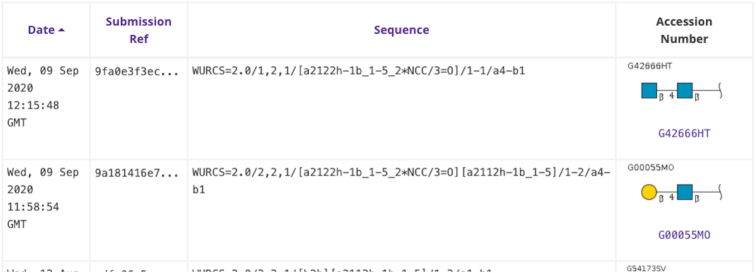
Examples of user-registered glycans and registered information on the Data Submission page (https://glytoucan.org/Users/structure). Initially, the data is sorted based on the date and time of submission (left-most column). Submission Ref is the hash key generated upon registration. Sequence is the user-submitted glycan data. If the batch processing confirms that the data is valid, the accession number and glycan image is displayed in the right-most column. Note that if the glycan was already registered, then the accession number already assigned is listed.
Figure 5.
Figure 5.
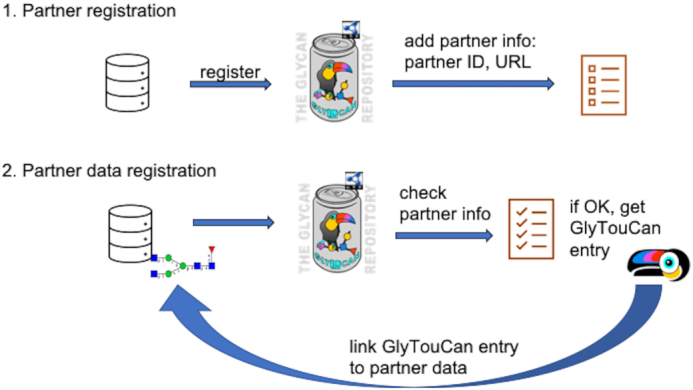
Illustration of the GlyTouCan Partner Program. First, database providers who have glycan data can register as a partner by providing their contributor ID and base URL. Once registered, database provider developers can register their glycans corresponding to GlyTouCan IDs, which will then be checked and, once validated, will generate links in GlyTouCan entry pages back to the partner's corresponding entry page.

References

    1. Varki A., Cummings R.D., Esko J.D., Stanley P., Hart G.W., Aebi M., Darvill A.G., Kinoshita T., Packer N.H., Prestegard J.H. et al. .. Essentials of Glycobiology. 2017; 3rd ednCold Spring Harbor Laboratory Press. - PubMed
    1. Aoki-Kinoshita K.F. A Practical Guide to Using Glycomics Databases. 2017; Japan, Tokyo: Springer.
    1. Tiemeyer M., Aoki K., Paulson J., Cummings R.D., York W.S., Karlsson N.G., Lisacek F., Packer N.H., Campbell M.P., Aoki N.P. et al. .. GlyTouCan: an accessible glycan structure repository. Glycobiology. 2017; 27:915–919. - PMC - PubMed
    1. Berners-Lee T., Hendler J.. Publishing on the semantic web. Nature. 2001; 410:1023–1024. - PubMed
    1. Herget S., Ranzinger R., Maass K., von der Lieth C.-W.. GlycoCT – a unifying sequence format for carbohydrates. Carbohydr. Res. 2008; 343:2162–2171. - PubMed

Publication types

Substances