


The relationship between rates of hospitalization for ambulatory care sensitive conditions and local access to primary healthcare in Manitoba First Nations communities : Results from the Innovation in Community-based Primary Healthcare Supporting Transformation in the Health of First Nations in Manitoba (iPHIT) study
- PMID: 33125638
- PMCID: PMC7910355
- DOI: 10.17269/s41997-020-00421-3
The relationship between rates of hospitalization for ambulatory care sensitive conditions and local access to primary healthcare in Manitoba First Nations communities : Results from the Innovation in Community-based Primary Healthcare Supporting Transformation in the Health of First Nations in Manitoba (iPHIT) study
Abstract
Objectives: The objective of this study was to assess the performance of models of primary healthcare (PHC) delivered in First Nation and adjacent communities in Manitoba, using hospitalization rates for ambulatory care sensitive conditions (ACSC) as the primary outcome.
Methods: We used generalized estimating equation logistic regression on administrative claims data for 63 First Nations communities from Manitoba (1986-2016) comprising 140,111 people, housed at the Manitoba Centre for Health Policy. We controlled for age, sex, and socio-economic status to describe the relationship between hospitalization rates for ACSC and models of PHC in First Nation communities.
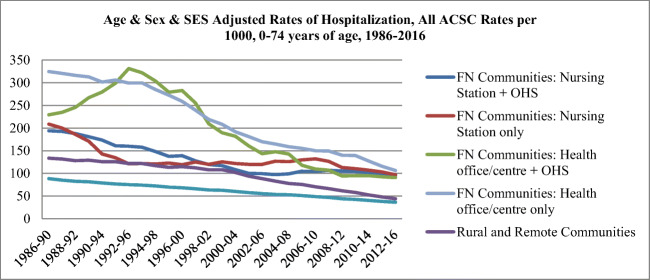
Results: Hospitalization rates for acute, chronic, vaccine-preventable, and mental health-related ACSCs have decreased over time in First Nation communities, yet remain significantly higher in First Nations and remote non-First Nations communities as compared with other Manitobans. When comparing different models of care, hospitalization rates were historically higher in communities served by health centres/offices, whether or not supplemented by itinerant medical services. These rates have significantly declined over the past two decades.
Conclusion: Local access to a broader complement of PHC services is associated with lower rates of avoidable hospitalization in First Nation communities. The lack of these services in many First Nation communities demonstrates the failure of the current Canadian healthcare system to meet the need of First Nation peoples. Improving access to PHC in all 63 First Nation communities can be expected to result in a reduction in ACSC hospitalization rates and reduce healthcare cost.
RéSUMé: OBJECTIFS: L’objectif de cette étude était d’évaluer le rendement des modèles de soins de santé primaires (SSP) dispensés dans les Premières Nations et les communautés adjacentes du Manitoba, en utilisant les taux d’hospitalisation pour les conditions propices aux soins ambulatoires (CPSA) comme résultat principal. MéTHODES: Nous avons utilisé une régression logistique par équation d’estimation généralisée sur les données de réclamations administratives pour 63 communautés des Premières Nations du Manitoba (1986-2016) comprenant 140 111 personnes, hébergées au Manitoba Centre for Health Policy. Nous avons contrôlé l’âge, le sexe et le statut socioéconomique afin de décrire la relation entre les taux d’hospitalisation pour les CPSA et les modèles de soins de santé primaires dans les communautés des Premières Nations. RéSULTATS: Les taux d’hospitalisation pour les CPSA aigus, chroniques, évitables par la vaccination et liés à la santé mentale ont diminué au fil du temps dans les communautés des Premières Nations, mais demeurent considérablement plus élevés dans les communautés des Premières Nations et éloignées non des Premières Nations par rapport aux autres Manitobains. Lorsque l’on compare différents modèles de soins, les taux d’hospitalisation étaient historiquement plus élevés dans les communautés desservies par les centres/bureaux de santé, qu’ils soient ou non complétés par des services médicaux itinérants. Ces taux ont considérablement diminué au cours des deux dernières décennies. CONCLUSION: L’accès local à un éventail plus large de services de SSP est associé à des taux plus faibles d’hospitalisation évitable dans les collectivités des Premières Nations. Le manque de ces services dans de nombreuses collectivités des Premières nations démontre l’incapacité du système de santé canadien actuel à répondre aux besoins des peuples des Premières nations. On peut s’attendre à ce que l’amélioration de l’accès aux soins de santé primaires dans les 63 collectivités des Premières nations se traduise par une réduction des taux d’hospitalisation et des coûts des soins de santé.
Keywords: Avoidable hospitalization; Indigenous health; Nursing stations; Primary care; Rural and remote communities.
Conflict of interest statement
The authors declare that they have no conflict of interest.
Figures
References
-
- Booz•Allen & Hamilton Canada Ltd. (1969). Study of health services for Canadian Indians. Ottawa: Booz•Allen & Hamilton Canada Ltd.
-
- Browne, A. J., & Varcoe, C. (2006). Critical cultural perspectives and health care involving aboriginal peoples. Contemp Nurse, 22(2), 155–167. - PubMed
Publication types
MeSH terms
LinkOut - more resources
Full Text Sources
Other Literature Sources
Miscellaneous
