An official website of the United States government
The .gov means it’s official.
Federal government websites often end in .gov or .mil. Before
sharing sensitive information, make sure you’re on a federal
government site.
The site is secure.
The https:// ensures that you are connecting to the
official website and that any information you provide is encrypted
and transmitted securely.
1 Department of Internal Medicine and Fraternal Order of Eagles Diabetes Research Center, University of Iowa, Iowa City, IA, USA; Hinton and Garza Lopez Family Consulting Company, Iowa City, IA.
2 Division of Hematology/Oncology, Department of Medicine, University of California, Los Angeles, Los Angeles, CA.
3 Teachers College, Columbia University, New York, NY.
4 Department of Molecular and Cell Biology, University of California, Berkeley, Berkeley, CA.
5 Department of Orthopaedic Surgery, University of Pennsylvania, Philadelphia, PA.
6 Fisk-Vanderbilt Center of Excellence, Peabody College Vanderbilt University, Nashville, TN.
7 Department of Cell & Tissue Biology, University of California, San Francisco, San Francisco, CA.
8 Department of Microbiology and Immunology, University of Iowa, Iowa City, IA.
9 Department of Pharmacology and Vanderbilt Center for Addiction Research, Vanderbilt University, Nashville, TN.
10 Hinton and Garza Lopez Family Consulting Company, Iowa City, IA.
11 Department of Internal Medicine and Fraternal Order of Eagles Diabetes Research Center, University of Iowa, Iowa City, IA, USA.
12 Department of Biological Sciences, Winston-Salem State University, Winston-Salem, NC.
13 Lewis-Sigler Institute for Integrative Genomics, Princeton University, Princeton, NJ; Department of Chemistry, Princeton University, Princeton, NJ. Electronic address: mcreynolds@princeton.edu.
14 Department of Neurobiology, Harvard Medical School, Boston, MA. Electronic address: Caroline_Palavicino-Maggio@hms.harvard.edu.
1 Department of Internal Medicine and Fraternal Order of Eagles Diabetes Research Center, University of Iowa, Iowa City, IA, USA; Hinton and Garza Lopez Family Consulting Company, Iowa City, IA.
2 Division of Hematology/Oncology, Department of Medicine, University of California, Los Angeles, Los Angeles, CA.
3 Teachers College, Columbia University, New York, NY.
4 Department of Molecular and Cell Biology, University of California, Berkeley, Berkeley, CA.
5 Department of Orthopaedic Surgery, University of Pennsylvania, Philadelphia, PA.
6 Fisk-Vanderbilt Center of Excellence, Peabody College Vanderbilt University, Nashville, TN.
7 Department of Cell & Tissue Biology, University of California, San Francisco, San Francisco, CA.
8 Department of Microbiology and Immunology, University of Iowa, Iowa City, IA.
9 Department of Pharmacology and Vanderbilt Center for Addiction Research, Vanderbilt University, Nashville, TN.
10 Hinton and Garza Lopez Family Consulting Company, Iowa City, IA.
11 Department of Internal Medicine and Fraternal Order of Eagles Diabetes Research Center, University of Iowa, Iowa City, IA, USA.
12 Department of Biological Sciences, Winston-Salem State University, Winston-Salem, NC.
13 Lewis-Sigler Institute for Integrative Genomics, Princeton University, Princeton, NJ; Department of Chemistry, Princeton University, Princeton, NJ. Electronic address: mcreynolds@princeton.edu.
14 Department of Neurobiology, Harvard Medical School, Boston, MA. Electronic address: Caroline_Palavicino-Maggio@hms.harvard.edu.
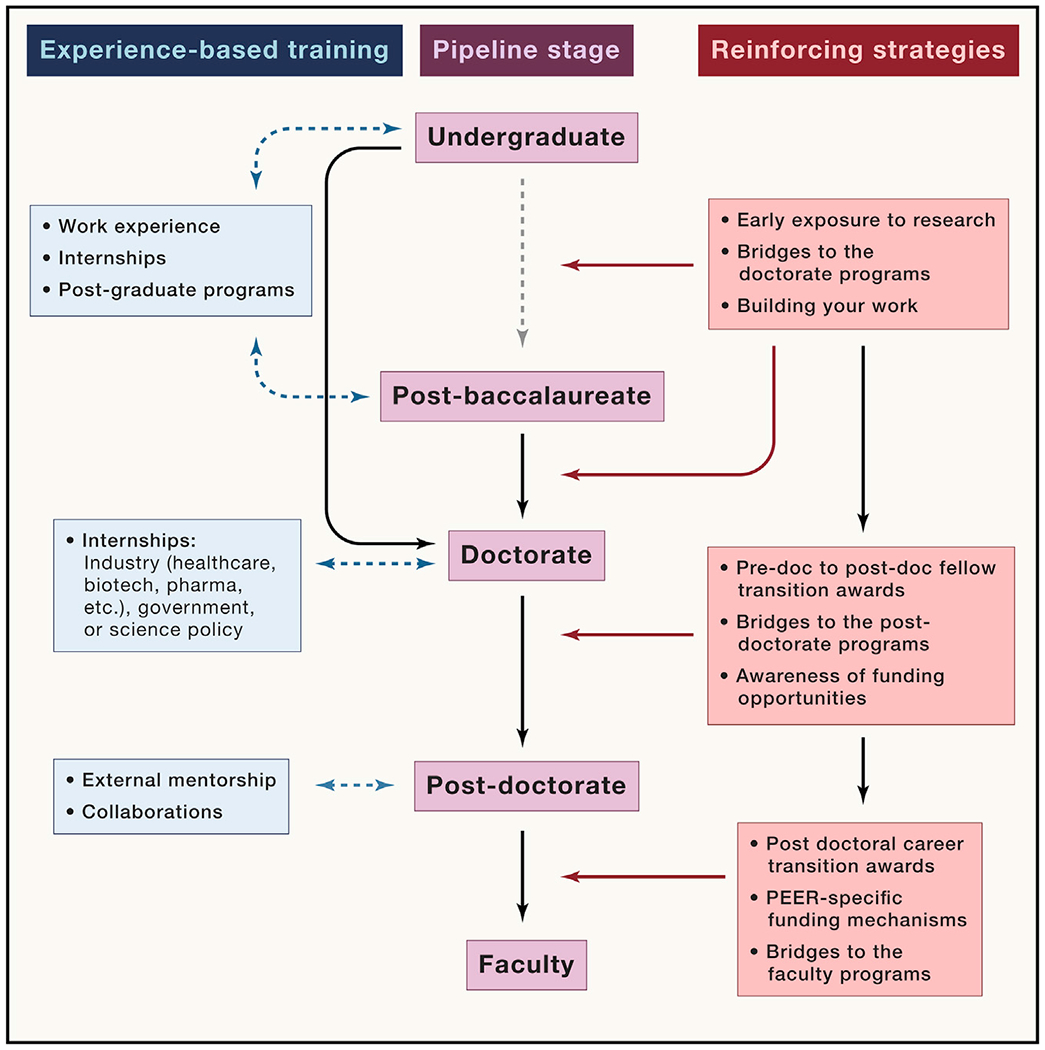
We identify problematic areas throughout the Science, Technology, Engineering and Mathematics (STEM) pipeline that perpetuate racial disparities in academia. Distinct ways to curtail these disparities include early exposure and access to resources, supportive mentoring networks and comprehensive training programs specifically for racially minoritized students and trainees at each career stage. These actions will revitalize the STEM pipeline.
Figure 1.. Diagram of a Multidimensional Academic…
Figure 1.. Diagram of a Multidimensional Academic Pipeline
In the center, we show defined training…
Figure 1.. Diagram of a Multidimensional Academic Pipeline
In the center, we show defined training stages within the academic pipeline moving from least experienced at the top (undergraduate) to most experienced at the bottom (faculty). We depict successful progression through the pipeline as black arrows transitioning from undergraduate to the optional post baccalaureate training phase, then to the doctorate, post doctorate, and ultimately faculty phase. On the left, we represent valuable experience-based training mechanisms that the scientists can draw from without exiting the pipeline. This continuous process of receiving experience-based training is depicted as an orange dotted arrow. On the right, we demonstrate reinforcing strategies that can support the transition of trainees from one stage to the next.

Andrianantoandro E. (2020). Being Black in the Ivory Tower. Cell Syst. 11, 1.
-
PubMed
Asai DJ (2020). Race Matters. Cell 181, 754–757.
-
PubMed
Bryson B. (2020). What Needs to Change in Academia to Increase the Number of Black Scientists and Engineers? Cell Syst. 11, 5–8.
-
PMC
-
PubMed
Estrada M, Burnett M, Campbell AG, Campbell PB, Denetclaw WF, Gutiérrez CG, Hurtado S, John GH, Matsui J, McGee R, et al. (2016). Improving Underrepresented Minority Student Persistence in STEM. CBE Life Sci. Educ 15, es5.
-
PMC
-
PubMed
Gibbs KD, Basson J, Xierali IM, and Broniatowski DA (2016). Decoupling of the minority PhD talent pool and assistant professor hiring in medical school basic science departments in the US. eLife 5, e21393.
-
PMC
-
PubMed