. 2020 Oct 28;10(11):2146.
doi: 10.3390/nano10112146.

Performant Composite Materials Based on Oxide Semiconductors and Metallic Nanoparticles Generated from Cloves and Mandarin Peel Extracts

Affiliations

Performant Composite Materials Based on Oxide Semiconductors and Metallic Nanoparticles Generated from Cloves and Mandarin Peel Extracts

Irina Zgura et al. Nanomaterials (Basel). .

Abstract

In this work, the metal and semiconducting nanoparticles (AgNPs, ZnONPs and AgZnONPs) were phyto-synthesized using aqueous vegetal extracts from: Caryophyllus aromaticus L. (cloves) and Citrus reticulata L. (mandarin) peels. The morphological, structural, compositional, optical and biological properties (antibacterial activity, and cytotoxicity) of the prepared composites were investigated. The most effective sample proved to be AgZnONPs, derived from cloves, with a minimum inhibitory concentration (MIC) value of 0.11 mg/mL and a minimum bactericidal concentration (MBC) value of 2.68 mg/mL. All the other three composites inhibited bacterial growth at a concentration between 0.25 mg/mL and 0.37 mg/mL, with a bactericidal concentration between 3 mg/mL and 4 mg/mL. The obtained composites presented biocidal activity against Staphylococcus aureus, and biocompatibility (on human fibroblast BJ cells) and did not damage the human red blood cells. Additionally, an important result is that the presence of silver in composite materials improved the bactericidal action of these nanomaterials against the most common nosocomial pathogen, Staphylococcus aureus.

Keywords: ZnO–Ag composites; antibacterial activity; cytotoxicity; “green” synthesis.


Conflict of interest statement

The authors declare no conflict of interest. The funders had no role in the design of the study; in the collection, analyses, or interpretation of data; in the writing of the manuscript, or in the decision to publish the results.

Figures
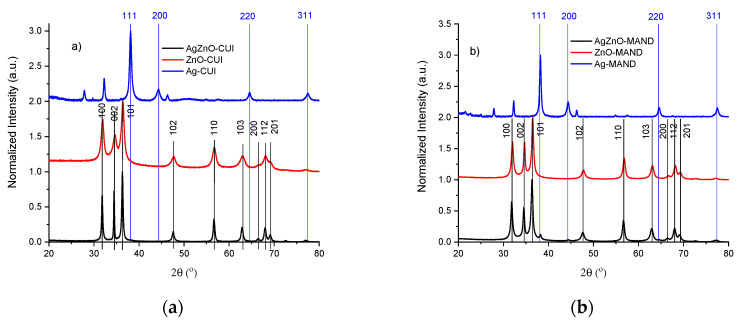
Figure 1
Figure 1
XRD patterns of the samples obtained in (a) cloves extract and (b) mandarins extract.
Figure 2
Figure 2
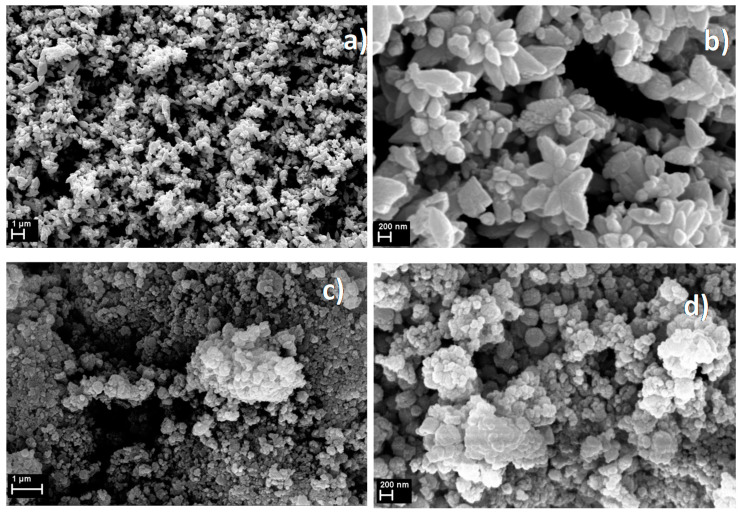
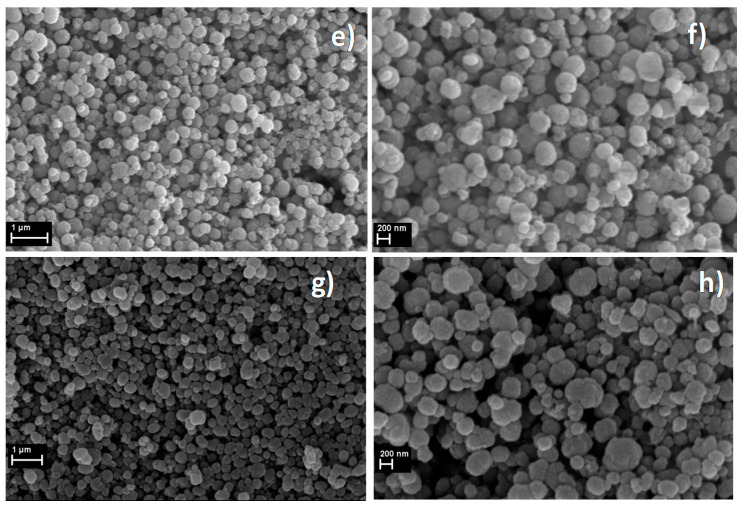
SEM images at two magnifications of samples: (a,b) AgZnO-CUI; (c,d) ZnO-CUI; (e,f) AgZnO-MAND and (g,h) ZnO-MAND.
Figure 2
Figure 2
SEM images at two magnifications of samples: (a,b) AgZnO-CUI; (c,d) ZnO-CUI; (e,f) AgZnO-MAND and (g,h) ZnO-MAND.
Figure 3
Figure 3
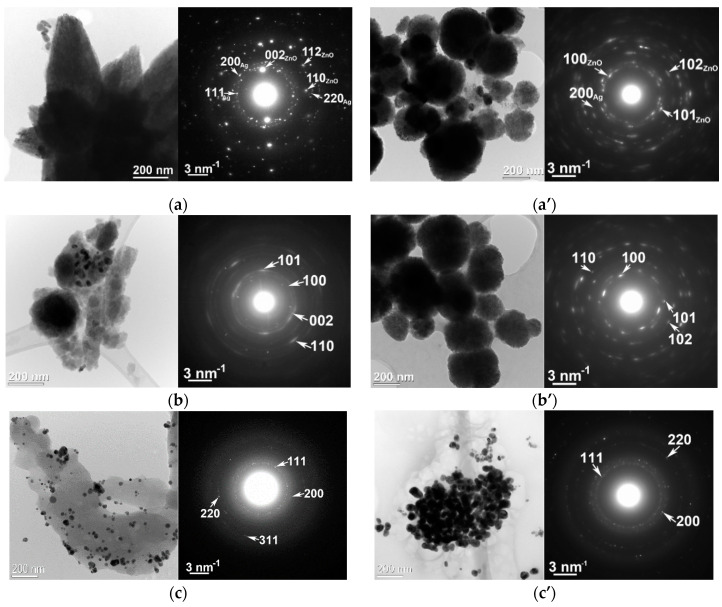
Scanning transmission electron microscopy-high angle annular dark field (HAADF-STEM) images and SAED diagrams for (a) AgZnO-CUI, (b) ZnO-CUI, (c) Ag-CUI, (a’) AgZnO-MAND, (b’) ZnO-MAND and (c’) Ag-MAND.
Figure 4
Figure 4
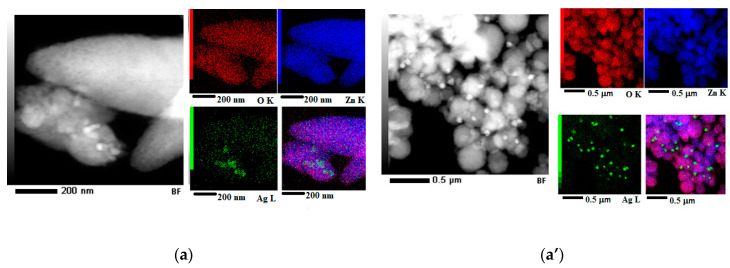
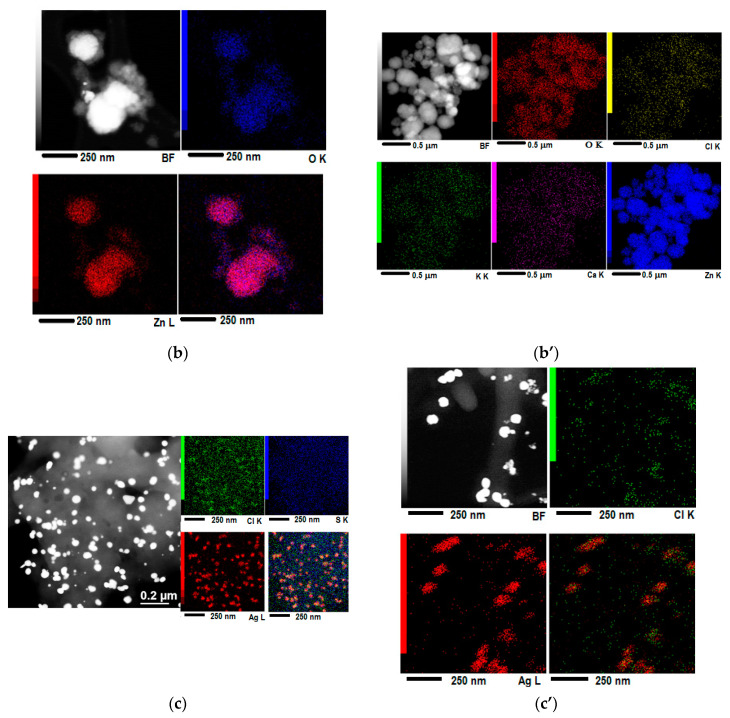
HAADF-STEM image at low magnification and elementary maps obtained by EDS mapping corresponding to the HAADF-STEM image, for (a) AgZnO-CUI (Ag L—green, Zn K—blue and O K—red), (b) ZnO-CUI (Zn K—red and O K—blue), (c) Ag-CUI (Ag L—red, Cl K—green, S K—blue), (a’) AgZnO-MAND (Ag L—green, Zn K—blue and O K—red), (b’) ZnO-MAND (O K—red, Cl K—yellow, K K—green, Ca K—purple and Zn K—blue) and (c’) Ag-MAND (Ag L—red and Cl K—green). For each sample, the last image was obtained by overlapping the individual elemental maps.
Figure 4
Figure 4
HAADF-STEM image at low magnification and elementary maps obtained by EDS mapping corresponding to the HAADF-STEM image, for (a) AgZnO-CUI (Ag L—green, Zn K—blue and O K—red), (b) ZnO-CUI (Zn K—red and O K—blue), (c) Ag-CUI (Ag L—red, Cl K—green, S K—blue), (a’) AgZnO-MAND (Ag L—green, Zn K—blue and O K—red), (b’) ZnO-MAND (O K—red, Cl K—yellow, K K—green, Ca K—purple and Zn K—blue) and (c’) Ag-MAND (Ag L—red and Cl K—green). For each sample, the last image was obtained by overlapping the individual elemental maps.
Figure 5
Figure 5
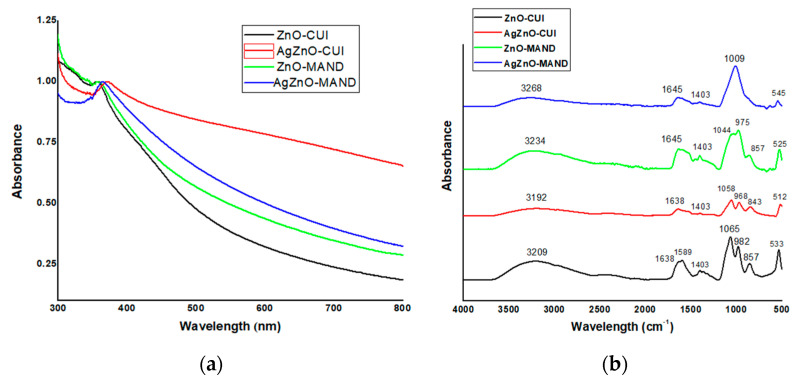
Optical characterization of “green” developed materials: (a) UV-Vis absorption spectra (normalized at the ZnO corresponding UV absorption peak) and (b) FTIR spectra of the phytosynthesized materials.
Figure 6
Figure 6
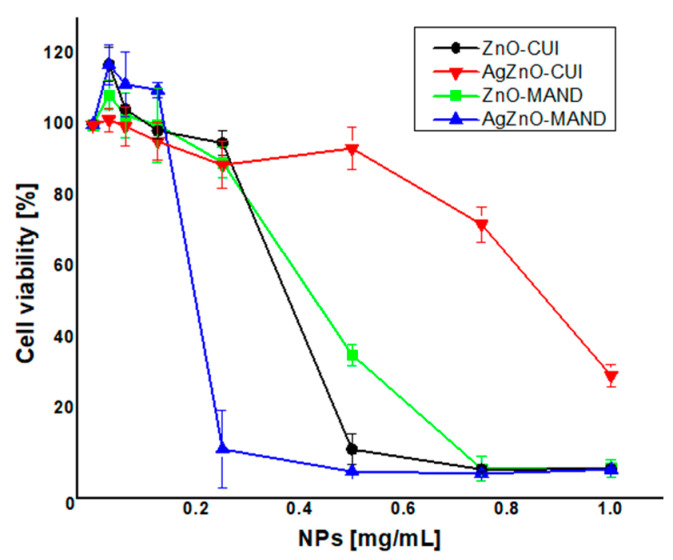
Cytotoxic effect of the samples on viability of BJ cells evaluated at 24 h using MTT assay.

References

    1. Kumar H., Bhardwaj K., Kuča K., Kalia A., Nepovimova E., Verma R., Kumar D. Flower-Based Green Synthesis of Metallic Nanoparticles: Applications beyond Fragrance. Nanomaterials. 2020;10:766. doi: 10.3390/nano10040766. - DOI - PMC - PubMed
    1. Siddiqi K.S., ur Rahman A., Tajuddin, Husen A. Properties of Zinc Oxide Nanoparticles and Their Activity Against Microbes. Nanoscale Res. Lett. 2018;13:141. doi: 10.1186/s11671-018-2532-3. - DOI - PMC - PubMed
    1. Some S., Kumar Sen I., Mandal A., Aslan T., Ustun Y., Yilmaz E.Ş., Kati A., Demirbas A., Mandal A.K., Ocsoy I. Biosynthesis of silver nanoparticles and their versatile antimicrobial properties. Mater. Res. Express. 2018;6:012001. doi: 10.1088/2053-1591/aae23e. - DOI
    1. Gajbhiye S., Sakharwade S. Silver nanoparticles in cosmetics. J. Cosmet. Dermatol. Sci. Appl. 2016;6:48–53. doi: 10.4236/jcdsa.2016.61007. - DOI
    1. Frederickson C.J., Koh J.Y., Bush A.I. The neurobiology of zinc in health and disease. Nat. Rev. Neurosci. 2005;6:449–462. doi: 10.1038/nrn1671. - DOI - PubMed

LinkOut - more resources