Review
. 2020 Oct 28;9(4):58.
doi: 10.3390/antib9040058.

The Role of Complement in the Mechanism of Action of Therapeutic Anti-Cancer mAbs

Affiliations
Review

The Role of Complement in the Mechanism of Action of Therapeutic Anti-Cancer mAbs

Josée Golay et al. Antibodies (Basel). .

Abstract

Unconjugated anti-cancer IgG1 monoclonal antibodies (mAbs) activate antibody-dependent cellular cytotoxicity (ADCC) by natural killer (NK) cells and antibody-dependent cellular phagocytosis (ADCP) by macrophages, and these activities are thought to be important mechanisms of action for many of these mAbs in vivo. Several mAbs also activate the classical complement pathway and promote complement-dependent cytotoxicity (CDC), although with very different levels of efficacy, depending on the mAb, the target antigen, and the tumor type. Recent studies have unraveled the various structural factors that define why some IgG1 mAbs are strong mediators of CDC, whereas others are not. The role of complement activation and membrane inhibitors expressed by tumor cells, most notably CD55 and CD59, has also been quite extensively studied, but how much these affect the resistance of tumors in vivo to IgG1 therapeutic mAbs still remains incompletely understood. Recent studies have demonstrated that complement activation has multiple effects beyond target cell lysis, affecting both innate and adaptive immunity mediated by soluble complement fragments, such as C3a and C5a, and by stimulating complement receptors expressed by immune cells, including NK cells, neutrophils, macrophages, T cells, and dendritic cells. Complement activation can enhance ADCC and ADCP and may contribute to the vaccine effect of mAbs. These different aspects of complement are also briefly reviewed in the specific context of FDA-approved therapeutic anti-cancer IgG1 mAbs.

Keywords: antibody dependent cellular cytotoxicity; complement; complement receptors; phagocytosis; therapeutic monoclonal antibodies (mAbs).


Conflict of interest statement

The authors declare no conflict of interest.

Figures
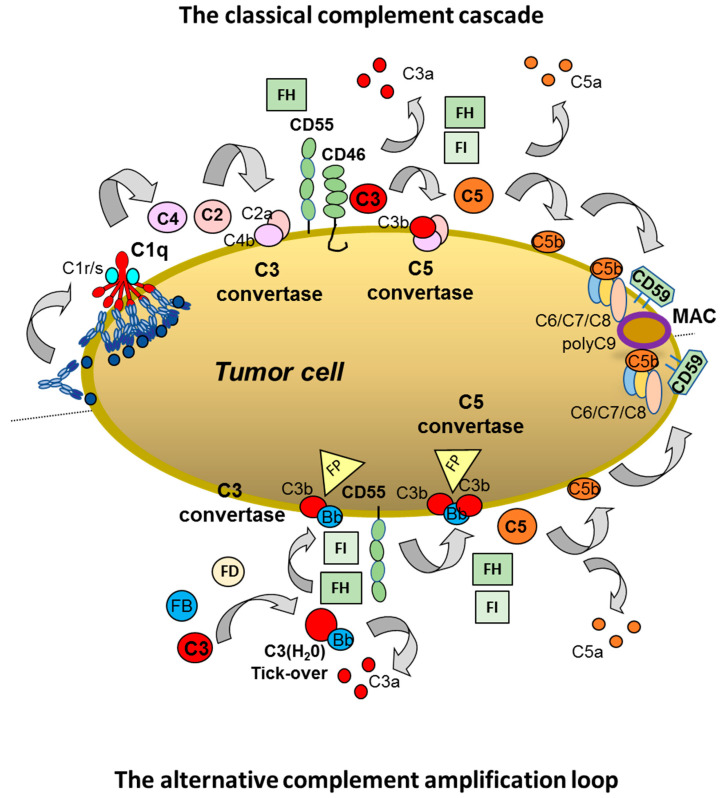
Figure 1
Figure 1
The classical and alternative complement pathways. The classical pathway (top): Human IgG1 antibodies bind antigen, form hexamers that allow C1q binding and the activation of the classical complement cascade. This is followed by C2 and C4 cleavage to produce the membrane bound C3 convertase (C4bC2a complex). Further cleavage of C3 to C3a and C3b forms the C5 convertase (C4bC2aC3b). C5 is cleaved to C5a and C5b allows further recruitment and activation of the C6, C7 and C8 components which catalyze C9 polymerization forming the membrane attack complex (MAC). The alternative pathway (bottom): it is initiated by tick-over activation of C3 in the fluid phase (C3(H2O)). It is further activated by Factors B and D to form the alternative C3 convertase (C3bBb) which is stabilized by Properdin (FP, yellow triangle). Further C3 cleavage forms the C5 convertase (C3bBbC3b) (also stabilized by Properdin). The alternative pathway amplifies the classical pathway. Both pathways are inhibited by the soluble inhibitors Factor H (FH) and Factor I (FI) and by membrane bound inhibitors: CD46 and CD55 at the level of the C3 convertase and CD59, which inhibits C9 polymerization. Complement pathway inhibitors are shown in green.
Figure 2
Figure 2
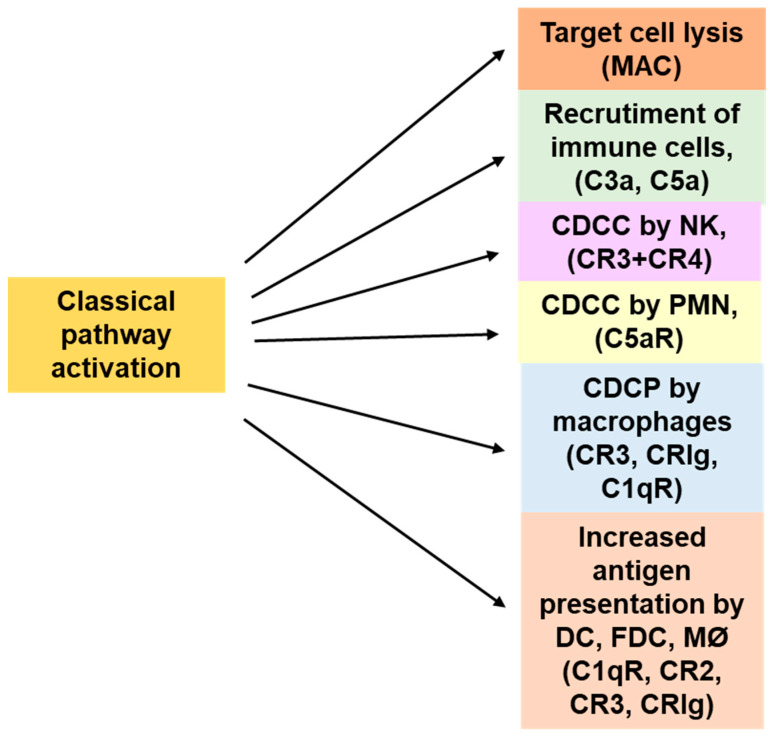
Multiple possible roles of complement for tumor control by IgG1 MAbs. Complement activation leads to complement mediated cell lysis but also to recruitment and activation of immune cells through complement fragments and their receptors which amplify the Fc-mediated ADCC and ADCP of IgG1 antibodies. CDCC: Complement dependent cellular cytotoxicity; CDCP: Complement dependent cellular phagocytosis; DC: dendritic cell; FDC: Follicular dendritic cells, MAC: membrane attack complex. MØ: macrophages; PMN: polymorphonuclear neutrophil; C1qR: C1q receptor, CR2, CR3, CR4, and CRIg: Receptors for complement fragments.

References

    1. Melis J.P., Strumane K., Ruuls S.R., Beurskens F.J., Schuurman J., Parren P.W. Complement in therapy and disease: Regulating the complement system with antibody-based therapeutics. Mol. Immunol. 2015;67:117–130. doi: 10.1016/j.molimm.2015.01.028. - DOI - PubMed
    1. Taylor R.P., Lindorfer M.A. Cytotoxic mechanisms of immunotherapy: Harnessing complement in the action of anti-tumor monoclonal antibodies. Semin. Immunol. 2016;28:309–316. doi: 10.1016/j.smim.2016.03.003. - DOI - PubMed
    1. Weiner G.J. Building better monoclonal antibody-based therapeutics. Nat. Rev. Cancer. 2015;15:361–370. doi: 10.1038/nrc3930. - DOI - PMC - PubMed
    1. Golay J. Direct targeting of cancer cells with antibodies: What can we learn from the successes and failure of unconjugated antibodies for lymphoid neoplasias? J. Autoimmun. 2017;85:6–19. doi: 10.1016/j.jaut.2017.06.002. - DOI - PubMed
    1. Lindorfer M.A., Koehl J., Taylor R.P. Interactions between the complement system and Fcgamma receptors. In: Nimmerhahn F., Ackerman M.E., editors. IgG Fc: Linking Adaptive and Innate Immunity. Elsevier Press; Amsterdam, The Netherlands: 2013. pp. 49–74.

LinkOut - more resources