Review
. 2020 Oct 28;21(21):8047.
doi: 10.3390/ijms21218047.

Role of Polycomb Complexes in Normal and Malignant Plasma Cells

Affiliations
Review

Role of Polycomb Complexes in Normal and Malignant Plasma Cells

Emmanuel Varlet et al. Int J Mol Sci. .

Abstract

Plasma cells (PC) are the main effectors of adaptive immunity, responsible for producing antibodies to defend the body against pathogens. They are the result of a complex highly regulated cell differentiation process, taking place in several anatomical locations and involving unique genetic events. Pathologically, PC can undergo tumorigenesis and cause a group of diseases known as plasma cell dyscrasias, including multiple myeloma (MM). MM is a severe disease with poor prognosis that is characterized by the accumulation of malignant PC within the bone marrow, as well as high clinical and molecular heterogeneity. MM patients frequently develop resistance to treatment, leading to relapse. Polycomb group (PcG) proteins are epigenetic regulators involved in cell fate and carcinogenesis. The emerging roles of PcG in PC differentiation and myelomagenesis position them as potential therapeutic targets in MM. Here, we focus on the roles of PcG proteins in normal and malignant plasma cells, as well as their therapeutic implications.

Keywords: epigenetics; multiple myeloma; plasma cell differentiation; polycomb.


Conflict of interest statement

The authors declare no conflict of interest.

Figures
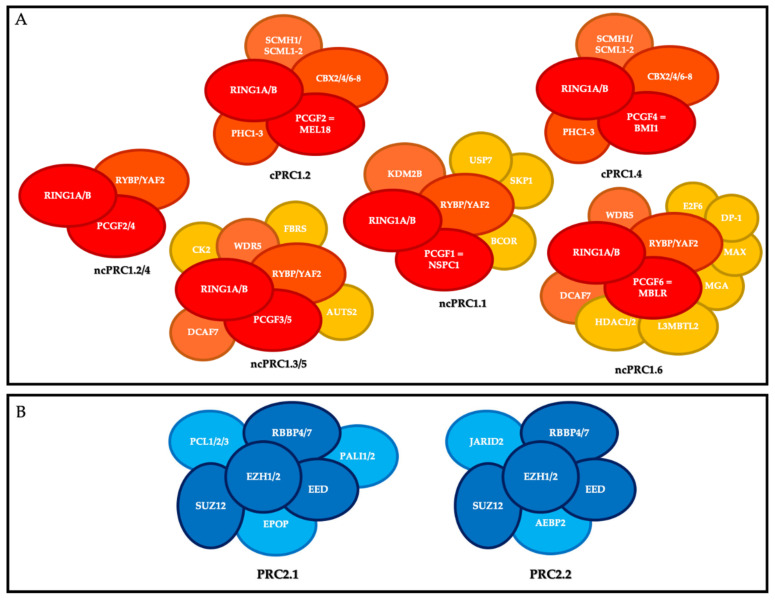
Figure 1
Figure 1
Polycomb repressive complexes (PRC). (A) Composition of canonical PRC1 (cPRC1) and non-canonical PRC1 (ncPRC1). Red, core members; orange, members that define the different canonical and non-canonical complexes; yellow, accessory factors. (B) Composition of PRC2. Dark blue, core members; light blue, members that define the different complexes.
Figure 2
Figure 2
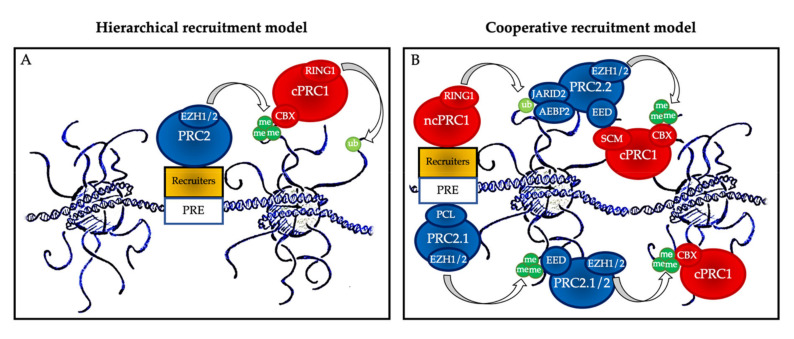
Polycomb group protein chromatin recruitment models. (A) Hierarchical recruitment model: PRC2 is recruited first and deposits H3K27me3 on chromatin via its catalytical subunit EZH1 or EZH2; then, canonical PRC1 (cPRC1) is recruited by a chromobox member CBX on the H3K27me3 mark and deposits H2AK119ub1 on chromatin via its catalytical subunit RING1. (B) Cooperative recruitment model: ncPRC1 complexes deposit H2AK119ub, which recruits PRC2.2 via its JARID2 and AEBP2 subunits. In parallel, PRC2.1 is recruited to unmethylated CpG island DNA via its PCL subunits. PRC2.1 and PRC2.2 complexes deposit H3K27me3, and this mark recruits both more copies of PRC2 and cPRC1. Mutual interactions between the core PRC2 member EED and the cPRC1 member SCM further stabilize their recruitment. PRE: polycomb responsive element (considered as CpG islands in mammals).
Figure 3
Figure 3
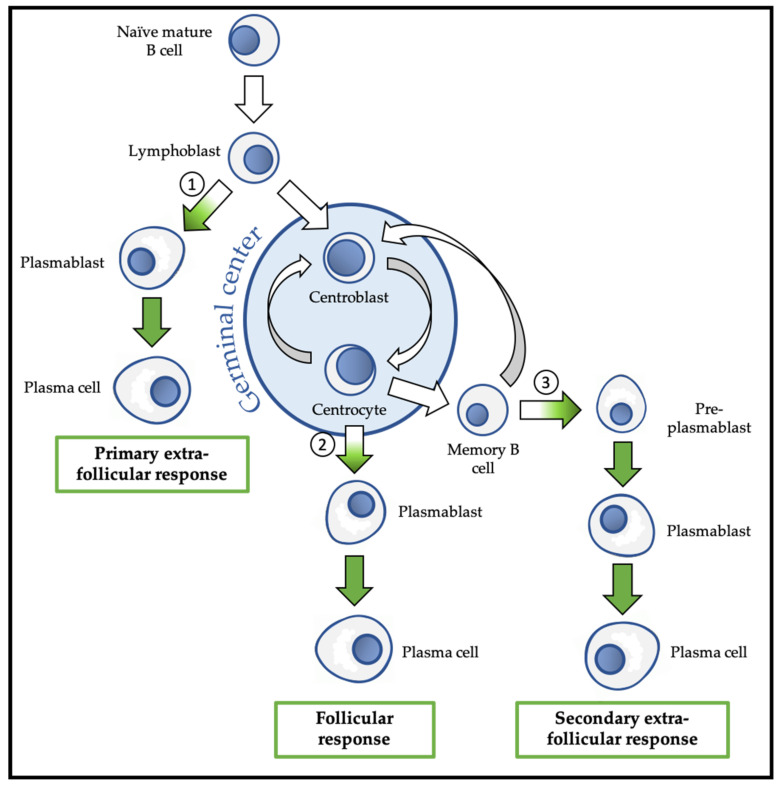
Overview of physiological differentiation of plasma cells (PC). Upon primary antigen contact, naïve mature B cells are activated and become lymphoblasts that can choose between two pathways: the primary extra-follicular response and the primary follicular response. In the primary extra-follicular response, lymphoblasts immediately differentiate into plasmablasts (PB) then into short-lived PC and produce immunoglobin M (IgM). In the primary follicular response, lymphoblasts enter a lymphoid follicle and form a germinal centre, while differentiating into centroblasts and then centrocytes. During the germinal centre reaction, immunoglobulin class switch recombination (CSR) and somatic hypermutation (SHM) take place. After selection, the centrocytes differentiate either into memory B cells, or into PB and then PC that produce IgG, IgA, or IgE. Upon secondary antigen contact, memory B cells are activated and can choose between a secondary extra-follicular response and a secondary follicular response. The secondary follicular response is similar to the primary follicular response and follows the same steps. In the secondary extra-follicular response, memory B cells immediately differentiate into pre-plasmablasts (pre-PB), PB, and then PC. The numbers indicate the cell fate decision points, where the antibody-secreting cell (ASC) program is switched on. Green arrows indicate cell differentiation steps where the ASC program takes place.
Figure 4
Figure 4
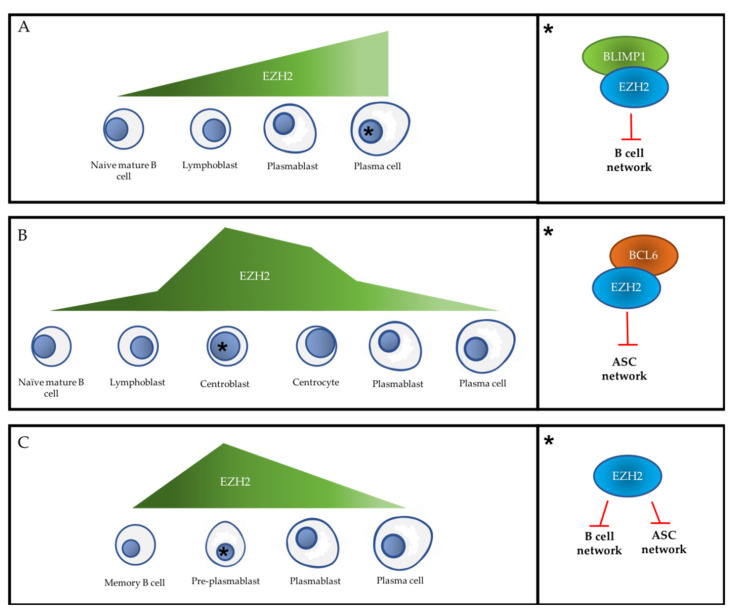
EZH2 expression level and its main cell fate control functions during PC differentiation. (A) Relative level of EZH2 expression during the primary extra-follicular response (left panel) and EZH2 main fate control function in primary extra-follicular PC (right panel). (B) EZH2 relative expression level during the follicular response (left panel) and EZH2 main fate control function in centroblasts (right panel). (C) Relative level of EZH2 expression during the secondary extra-follicular response (left panel) and EZH2 main fate control function in pre-PB (right panel). For each immunological response, the black asterisk indicates the cell step in which EZH2 expression level is maximal and refers to the right part of the figure. ASC: antibody-secreting cell. Red T-arrow represents repressive activity.
Figure 5
Figure 5
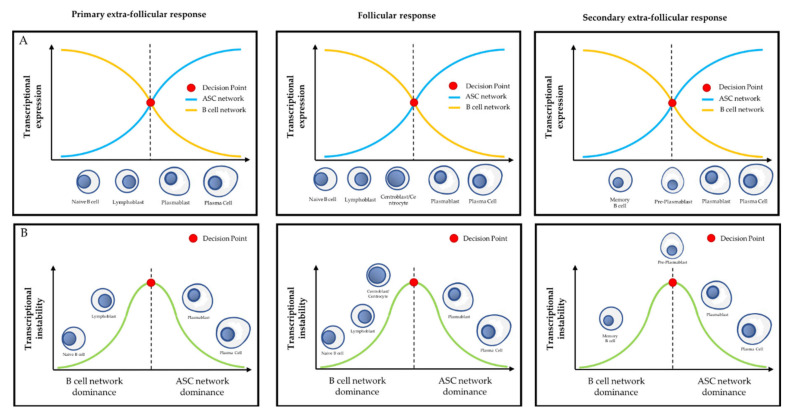
Transcriptional differentiation during PC differentiation. (A) Relationship between the antagonistic B cell transcriptional network and the ASC transcriptional network according to the cell differentiation step during the primary extra-follicular response (left), follicular response (middle), and secondary extra-follicular response (right). (B) Representation of the stability of the transcriptional network during PC differentiation. According to this model, naïve B cells and memory B cells represent the stable cell type that durably expresses B cell transcriptional network factors, and PC represents the stable cell type that durably expresses ASC transcriptional network factors. Other cell types (e.g., lymphoblasts, centroblasts, centrocytes, pre-PB, and PB) are transient and transcriptionally unstable, being are the site of active antagonism between the B cell and ASC transcriptional networks. The decision point represents the cell fate choice point where the transcriptional switch between the B cell network and the ASC network occurs, irreversibly inducing the activation of the ASC program and the extinction of the B cell program.
Figure 6
Figure 6
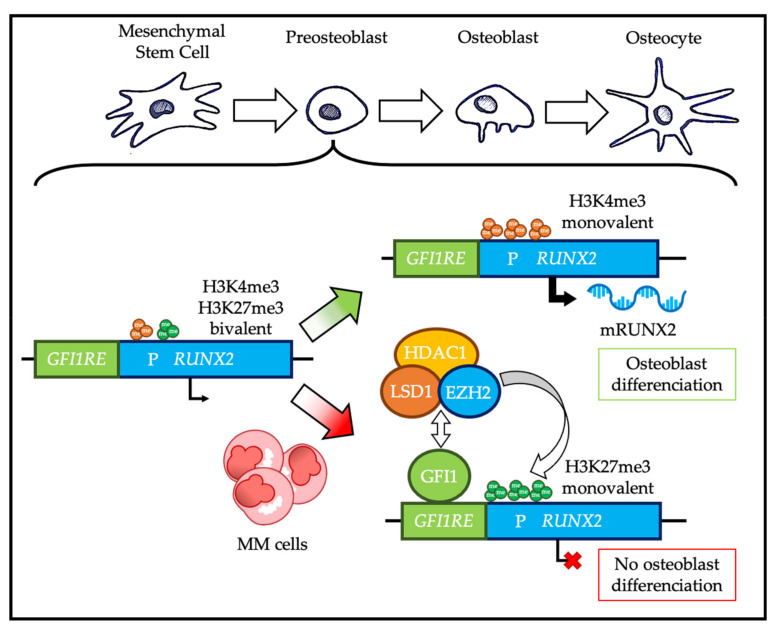
Role of EZH2 in multiple myeloma (MM) bone disease. Under physiological conditions, the RUNX2 gene promoter is found in a bivalent state in osteoblastic progenitors; the normal resolution of this bivalency is oriented towards a H3K4me3 monovalent state, which allows the transcription of RUNX2 and then osteoblastic differentiation. However, in presence of MM cells, osteoblastic progenitors overexpress GFI1, which recruits EZH2, LSD1, and HDAC1 on RUNX2 promoter and induces a bivalent resolution oriented towards a H3K27me3 monovalent state and a transcriptional repression of RUNX2, resulting in an inhibition of osteoblastic differentiation. P: promoter; GFI1RE: GRI1 responsive element; mRUNX2: RUNX2 mRNA. Green arrow represents normal physiology and red arrow represents deregulations in MM malignancy.

References

    1. Ribatti D. The discovery of plasma cells: An historical note. Immunol. Lett. 2017;188:64–67. doi: 10.1016/j.imlet.2017.06.006. - DOI - PubMed
    1. Maximow A.A. Experimentelle Untersuchungen über Entzündliche Neubildung von Bindegewebe. Fischer; Leipzig, Germany: 1902. Chapter III-C.
    1. Fagraeus A. Plasma Cellular Reaction and its Relation to the Formation of Antibodies in vitro. Nature. 1947;159:499. doi: 10.1038/159499a0. - DOI - PubMed
    1. Cooper M.D., Peterson R.D.A., Good R.A. Delineation of the thymic and bursal lymphoid systems in chicken. Nature. 1965;205:103–146. doi: 10.1038/205143a0. - DOI - PubMed
    1. Cyster J.G., Allen C.D.C. B cell responses—Cell interaction dynamics and decisions. Cell. 2019;177:524–540. doi: 10.1016/j.cell.2019.03.016. - DOI - PMC - PubMed

Substances