


Willingness to Accept Trade-Offs Among COVID-19 Cases, Social-Distancing Restrictions, and Economic Impact: A Nationwide US Study
- PMID: 33127014
- PMCID: PMC7473013
- DOI: 10.1016/j.jval.2020.07.003
Willingness to Accept Trade-Offs Among COVID-19 Cases, Social-Distancing Restrictions, and Economic Impact: A Nationwide US Study
Abstract
Objective: To conduct a discrete-choice experiment to quantify Americans' acceptance of severe acute respiratory syndrome coronavirus 2 infection risks for earlier lifting of social-distancing restrictions and diminishing the pandemic's economic impact.
Methods: We designed a discrete-choice experiment to administer 10 choice questions to each respondent representing experimentally controlled pairs of scenarios defined by when nonessential businesses could reopen (May, July, or October 2020), cumulative percentage of Americans contracting coronavirus disease 2019 (COVID-19) through 2020 (2% to 20%), time for economic recovery (2 to 5 years), and the percentage of US households falling below the poverty threshold (16% to 25%). Respondents were recruited by SurveyHealthcareGlobus.
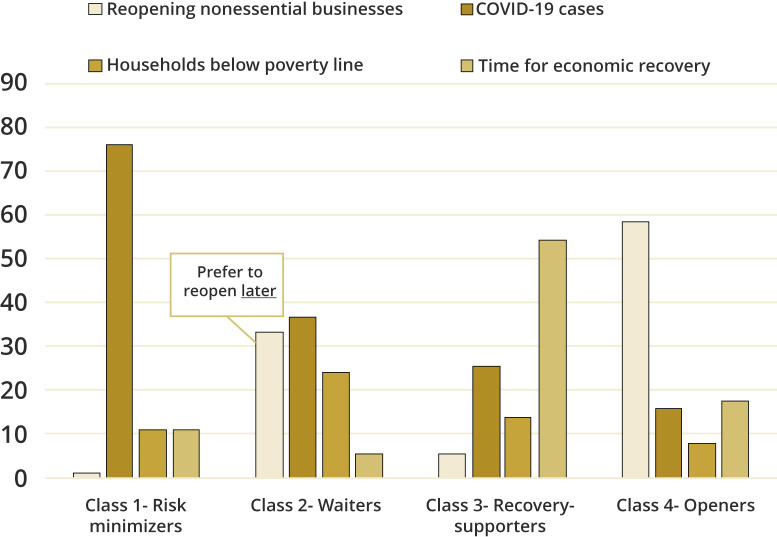
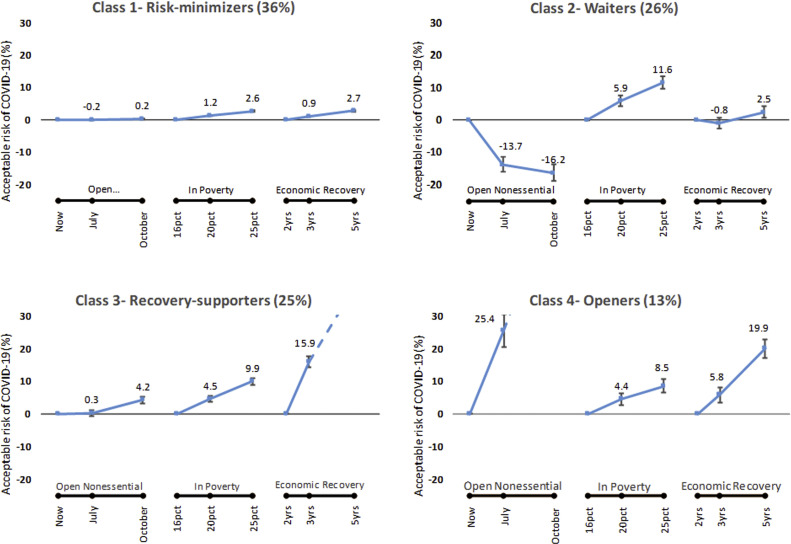
Results: A total of 5953 adults across all 50 states completed the survey between May 8 and 20, 2020. Latent-class analysis supported a 4-class model. The largest class (36%) represented COVID-19 risk-minimizers, reluctant to accept any increases in COVID-19 risks. About 26% were waiters, strongly preferring to delay reopening nonessential businesses, independent of COVID-19 risk levels. Another 25% represented recovery-supporters, primarily concerned about time required for economic recovery. This group would accept COVID-19 risks as high as 16% (95% CI: 13%-19%) to shorten economic recovery from 3 to 2 years. The final openers class prioritized lifting social distancing restrictions, accepting of COVID-19 risks greater than 20% to open in May rather than July or October. Political affiliation, race, household income, and employment status were all associated with class membership (P<.01).
Conclusion: Americans have diverse preferences pertaining to social-distancing restrictions, infection risks, and economic outcomes. These findings can assist elected and public-health officials in making difficult policy decisions related to the pandemic.
Keywords: COVID-19; discrete-choice experiment; social-distancing restrictions; stated preference.
Copyright © 2020 ISPOR–The Professional Society for Health Economics and Outcomes Research. Published by Elsevier Inc. All rights reserved.
Figures
References
-
- Loo B.P. Role of stated preference methods in planning for sustainable urban transportation: state of practice and future prospects. J Urban Plann Dev. 2002;128:210–224.
-
- Carson R.T., Czajkowski M. The discrete choice experiment approach to environmental contingent valuation. In: Hess S., Daly A., editors. Handbook of Choice Modelling. Edward Elgar Publishing; 2014.
-
- Hoyos D. The state of the art of environmental valuation with discrete choice experiments. Ecol Econ. 2010;69:1595–1603.
-
- Watson V., Carnon A., Ryan M., Cox D. Involving the public in priority setting: a case study using discrete choice experiments. J Public Health (Oxf) 2012;34(2):253–260. - PubMed
-
- Basu A., Sullivan S.D. Toward a hedonic value framework in health care. Value Health. 2017;20(2):261–265. - PubMed
MeSH terms
LinkOut - more resources
Full Text Sources
