Review
. 2020 Oct 30;11(10):932.
doi: 10.1038/s41419-020-03137-x.

Age-related cerebral small vessel disease and inflammaging

Affiliations
Review

Age-related cerebral small vessel disease and inflammaging

Tiemei Li et al. Cell Death Dis. .

Abstract

The continued increase in global life expectancy predicts a rising prevalence of age-related cerebral small vessel diseases (CSVD), which requires a better understanding of the underlying molecular mechanisms. In recent years, the concept of "inflammaging" has attracted increasing attention. It refers to the chronic sterile low-grade inflammation in elderly organisms and is involved in the development of a variety of age-related chronic diseases. Inflammaging is a long-term result of chronic physiological stimulation of the immune system, and various cellular and molecular mechanisms (e.g., cellular senescence, immunosenescence, mitochondrial dysfunction, defective autophagy, metaflammation, gut microbiota dysbiosis) are involved. With the deepening understanding of the etiological basis of age-related CSVD, inflammaging is considered to play an important role in its occurrence and development. One of the most critical pathophysiological mechanisms of CSVD is endothelium dysfunction and subsequent blood-brain barrier (BBB) leakage, which gives a clue in the identification of the disease by detecting circulating biological markers of BBB disruption. The regional analysis showed blood markers of vascular inflammation are often associated with deep perforating arteriopathy (DPA), while blood markers of systemic inflammation appear to be associated with cerebral amyloid angiopathy (CAA). Here, we discuss recent findings in the pathophysiology of inflammaging and their effects on the development of age-related CSVD. Furthermore, we speculate the inflammaging as a potential target for future therapeutic interventions to delay or prevent the progression of the age-related CSVD.


Conflict of interest statement

The authors declare that the research was conducted in the absence of any commercial or financial relationships that could be construed as a potential conflict of interest.

Figures
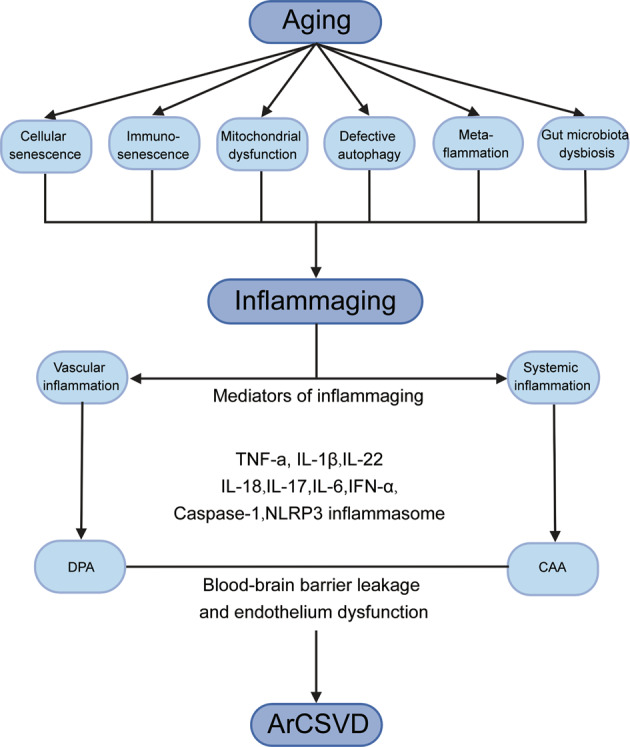
Fig. 1
Fig. 1. The deep interactions between aging, inflammaging, and age-related CSVD.
As aging, several cellular and molecular mechanisms lead to chronic inappropriate activation of the immune system. This complex interaction between genetic susceptibility and risk stimuli (both exogenous and endogenous) contributes to the continuous activation of a limited range of confounding sensors which triggers inflammaging (upper part of the box). The resulting synthesis and release of different inflammatory mediators are related to the common pathophysiological mechanisms of age-related diseases. For age-related CSVD, regional analyses showed that blood markers of vascular inflammation were associated with deep perforating arteriopathy (DPA), while blood markers of systemic inflammation were associated with cerebral amyloid angiopathy (CAA), both of which were closely related to the critical pathophysiological mechanisms of blood-brain barrier leakage and endothelial dysfunction (lower part of the box).
Fig. 2
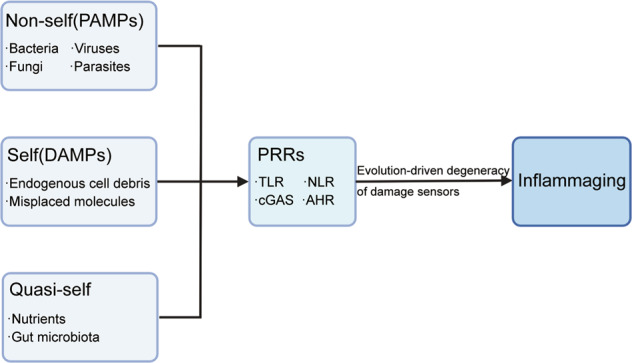
Fig. 2. The degeneracy of the damage sensor triggers inflammaging.
Exogenous and endogenous danger stimuli interact with pattern recognition receptors (PRRs) expressed on the cell surface and in the cytoplasm. Danger molecules can be non-self (pathogen-associated molecular patterns, PAMPs), self (damage-associated molecular patterns, DAMPs) and quasi-self (nutritional and metabolic products from the gut microbiota). These multitude of stimuli converge on the same evolutionarily selected promiscuous sensors, and trigger inflammaging.
Fig. 3
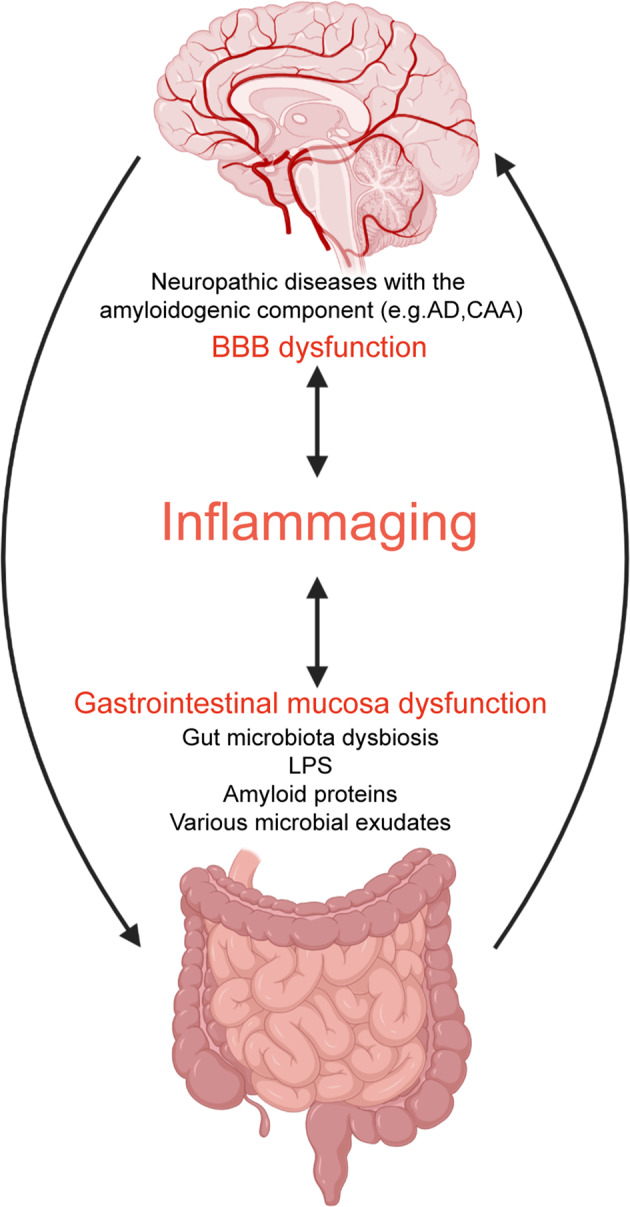
Fig. 3. Pathogenic role of the brain-gut-microbiota axis dysfunction during inflammaging.
In the process of inflammaging, gastrointestinal mucosa and blood-brain barrier (BBB) function are impaired, and the brain-gut-microbiota axis function is disturbed. Pathogenic microbiota and their products (LPS, amyloid proteins, and various microbial exudates) can further induce inflammatory responses and dysfunction of the brain-gut-microbiota axis, ultimately leading to the neuropathic diseases with the amyloidogenic component.

References

    1. Cannistraro RJ, et al. CNS small vessel disease: a clinical review. Neurology. 2019;92:1146–1156. doi: 10.1212/WNL.0000000000007654. - DOI - PMC - PubMed
    1. Schreiber S, et al. Invited Review: the spectrum of age-related small vessel diseases: potential overlap and interactions of amyloid and nonamyloid vasculopathies. Neuropathol. Appl. Neurobiol. 2020;46:219–239. doi: 10.1111/nan.12576. - DOI - PubMed
    1. Franceschi C, Garagnani P, Parini P, Giuliani C, Santoro A. Inflammaging: a new immune-metabolic viewpoint for age-related diseases. Nat. Rev. Endocrinol. 2018;14:576–590. doi: 10.1038/s41574-018-0059-4. - DOI - PubMed
    1. Franceschi C, et al. Inflamm-aging. An evolutionary perspective on immunosenescence. Ann. N. Y. Acad. Sci. 2000;908:244–254. doi: 10.1111/j.1749-6632.2000.tb06651.x. - DOI - PubMed
    1. Vitale G, Salvioli S, Franceschi C. Oxidative stress and the ageing endocrine system. Nat. Rev. Endocrinol. 2013;9:228–240. doi: 10.1038/nrendo.2013.29. - DOI - PubMed

Publication types

MeSH terms