


Early Antecedents of School Burnout in Upper Secondary Education: A Five-year Longitudinal Study
- PMID: 33128134
- PMCID: PMC7875950
- DOI: 10.1007/s10964-020-01331-w
Early Antecedents of School Burnout in Upper Secondary Education: A Five-year Longitudinal Study
Abstract
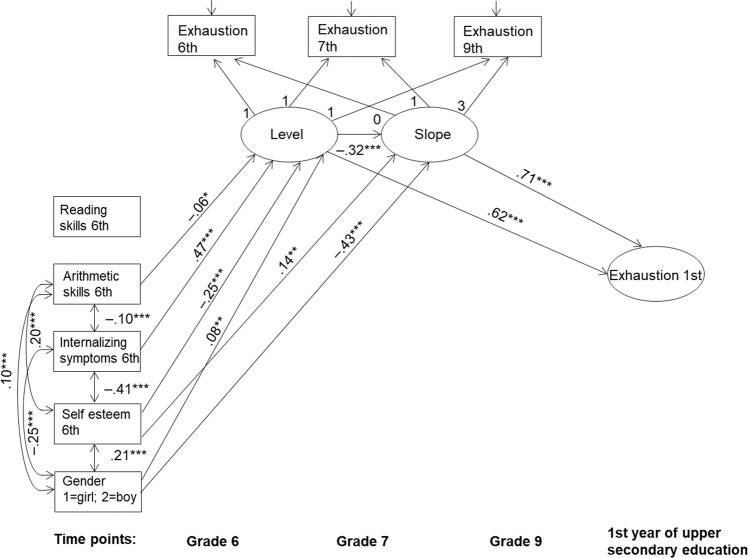
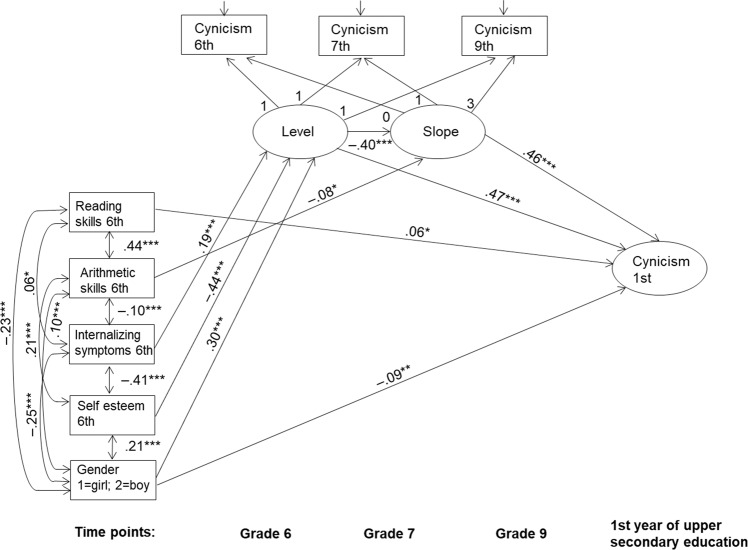
School burnout symptoms are prevalent among upper secondary education students, but thus far, very little is known about the background of these symptoms. The present study examined the extent to which school burnout symptoms (i.e., exhaustion and cynicism) among upper secondary education students have their roots in primary and lower secondary school and whether early antecedents of school burnout symptoms could be identified. The sample consisted of 1544 Finnish students followed up four times (Time1-Time 4) from the end of primary school (T1; mean age 12.74 and range 11.71-14.20) to the first year of upper secondary education (T4; mean age 16.66 and range 15.55-18.39). The results of latent growth curve modeling showed that school burnout symptoms in upper secondary education were predicted by the level of school burnout symptoms at the end of primary school and by an increase in these symptoms across the transition from primary school through lower secondary school. In addition, psychological well-being, academic skills, and gender were found to contribute to the prediction of school burnout symptoms. Overall, the present study suggest that potential warning signs of school burnout should not be ignored and attention should be directed to earlier education phases.
Keywords: Academic skills; Developmental trajectories; Psychological well-being; School burnout; Upper secondary education.
Conflict of interest statement
The authors declare that they have no conflict of interest.
Figures
References
-
- Aunola, K., & Räsänen, P. (2007). The 3-minute basic arithmetic test. Unpublished test material. Jyväskylä: University of Jyväskylä.
-
- Bask M, Salmela-Aro K. Burned out to drop out: exploring the relationship between school burnout and school dropout. European Journal of Psychology of Education. 2013;28(2):511–528. doi: 10.1007/s10212-012-0126-5. - DOI
MeSH terms
Grants and funding
LinkOut - more resources
Full Text Sources
