


Association between anthropometry and lifestyle factors and risk of B-cell lymphoma: An exposome-wide analysis
- PMID: 33128820
- PMCID: PMC8048490
- DOI: 10.1002/ijc.33369
Association between anthropometry and lifestyle factors and risk of B-cell lymphoma: An exposome-wide analysis
Abstract
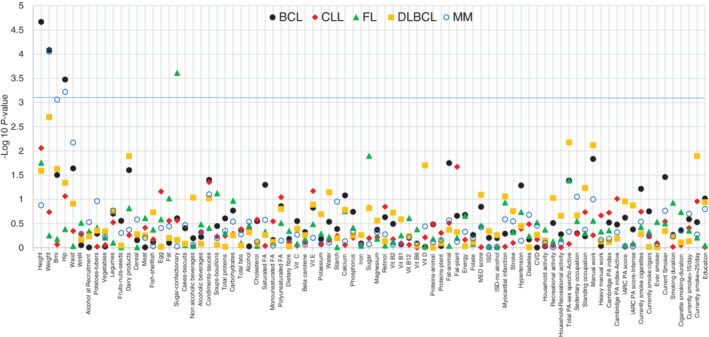
To better understand the role of individual and lifestyle factors in human disease, an exposome-wide association study was performed to investigate within a single-study anthropometry measures and lifestyle factors previously associated with B-cell lymphoma (BCL). Within the European Prospective Investigation into Cancer and nutrition study, 2402 incident BCL cases were diagnosed from 475 426 participants that were followed-up on average 14 years. Standard and penalized Cox regression models as well as principal component analysis (PCA) were used to evaluate 84 exposures in relation to BCL risk. Standard and penalized Cox regression models showed a positive association between anthropometric measures and BCL and multiple myeloma/plasma cell neoplasm (MM). The penalized Cox models additionally showed the association between several exposures from categories of physical activity, smoking status, medical history, socioeconomic position, diet and BCL and/or the subtypes. PCAs confirmed the individual associations but also showed additional observations. The PC5 including anthropometry, was positively associated with BCL, diffuse large B-cell lymphoma (DLBCL) and MM. There was a significant positive association between consumption of sugar and confectionary (PC11) and follicular lymphoma risk, and an inverse association between fish and shellfish and Vitamin D (PC15) and DLBCL risk. The PC1 including features of the Mediterranean diet and diet with lower inflammatory score showed an inverse association with BCL risk, while the PC7, including dairy, was positively associated with BCL and DLBCL risk. Physical activity (PC10) was positively associated with DLBCL risk among women. This study provided informative insights on the etiology of BCL.
Keywords: exposome; exposome-wide association study; lifestyle; lymphoma; prospective study.
© 2020 The Authors. International Journal of Cancer published by John Wiley & Sons Ltd on behalf of Union for International Cancer Control.
Conflict of interest statement
The authors declare no potential conflict of interest. Where authors are identified as personnel of the International Agency for Research on Cancer/WHO, the authors alone are responsible for the views expressed in this article and they do not necessarily represent the decisions, policy or views of the International Agency for Research on Cancer/WHO.
Figures

References
-
- Van Veldhoven CM, Khan AE, Teucher B, et al. Physical activity and lymphoid neoplasms in the European Prospective Investigation into Cancer and nutrition (EPIC). Eur J Cancer. 2011;47(5):748‐760. - PubMed
-
- Nieters A, Rohrmann S, Becker N, et al. Smoking and lymphoma risk in the European prospective investigation into cancer and nutrition. Am J Epidemiol. 2008;167(9):1081‐1089. - PubMed
-
- Britton JA, Khan AE, Rohrmann S, et al. Anthropometric characteristics and non‐Hodgkin's lymphoma and multiple myeloma risk in the European Prospective Investigation into Cancer and Nutrition (EPIC). Haematologica. 2008;93(11):1666‐1677. - PubMed
Publication types
MeSH terms
Grants and funding
- MR/M012190/1/MRC_/Medical Research Council/United Kingdom
- 1000143 (to EPIC-Norfolk)/MRC_/Medical Research Council/United Kingdom
- MR/N003284/1/MRC_/Medical Research Council/United Kingdom
- 14136/CRUK_/Cancer Research UK/United Kingdom
- G0401527/MRC_/Medical Research Council/United Kingdom
- C570/A11692/CRUK_/Cancer Research UK/United Kingdom
- C570/A16491/CRUK_/Cancer Research UK/United Kingdom
- 001/WHO_/World Health Organization/International
- 14136 (to EPIC-Norfolk)/CRUK_/Cancer Research UK/United Kingdom
- G1000143/MRC_/Medical Research Council/United Kingdom
- 205212/Z/16/Z/WT_/Wellcome Trust/United Kingdom
- MR/M012190/1 (to EPIC-Oxford)/MRC_/Medical Research Council/United Kingdom
- WT_/Wellcome Trust/United Kingdom
LinkOut - more resources
Full Text Sources
Research Materials
Miscellaneous
