


Synthesis and biological evaluation of novel flexible nucleoside analogues that inhibit flavivirus replication in vitro
- PMID: 33128910
- PMCID: PMC7457965
- DOI: 10.1016/j.bmc.2020.115713
Synthesis and biological evaluation of novel flexible nucleoside analogues that inhibit flavivirus replication in vitro
Abstract
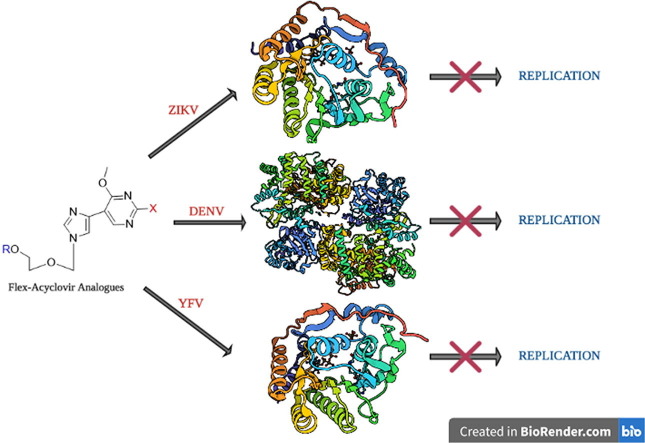
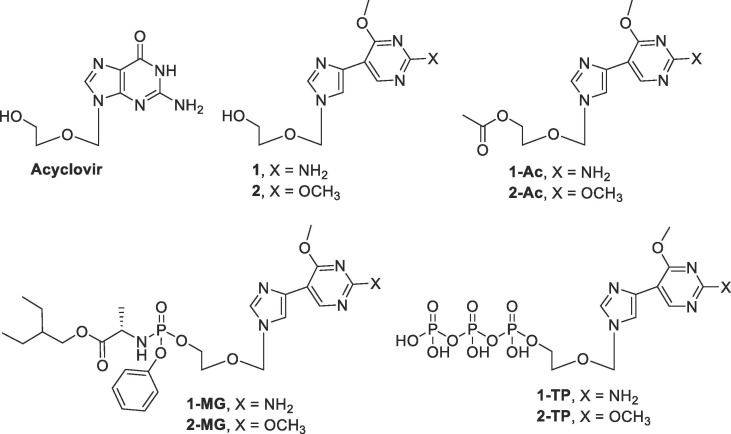
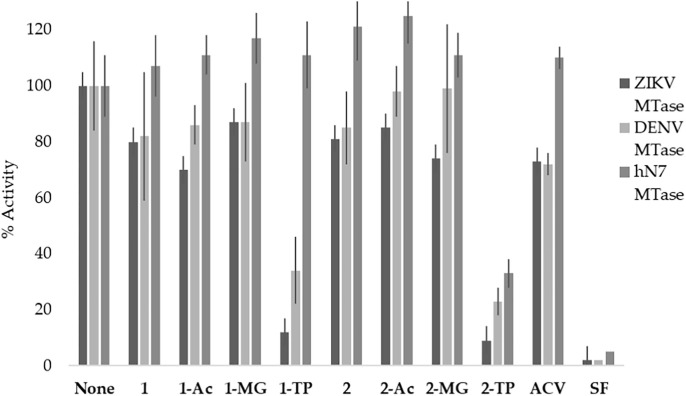
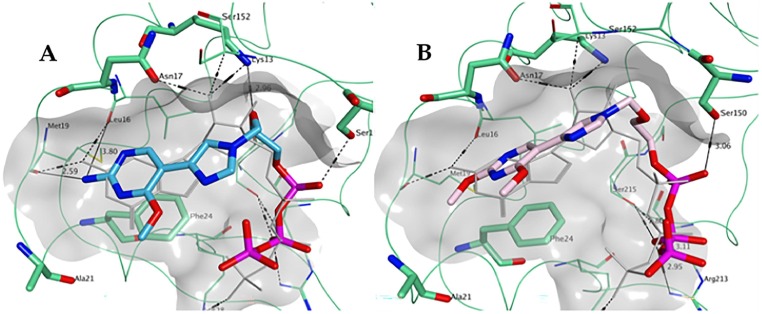
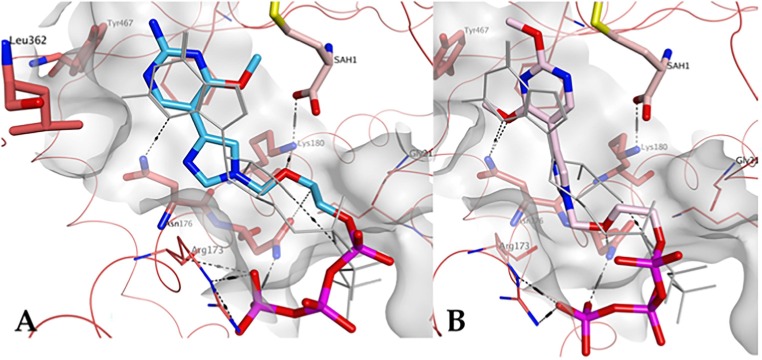
Flaviviruses, such as Dengue (DENV) and Zika (ZIKV) viruses, represent a severe health burden. There are currently no FDA-approved treatments, and vaccines against most flaviviruses are still lacking. We have developed several flexible analogues ("fleximers") of the FDA-approved nucleoside Acyclovir that exhibit activity against various RNA viruses, demonstrating their broad-spectrum potential. The current study reports activity against DENV and Yellow Fever Virus (YFV), particularly for compound 1. Studies to elucidate the mechanism of action suggest the flex-analogue triphosphates, especially 1-TP, inhibit DENV and ZIKV methyltransferases, and a secondary, albeit weak, effect on the DENV RNA-dependent RNA polymerase was observed at high concentrations. The results of these studies are reported herein.
Keywords: Acyclovir; Dengue; Flavivirus; Fleximers; Methyltransferase; Nucleoside; Yellow Fever; Zika.
Copyright © 2020 Elsevier Ltd. All rights reserved.
Conflict of interest statement
The authors declare that they have no known competing financial interests or personal relationships that could have appeared to influence the work reported in this paper.
Figures



Similar articles
-
In search of flavivirus inhibitors: evaluation of different tritylated nucleoside analogues.Eur J Med Chem. 2013 Jul;65:249-55. doi: 10.1016/j.ejmech.2013.04.034. Epub 2013 Apr 24. Eur J Med Chem. 2013. PMID: 23721953
-
Exploration of 4'-fluoro fleximer nucleoside analogues as potential broad-spectrum antiviral agents.Bioorg Med Chem. 2025 Oct 1;128:118243. doi: 10.1016/j.bmc.2025.118243. Epub 2025 May 20. Bioorg Med Chem. 2025. PMID: 40483926
-
Flex-nucleoside analogues - Novel therapeutics against filoviruses.Bioorg Med Chem Lett. 2017 Jun 15;27(12):2800-2802. doi: 10.1016/j.bmcl.2017.04.069. Epub 2017 Apr 22. Bioorg Med Chem Lett. 2017. PMID: 28465098 Free PMC article.
-
Nucleoside analogs as a rich source of antiviral agents active against arthropod-borne flaviviruses.Antivir Chem Chemother. 2018 Jan-Dec;26:2040206618761299. doi: 10.1177/2040206618761299. Antivir Chem Chemother. 2018. PMID: 29534608 Free PMC article. Review.
-
The search for nucleoside/nucleotide analog inhibitors of dengue virus.Antiviral Res. 2015 Oct;122:12-9. doi: 10.1016/j.antiviral.2015.07.010. Epub 2015 Aug 1. Antiviral Res. 2015. PMID: 26241002 Review.
Cited by
-
In silico exploration of potent flavonoids for dengue therapeutics.PLoS One. 2024 Dec 12;19(12):e0301747. doi: 10.1371/journal.pone.0301747. eCollection 2024. PLoS One. 2024. PMID: 39666626 Free PMC article.
-
Design and Synthesis of New Modified Flexible Purine Bases as Potential Inhibitors of Human PNP.Molecules. 2023 Jan 17;28(3):928. doi: 10.3390/molecules28030928. Molecules. 2023. PMID: 36770593 Free PMC article.
-
Binding of Nucleotide Inhibitors to the NS5 RdRp of the ZIKA Virus in the Replication Initiation State.Curr Med Chem. 2025;32(12):2460-2476. doi: 10.2174/0109298673259914231213052438. Curr Med Chem. 2025. PMID: 38347786
-
Chemical biology and medicinal chemistry of RNA methyltransferases.Nucleic Acids Res. 2022 May 6;50(8):4216-4245. doi: 10.1093/nar/gkac224. Nucleic Acids Res. 2022. PMID: 35412633 Free PMC article.
-
Mosquito-Borne Flaviviruses and Current Therapeutic Advances.Viruses. 2022 Jun 5;14(6):1226. doi: 10.3390/v14061226. Viruses. 2022. PMID: 35746697 Free PMC article. Review.
References
Publication types
MeSH terms
Substances
Grants and funding
LinkOut - more resources
Full Text Sources
