Multicenter Study
. 2020 Oct 31;21(1):453.
doi: 10.1186/s12882-020-02120-0.

Association between health-related hope and adherence to prescribed treatment in CKD patients: multicenter cross-sectional study

Affiliations
Multicenter Study

Association between health-related hope and adherence to prescribed treatment in CKD patients: multicenter cross-sectional study

Noriaki Kurita et al. BMC Nephrol. .

Abstract

Background: In chronic kidney disease (CKD), patients' adherence to prescriptions for diet and for medications might depend on the degree to which they have hope that they will enjoy life, and that hope could vary with the stage of CKD. The aims of this study were to quantify both the association of CKD stage with health-related hope (HR-Hope), and the association of that hope with psychological and physiological manifestations of adherence.

Methods: This was a cross-sectional study involving 461 adult CKD patients, some of whom were receiving dialysis. The main exposure was HR-Hope, measured using a recently-developed 18-item scale. The outcomes were perceived burden of fluid restriction and of diet restriction, measured using the KDQOL, and physiological manifestations of adherence (systolic and diastolic blood pressure [BP], and serum phosphorus and potassium levels). General linear models and generalized ordered logit models were fit.

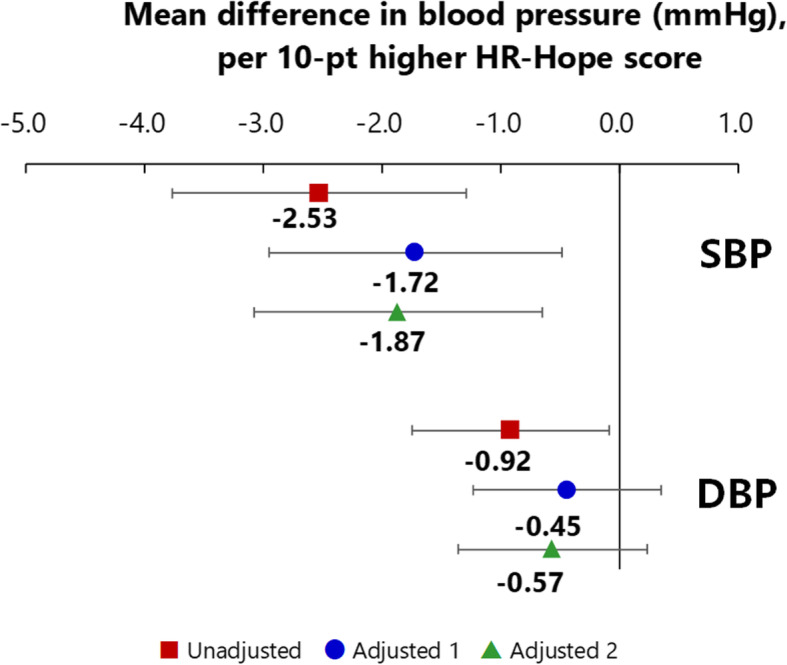
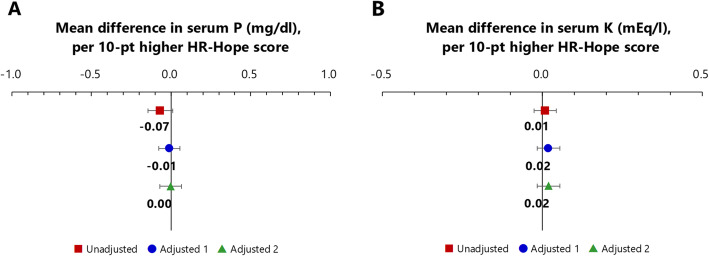
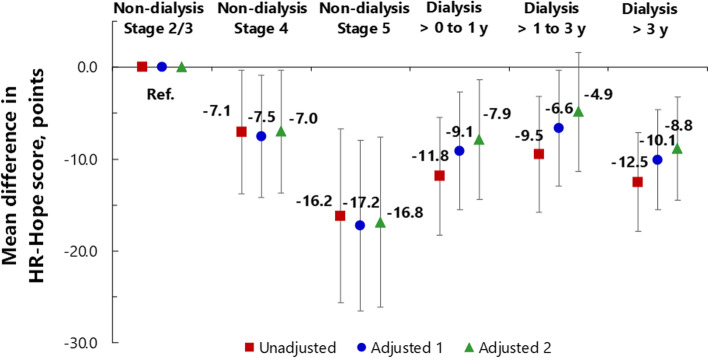
Results: Participants at non-dialysis stage 4 and those at stage 5 had lower HR-Hope scores than did those at stage 2 or 3 (combined). Those at non-dialysis stage 5 had the lowest scores. HR-Hope scores of participants at stage 5D were similar to those of participants at stage 4, but they were lower than the scores of participants at stage 2 or 3 (combined). Higher HR-Hope scores were associated with lower perceived burdens of fluid restriction and of diet restriction (adjusted ORs per ten-point difference were 0.82 and 0.84, respectively). Higher HR-Hope scores were associated with lower systolic BP (adjusted mean difference in systolic BP per ten-point difference in HR-Hope scores was - 1.87 mmHg). In contrast, HR-Hope scores were not associated with diastolic BP, serum phosphorus levels, or serum potassium levels.

Conclusions: Among CKD patients, HR-Hope is associated with disease stage, with psychological burden, and with some physiological manifestations of adherence.

Keywords: Adherence; Blood pressure; Chronic kidney disease; Dialysis; Diet restriction; Fluid restriction; Health-related hope; Quality of life.


Conflict of interest statement

NK, TW, YI, S. Fujimoto, M Yazawa, TS, KK, M Yanagi, HK, JG, S Fukuhara, and YS declare that they have no relevant financial interests.

Figures
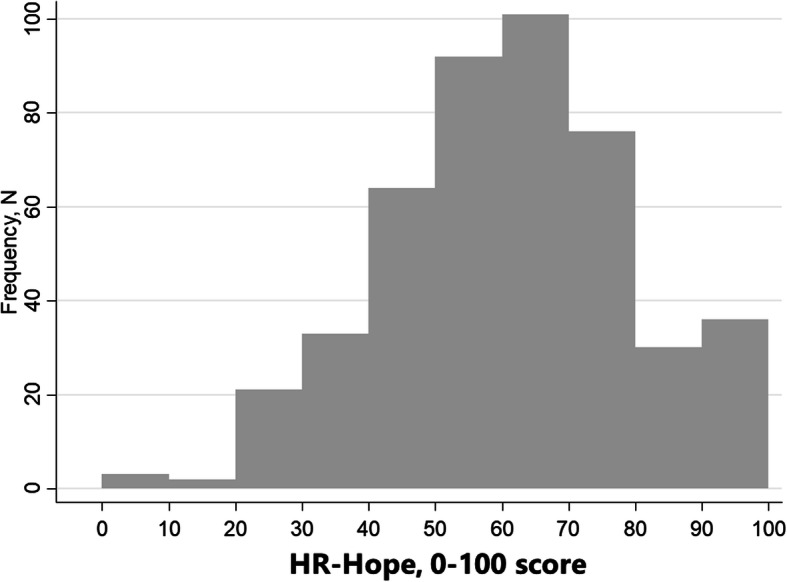
Fig. 1
Fig. 1
Distribution of HR-Hope scores
Fig. 2
Fig. 2
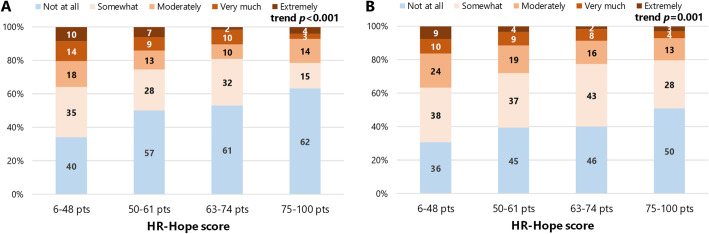
The distributions of degree of burdens of fluid or diet restriction by quartile-defined categories of HR-Hope score. A shows distributions of perceived burden of fluid restriction. B shows distributions of perceived burden of diet restriction. Vertical axes indicate proportions of responses. Numbers in each bar graph indicate absolute numbers of responses (n = 444). HR-Hope: health-related hope
Fig. 3
Fig. 3
Associations between HR-Hope and blood pressure. Red squares: unadjusted models. Blue circles: models adjusted for age, sex, performance status, presence of family, working status, and number of categories of prescribed antihypertensives (adjusted model 1). Green triangles: models adjusted for all of the variables listed above, and also for primary renal disease, diabetes, coronary artery disease, and cerebrovascular disease (adjusted model 2). Mean differences estimated via general linear models (n = 429 for systolic BP and n = 408 for diastolic BP). Error bars indicate 95% confidence intervals. HR-Hope: health-related hope; SBP: systolic blood pressure, DBP: diastolic blood pressure
Fig. 4
Fig. 4
Associations between HR-Hope and serum phosphorus or potassium levels. A: Association between HR-Hope and serum phosphorus. Red squares: unadjusted models. Blue circles: models adjusted for age, sex, performance status, presence of family, working status, and number of categories of prescribed phosphate binders (adjusted model 1). Green triangles: models adjusted for all of the variables listed above, and also for primary renal disease, diabetes, coronary artery disease, and cerebrovascular disease (adjusted model 2). B: Association between HR-Hope and serum potassium. Red squares: unadjusted models. Blue circles: models adjusted for age, sex, performance status, presence of family, working status, and number of categories of prescribed potassium binders (adjusted model 1). Green triangles: models adjusted for all of the variables listed above, and also for primary renal disease, diabetes, coronary artery disease, and cerebrovascular disease (adjusted model 2). Mean differences estimated via general linear models (n = 422 for phosphorus and n = 453 for potassium). Error bars indicate 95% confidence intervals. HR-Hope: health-related hope; P: phosphorus, K: potassium
Fig. 5
Fig. 5
Association between stage of kidney disease and HR-Hope scores. Red squares: unadjusted models. Blue circles: models adjusted for age, sex, performance status, presence of family, and working status (adjusted model 1). Green triangles: models adjusted for all of the variables listed above, and also for primary renal disease, diabetes, coronary artery disease, and cerebrovascular disease (adjusted model 2). Vertical axis indicates mean difference in HR-Hope scores. Error bars indicate 95% confidence intervals. The stages of kidney disease shown here are non-dialysis stages 2 and 3 (combined), which is the reference category, non-dialysis stage 4, non-dialysis stage 5, stage 5D with dialysis duration no longer than 1 year, stage 5D with dialysis duration greater than 1 but no longer than 3 years, and stage 5D with dialysis duration greater than 3 years. Mean differences estimated via general linear models (n = 458). HR-Hope: health-related hope

References

    1. Kurita N, Hayashino Y, Yamazaki S, Akizawa T, Akiba T, Saito A, et al. Revisiting Interdialytic weight gain and mortality association with serum albumin interactions: the Japanese dialysis outcomes and practice pattern study. J Ren Nutr. 2017;27(6):421–429. doi: 10.1053/j.jrn.2017.05.003. - DOI - PubMed
    1. Palmer SC, Hanson CS, Craig JC, Strippoli GF, Ruospo M, Campbell K, et al. Dietary and fluid restrictions in CKD: a thematic synthesis of patient views from qualitative studies. Am J Kidney Dis. 2015;65(4):559–573. doi: 10.1053/j.ajkd.2014.09.012. - DOI - PubMed
    1. Saran R, Bragg-Gresham JL, Rayner HC, Goodkin DA, Keen ML, Van Dijk PC, et al. Nonadherence in hemodialysis: associations with mortality, hospitalization, and practice patterns in the DOPPS. Kidney Int. 2003;64(1):254–262. doi: 10.1046/j.1523-1755.2003.00064.x. - DOI - PubMed
    1. Berg CJ, Rapoff MA, Snyder CR, Belmont JM. The relationship of children's hope to pediatric asthma treatment adherence. J Posit Psychol. 2007;2(3):176–184. doi: 10.1080/17439760701409629. - DOI
    1. Santos FR, Sigulem D, Areco KC, Gabbay MA, Dib SA, Bernardo V. Hope matters to the glycemic control of adolescents and young adults with type 1 diabetes. J Health Psychol. 2015;20(5):681–689. doi: 10.1177/1359105315573429. - DOI - PubMed

Publication types