


Impact of the COVID-19 Pandemic on Emergency Department Use: Focus on Patients Requiring Urgent Revascularization
- PMID: 33129611
- PMCID: PMC7598350
- DOI: 10.1016/j.jemermed.2020.09.042
Impact of the COVID-19 Pandemic on Emergency Department Use: Focus on Patients Requiring Urgent Revascularization
Abstract
Background: The novel coronavirus (2019-nCOV) appeared in China and precipitously extended across the globe. As always, natural disasters or infectious disease outbreaks have the potential to cause emergency department (ED) volume changes.
Objective: We aimed to assess the influence of the Coronavirus Disease 2019 (COVID-19) pandemic on ED visits and the impact on the handling of patients requiring urgent revascularization.
Methods: We reviewed the charts of all patients presenting to the ED of Hospital Sainte Anne (Toulon, France) from March 23 to April 5, 2020 and compared them with those of the same period in 2019. Then we analyzed complementary data on acute coronary syndrome (ST-elevation myocardial infarction [STEMI] and non-ST-elevation myocardial infarction [NSTEMI]) and neurovascular emergencies (strokes and transient ischemic attacks).
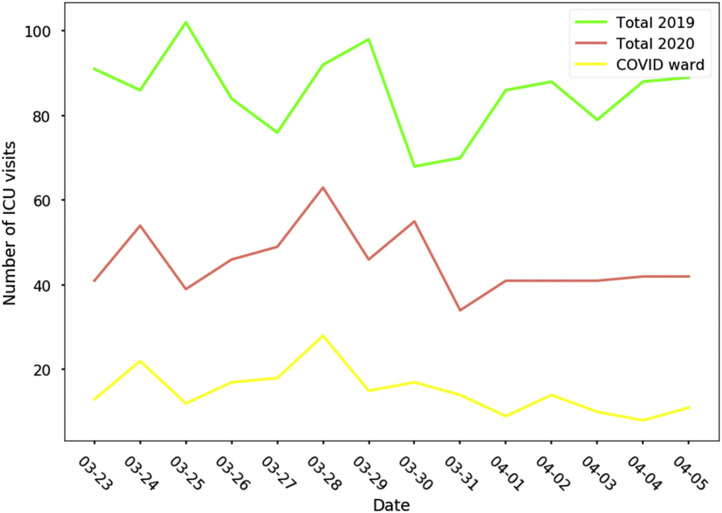
Results: The total number of visits decreased by 47%. The number of people assessed as triage level 2 was 8% lower in 2020. There were five fewer cases of NSTEMI in 2020, but the same number of STEMI. The number of neurovascular emergencies increased (27 cases in 2019 compared with 30 in 2020). We observed a reduction in the delay between arrival at the ED and the beginning of coronary angiography for STEMI cases (27 min in 2019 and 22 min in 2020). In 2020, 7 more stroke patients were admitted.
Conclusion: The COVID-19 pandemic probably dissuaded "non-critical" patients from coming to the hospital, whereas the same number of patients with a critical illness attended the ED as attended prior to the pandemic. There does not seem to have been any effect of the pandemic on patients requiring reperfusion therapy (STEMI and stroke).
Keywords: COVID-19; NSTEMI; STEMI; TIA; emergency department; stroke.
Copyright © 2020 Elsevier Inc. All rights reserved.
Figures

Comment in
-
Stroke With Delayed Visit to the Emergency Department: The Next Public Crisis?J Emerg Med. 2021 Jun;60(6):e147-e148. doi: 10.1016/j.jemermed.2020.12.027. J Emerg Med. 2021. PMID: 34147234 Free PMC article. No abstract available.
References
-
- World Health Organization (WHO) COVID-19 situation reports. https://www.who.int/emergencies/diseases/novel-coronavirus-2019/situatio... Available at:
-
- European Centre for Disease Prevention and Control (ECDC) Situation update worldwide, as of 26 April 2020. https://www.ecdc.europa.eu/en/geographical-distribution-2019-ncov-cases Available at:
Publication types
MeSH terms
LinkOut - more resources
Full Text Sources
Other Literature Sources
Medical
Research Materials
Miscellaneous
