. 2021 Mar;29(3):402-410.
doi: 10.1038/s41431-020-00748-y. Epub 2020 Oct 31.

Estimation of the number of people with Down syndrome in Europe

Affiliations

Estimation of the number of people with Down syndrome in Europe

Gert de Graaf et al. Eur J Hum Genet. 2021 Mar.

Erratum in

Abstract

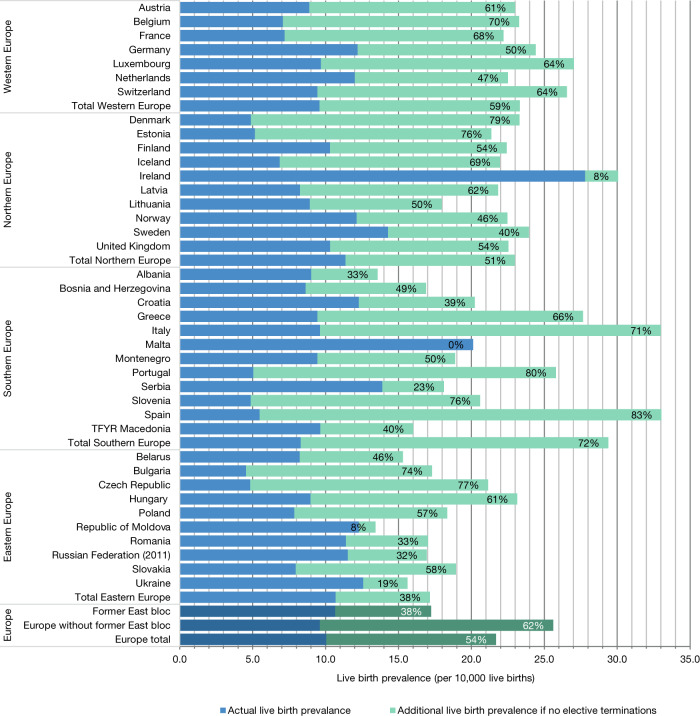
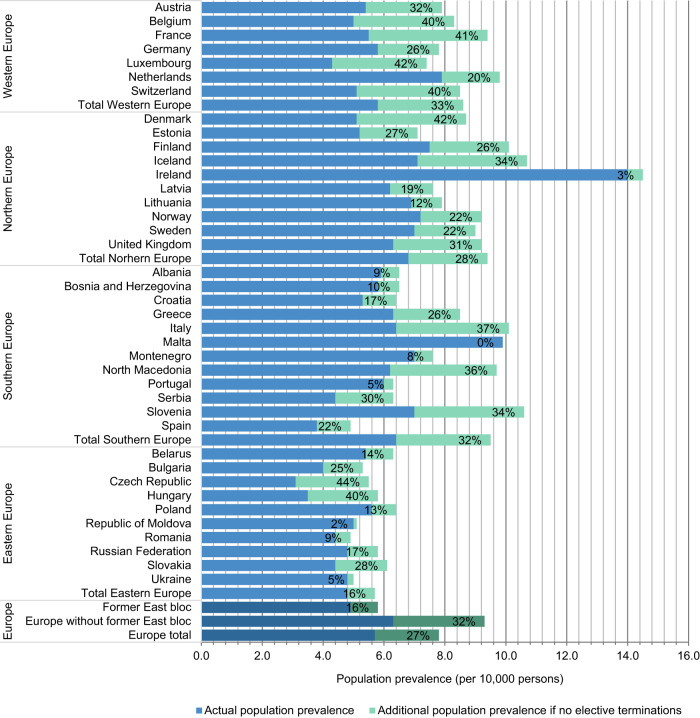
We aimed to estimate the nonselective live birth prevalence, actual live birth prevalence, reduction percentage because of selective terminations, and population prevalence for Down syndrome (DS) in European countries. The number of people with DS alive in a country was estimated by first modeling the number of live births of children with DS by year of birth. Subsequently, for these different years of birth, survival curves for people with DS were constructed and then applied to these yearly estimates of live births with DS. For Europe, 2011-2015, we estimate 8,031 annual live births of children with DS, which would have been around 17,331 births annually, absent selective terminations. The estimated reduction of live birth prevalence was, on average, 54%, varying between 0% in Malta and 83% in Spain. As of 2015, we estimate 417,000 people with DS are living in Europe; without elective terminations, there would have been about 572,000 people with DS, which corresponds to a population reduction rate of 27%. Such statistics can be important barometers for prenatal testing trends and resource allocation within countries. Disability awareness initiatives and public policy initiatives can also be better grounded with these more precise estimates.


Conflict of interest statement

Dr BGS occasionally consults on the topic of Down syndrome through Gerson Lehrman Group. He receives remuneration from Down syndrome non-profit organizations for speaking engagements and associated travel expenses. Dr BGS receives annual royalties from Woodbine House, Inc., for the publication of his book, Fasten Your Seatbelt: A Crash Course on Down Syndrome for Brothers and Sisters. Within the past 2 years, he has received research funding from F. Hoffmann-La Roche, Inc. and LuMind IDSC Down Syndrome Foundation to conduct clinical trials for people with Down syndrome. Dr BGS is occasionally asked to serve as an expert witness for legal cases where Down syndrome is discussed. Dr BGS serves in a non-paid capacity on the Honorary Board of Directors for the Massachusetts Down Syndrome Congress and the Professional Advisory Committee for the National Center for Prenatal and Postnatal Down Syndrome Resources. Dr BGS has a sister with Down syndrome. Dr GdG had a daughter with DS, who passed away in 2005 at the age of 15. He works as science and education officer at the Dutch Down Syndrome Foundation, a non-profit organization. FB serves a CEO of Down Syndrome Education International and Down Syndrome Education USA, nonprofits engaged in research and support for young people with Down syndrome. He has a sister with Down syndrome.

Figures

Fig. 1
Fig. 1. Live birth prevalence estimates of people with Down syndrome (DS) per 10,000 live births (2011–2015) and the effect of elective terminations.
Percentages denote the reduction due to DS-specific elective terminations.
Fig. 2
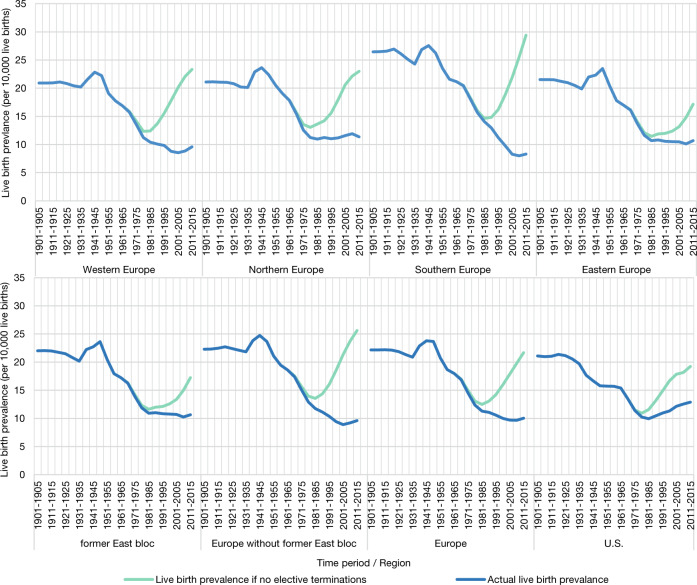
Fig. 2. Estimates of nonselective and actual live birth prevalence of children with Down syndrome per 10,000 live births, 1901–2015.
US comparison based on previously reported modelling [3, 4, 17], updated with recent data.
Fig. 3
Fig. 3. Population prevalence estimates of people with Down syndrome (DS) per 10,000 inhabitants (as of 2015) and the effect of elective terminations.
Model D used for former East bloc countries. Percentages denote the reduction due to DS-specific elective terminations.
Fig. 4
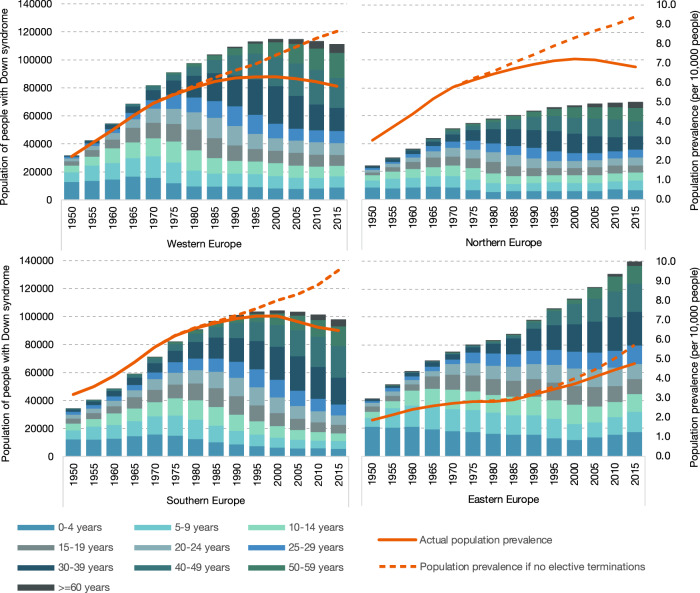
Fig. 4. Estimates of the actual numbers of people with Down syndrome (DS) by age, along with nonselective and actual population prevalence per 10,000 inhabitants.
Model D used for former East bloc countries.

References

    1. Gregg AR, Skotko BG, Benkendorf JL, Monaghan KG, Bajaj K, Best RG, et al. Noninvasive prenatal screening for fetal aneuploidy, 2016 update: a position statement of the American College of Medical Genetics and Genomics. Genet Med. 2016;18:1056–65. doi: 10.1038/gim.2016.97. - DOI - PubMed
    1. Committee on Practice Bulletins—Obstetrics, Committee on Genetics, and the Society for Maternal-Fetal Medicine Practice bulletin no. 163 summary: screening for fetal Aneuploidy. Obstet Gynecol. 2016;127:979–81. doi: 10.1097/AOG.0000000000001439. - DOI - PubMed
    1. de Graaf G, Buckley F, Skotko BG. Estimates of the live births, natural losses, and elective terminations with Down syndrome in the United States. Am J Med Genet A. 2015;167:756–67. doi: 10.1002/ajmg.a.37001. - DOI - PubMed
    1. de Graaf G, Buckley F, Skotko BG. Estimation of the number of people with Down syndrome in the United States. Genet Med. 2017;19:439–47. doi: 10.1038/gim.2016.127. - DOI - PubMed
    1. Boyd PA, Devigan C, Khoshnood B, Loane M, Garne E, Dolk H, et al. Survey of prenatal screening policies in Europe for structural malformations and chromosome anomalies, and their impact on detection and termination rates for neural tube defects and Down’s syndrome. BJOG Int J Obstet Gynaecol. 2008;115:689–96. doi: 10.1111/j.1471-0528.2008.01700.x. - DOI - PMC - PubMed