Comparative Study
. 2020 Nov;41(11):1197-1203.
doi: 10.15537/smj.2020.11.25457.

Effects of the Coronavirus disease 2019 pandemic on routine pediatric immunization coverage rates at the main University Hospital in Saudi Arabia

Affiliations
Comparative Study

Effects of the Coronavirus disease 2019 pandemic on routine pediatric immunization coverage rates at the main University Hospital in Saudi Arabia

Abdulkarim A Alrabiaah et al. Saudi Med J. 2020 Nov.

Abstract

Objectives: To investigate whether the coronavirus disease-2019 pandemic has had any effects on pediatric vaccination rates at the main university hospital in Saudi Arabia.

Methods: A retrospective study conducted at King Saud University Medical City, Riyadh, Saudi Arabia using electronic health records. The vaccination statuses of all children who were scheduled for vaccinations at birth and at 2, 4, 6, 9, and 12 months during March, April and May between 2017 and 2020 were included in the study with total sample of 15,870 children, and comparisons between the cohorts were performed.

Results: All vaccination visits during April and May 2020 were below the lower extremes except for the birth vaccinations. In March, April, and May 2020 there were respective drops in vaccination visits of 49.93%, 71.90% and 68.48% compared with the mean numbers of vaccination visits during the same months from 2017 to 2019. In comparisons of mean numbers of visits from March 2017 to May 2019 and March to May in 2020, the respective reductions in visits for birth and 2, 4, 6, 9 and 12-month vaccinations were 16.5%, 80.5%, 74.7%, 72.9%, 80.0% and 74.1%.

Conclusions: The huge impact of the coronavirus disease-2019 pandemic on childhood vaccinations will require urgent vaccination recovery plans with innovative approaches and future action plans to maintain vaccination coverage during any subsequent pandemics.


Figures
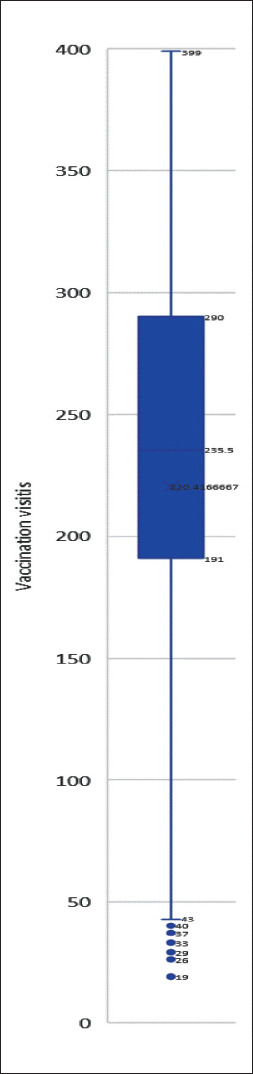
Figure 1
Figure 1
Box and whisker plot representing monthly vaccination visits during March-May 2017-2020.
Figure 2
Figure 2
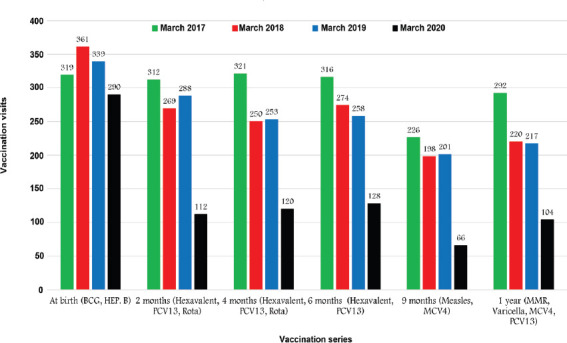
Bar chart representing vaccination visits for the primary vaccination series during the month of March from 2017 to 2020. There were substantial drops in the numbers of all types of vaccinations during March 2020 except for birth vaccinations. Hexavalent vaccine includes hepatitis B, diphtheria, tetanus, acellular pertussis, Haemophilus influenzae type b and inactivated poliovirus, MCV4: quadruple conjugated meningococcus vaccine, PCV13: pneumococcal conjugate vaccine, MMR: measles, mumps, rubella
Figure 3
Figure 3
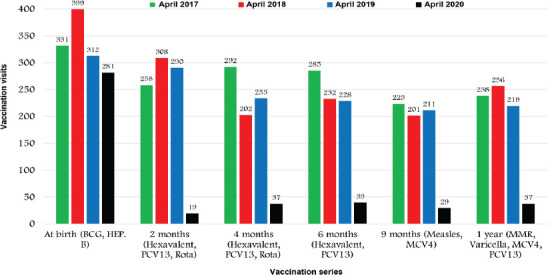
Bar chart representing vaccination visits for the primary vaccination series during the month of April from 2017 to 2020. There were substantial drops in the numbers of all types of vaccinations during March 2020 except for birth vaccinations. Hexavalent vaccine includes hepatitis B, diphtheria, tetanus, acellular pertussis, Haemophilus influenzae type b and inactivated poliovirus, MCV4: quadruple conjugated meningococcus vaccine, PCV1: pneumococcal conjugate vaccine, MMR: measles, mumps, rubella
Figure 4
Figure 4
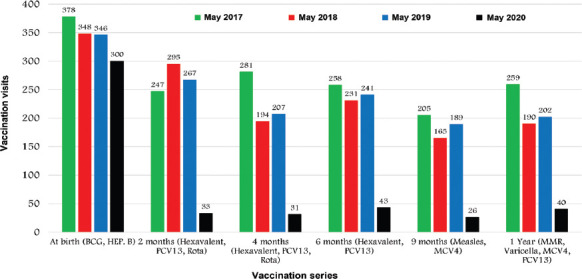
Bar chart representing vaccination visits for the primary vaccination series during the month of May from 2017 to 2020. There were substantial drops in the numbers of all types of vaccinations during March 2020 except for birth vaccinations. Hexavalent vaccine includes hepatitis B, diphtheria, tetanus, acellular pertussis, Haemophilus influenzae type b, and inactivated poliovirus, MCV4: quadruple conjugated meningococcus vaccine, PCV13: pneumococcal conjugate vaccine, MMR: measles, mumps, rubella.

References

    1. Andre FE, Booy R, Bock HL, et al. Vaccination greatly reduces disease, disability, death and inequity worldwide. Bull World Health Organ. 2008;86:140–146. - PMC - PubMed
    1. Ozawa S, Mirelman A, Stack ML, Walker DG, Levine OS. Cost-effectiveness and economic benefits of vaccines in low- and middle-income countries:a systematic review. Vaccine. 2012;31:96–108. - PubMed
    1. Li X, Mukandavire C, Cucunubá ZM, Abbas K, Clapham HE, Jit M, et al. Estimating the health impact of vaccination against 10 pathogens in 98 low and middle income countries from 2000 to 2030. medRxiv. 2019 Aug 27;:19004358. - PMC - PubMed
    1. World Health Organization. Immunization agenda 2030: a global strategy to leave no one behind. cited 2020 April. Available from: https://www.who.int/immunization/immunization_agenda_2030/en/
    1. Roberton T, Carter ED, Chou VB, Stegmuller A, Jackson BD Y, et al. Early estimates of the indirect effects of the COVID-19 pandemic on maternal and child mortality in low-income and middle-income countries:a modelling study. Lancet Glob Health. 2020;8:e901–e908. - PMC - PubMed

Publication types

MeSH terms