. 2020 Oct 2:12:590403.
doi: 10.3389/fnsyn.2020.590403. eCollection 2020.

The Synapse Diversity Dilemma: Molecular Heterogeneity Confounds Studies of Synapse Function

Affiliations

The Synapse Diversity Dilemma: Molecular Heterogeneity Confounds Studies of Synapse Function

Seth G N Grant et al. Front Synaptic Neurosci. .

Abstract

Recent studies have shown an unexpectedly high degree of synapse diversity arising from molecular and morphological differences among individual synapses. Diverse synapse types are spatially distributed within individual dendrites, between different neurons, and across and between brain regions, producing the synaptome architecture of the brain. The spatial organization of synapse heterogeneity is important because the physiological activation of heterogeneous excitatory synapses produces a non-uniform spatial output of synaptic potentials, which confounds the interpretation of measurements obtained from population-averaging electrodes, optrodes and biochemical methods that lack single-synapse resolution. Population-averaging measurements cannot distinguish between changes in the composition of populations of synapses and changing synaptic physiology. Here we consider the implications of synapse diversity and its organization into synaptome architecture for studies of synapse physiology, plasticity, development and behavior, and for the interpretation of phenotypes arising from pharmacological and genetic perturbations. We conclude that prevailing models based on population-averaging measurements need reconsideration and that single-synapse resolution physiological recording methods are required to confirm or refute the major synaptic models of behavior.

Keywords: LTP; electrophysiology; synapse heterogeneity; synapse proteome; synaptic computation; synaptome.


Figures

FIGURE 1
FIGURE 1
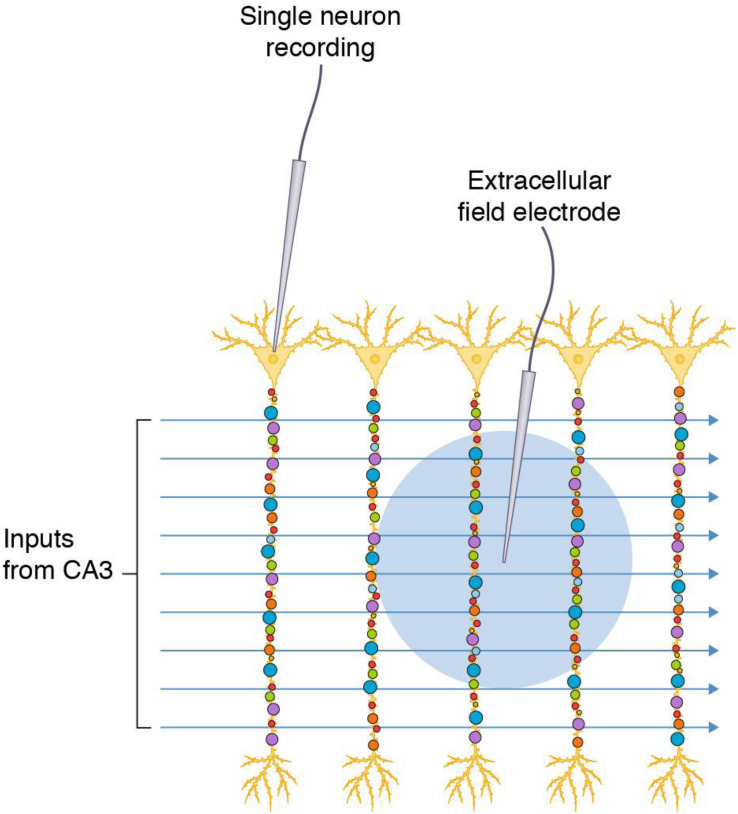
Commonly used electrophysiological methods record responses from synapse populations and do not inform on individual synapses. Populations of diverse synapses in the CA1 stratum radiatum of the hippocampal formation (small colored circles) are distributed on the apical dendrites of pyramidal neurons. Axon inputs from CA3 are stimulated and recording electrodes access populations of synapses in a single neuron by direct recording or populations of neurons by recording in the extracellular space (blue circle indicates the area from which synaptic potentials are detected).
FIGURE 2
FIGURE 2
Populations of (A) homogeneous and (B) heterogeneous synapses can show the same overall response. The key shows three synapse types and their strength. Σpop, summed response for each population.
FIGURE 3
FIGURE 3
LTP and LTD in populations of (A) homogeneous and (B) heterogeneous synapses. The strength of the synapse populations in Figure 2 are shown before (naïve) and after LTP (Stim 1) and LTD (Stim 2) induction. Although both homogeneous and heterogeneous populations show LTP and LTD, only some synapses in the heterogeneous populations reflect the population measure and subpopulations of synapses can show opposite phenotypes (i.e., LTD in individual synapses when the population shows LTP, and vice versa). The key shows three synapse types and their strength. Σpop, summed response for each population.
FIGURE 4
FIGURE 4
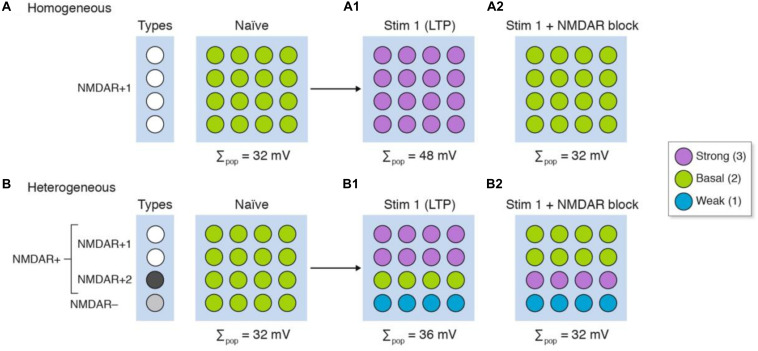
The differing molecular composition of individual synapses confounds the interpretation of signaling mechanisms. Three types of synapse are illustrated in four rows: NMDAR+ synapses, which express the NMDA receptor, are divided into NMDAR+1 synapses that have an enzyme used for NMDAR induction of LTP, and NMDAR+2 synapses which lack the enzyme; and NMDAR− synapses that do not express NMDA receptors but can be weakened by synaptic stimulation. After stimulation (Stim 1), LTP is induced in all the homogeneous synapses (A1) but in only half the heterogeneous synapse populations (B1) even though LTP is measured in the whole population. The same experiment performed in the presence of an NMDA receptor blocker (A2,B2) shows that the population measure of LTP is blocked. However, there are synaptic physiological changes in the heterogeneous population that remain undetected (B2).
FIGURE 5
FIGURE 5
Synaptome reprograming by gene mutations alters the spatial distribution of heterogeneous synapses. The wild-type synaptome map, which is composed of three synapse types, provides an overall population measure (Σpop) after LTP induction of 36 mV. With mutation 1, the spatial distribution of synapses has changed but the total LTP is the same as for wild type (Σpop = 36 mV). Mutation 2, however, has altered the representation of synapse types (more type 1 and fewer type 2) and an LTP-inducing stimulus shows less LTP than the wild type.

References

    1. Altschuler S. J., Wu L. F. (2010). Cellular heterogeneity: do differences make a difference? Cell 141 559–563. 10.1016/j.cell.2010.04.033 - DOI - PMC - PubMed
    1. Basu J., Siegelbaum S. A. (2015). The corticohippocampal circuit, synaptic plasticity, and memory. Cold Spring Harb. Perspect. Biol. 7:a021733. 10.1101/cshperspect.a021733 - DOI - PMC - PubMed
    1. Bayes A., Collins M. O., Croning M. D. R., van de Lagemaat L. N., Choudhary J. S., Grant S. G. N. (2012). Comparative study of human and mouse postsynaptic proteomes finds high compositional conservation and abundance differences for key synaptic proteins. PLoS One 7:e46683. 10.1371/journal.pone.0046683 - DOI - PMC - PubMed
    1. Bayes A., Collins M. O., Reig-Viader R., Gou G., Goulding D., Izquierdo A., et al. (2017). Zebrafish synapse proteome complexity, evolution and ultrastructure. Nat. Commun. 8:14613. 10.1038/ncomms14613 - DOI - PMC - PubMed
    1. Bayes A., van de Lagemaat L. N., Collins M. O., Croning M. D. R., Whittle I. R., Choudhary J. S., et al. (2011). Characterization of the proteome, diseases and evolution of the human postsynaptic density. Nat. Neurosci. 14 19–21. 10.1038/nn.2719 - DOI - PMC - PubMed

LinkOut - more resources