Review
. 2020 Sep 29:11:570628.
doi: 10.3389/fendo.2020.570628. eCollection 2020.

Ceramides and Ceramide Scores: Clinical Applications for Cardiometabolic Risk Stratification

Affiliations
Review

Ceramides and Ceramide Scores: Clinical Applications for Cardiometabolic Risk Stratification

Mika Hilvo et al. Front Endocrinol (Lausanne). .

Abstract

Ceramides are bioactive lipids that have an important role in many cellular functions such as apoptosis and inflammation. During the past decade emerging clinical data have shown that ceramides are not only of great biochemical interest but may also have diagnostic utility. Ceramides have shown independent predictive value for negative cardiovascular outcomes as well as for the onset of type 2 diabetes. Based on abundant published data, risk score using the concentrations of circulating ceramides have been developed and adapted for routine clinical practice. Currently serum ceramides are used clinically as efficient risk stratifiers for primary and secondary prevention of atherosclerotic cardiovascular disease (CVD). A direct cause-effect relationship between CVD and ceramide has not been established to date. As ceramide-specific medications are being developed, conventional strategies such as lipid lowering agents and lifestyle interventions can be used to reduce overall risk. Ceramides can identify a very high-risk coronary heart disease category of patients in need for more intense medical attention, specifically those patients at higher risk as highlighted in the 2019 European Society of Cardiology guidelines for stable chronic coronary syndrome patients. In addition, the ceramide risk score may be used as a decision-making tool in primary prevention patients with moderate CVD risk. Finally, the ceramide risk score may have a unique utility as a motivational tool to increase patient's adherence to medical therapy and lifestyle changes.

Keywords: cardiovascular disease; ceramide; ceramide score; coronary heart disease; diabetes mellitus; heart failure; stroke.


Figures

Figure 1
Figure 1
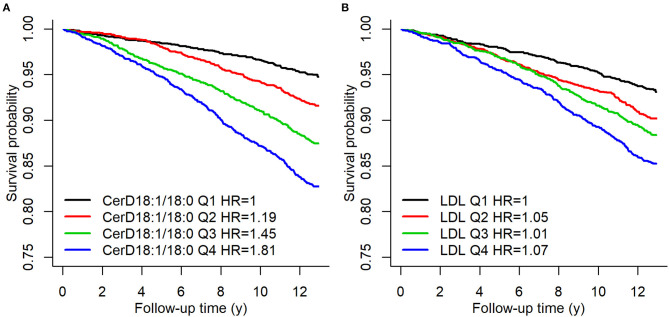
Kaplan–Meier estimates of incident MACE Cer(d18:1/18:0) and LDL-C quartiles. A hazard ratio in the legend indicates the quartile specific hazard relative to the 1st quartile (models stratified for sex). Figure from Havulinna et al. (21). Figure reproduced under the terms of the Creative Commons Attribution License.
Figure 2
Figure 2
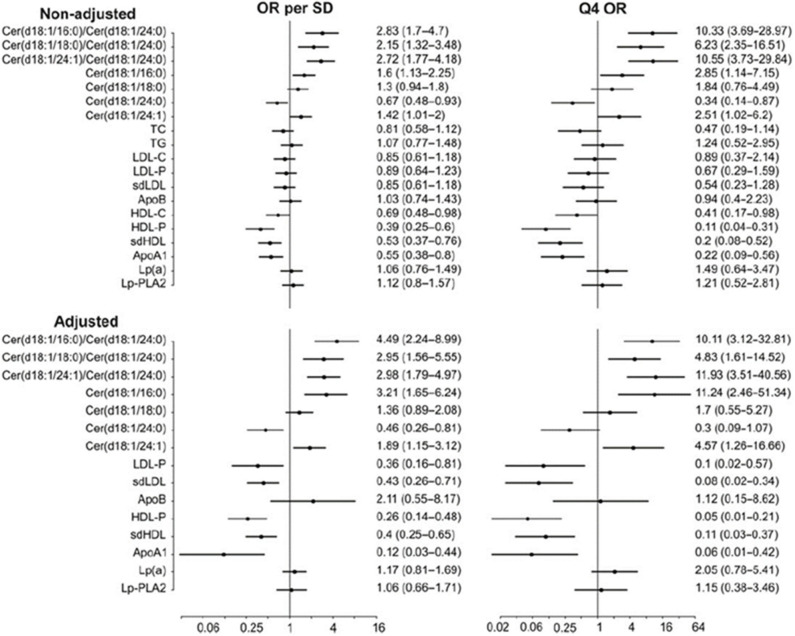
CV death odds ratios for per standard deviation and 4th quartile for different lipid markers and ceramides in the COROGENE study. Adjustment is made for TC, TG, LDL-C, HDL-C, and CRP. Figure from Laaksonen et al. (13). Figure reproduced under the terms of the Creative Commons Attribution License.
Figure 3
Figure 3
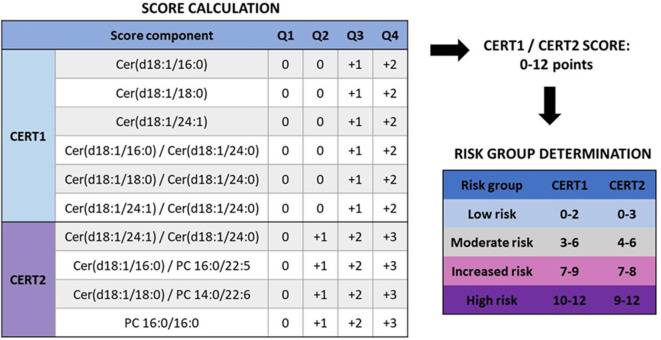
Calculation of CERT2 risk scores and determination of CVD risk groups (14). When determining the score for a subject, it is evaluated to which quartile the person belongs with regards to each score component. CERT1 has six components, and only quartiles 3 and 4 give points, while CERT2 has only 4 components but already the second quartile yields a risk point. Thus, the scale for both of these scores is the same, 0–12 points. Based on these the subject is categorized to one of the CVD risk categories. Figure reproduced under the terms of the Creative Commons Attribution License.
Figure 4
Figure 4
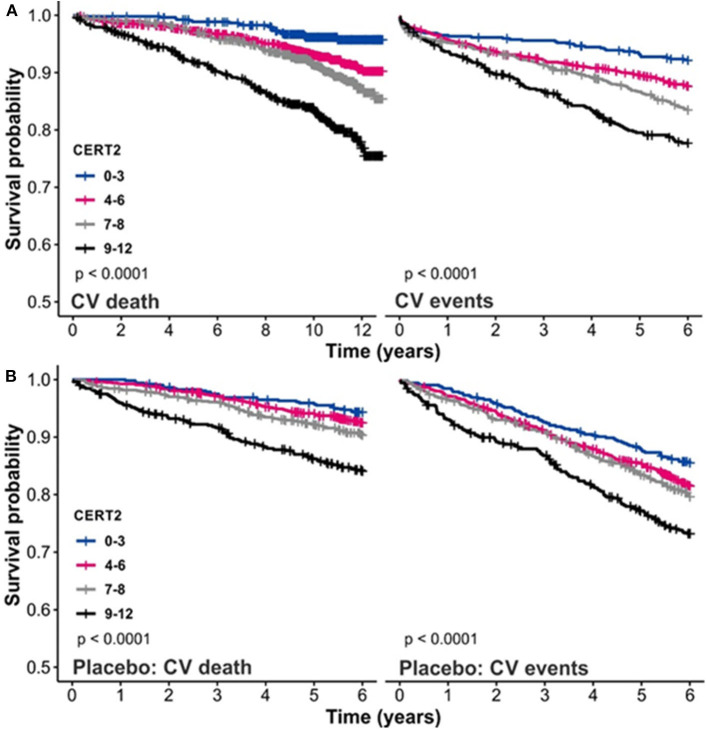
Kaplan–Meier curves for CERT2 (A) in the WECAC cohort and (B) in the placebo treatment arm in the LIPID trial. Figure adapted from Hilvo et al. (14). Figure reproduced under the terms of the Creative Commons Attribution License.
Figure 5
Figure 5
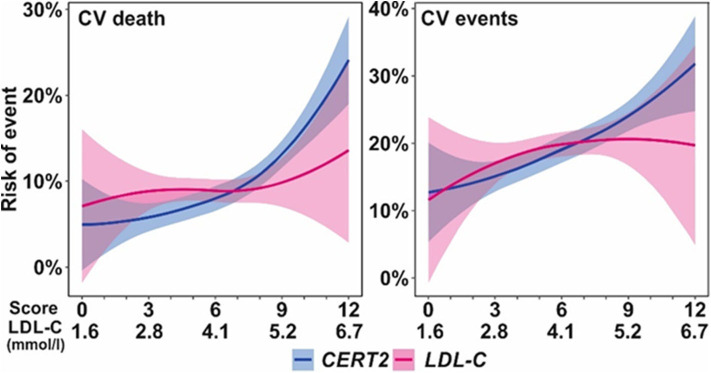
Risk (6 years) curves for CERT2 and LDL-C in the LIPID trial placebo treatment arm. Figure adapted from Hilvo et al. (14). Figure reproduced under the terms of the Creative Commons Attribution License.
Figure 6
Figure 6
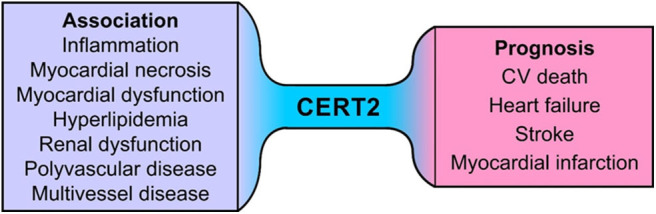
Association of CERT2 with pathophysiological processes and cardiovascular outcomes.

References

    1. Turpin-Nolan SM, Brüning JC. The role of ceramides in metabolic disorders: when size and localization matters. Nat Rev Endocrinol. (2020) 16:224–33. 10.1038/s41574-020-0320-5 - DOI - PubMed
    1. Albeituni S, Stiban J. Roles of ceramides and other sphingolipids in immune cell function and inflammation. Adv Exp Med Biol. (2019) 1161:169–91. 10.1007/978-3-030-21735-8_15 - DOI - PubMed
    1. Castro BM, Prieto M, Silva LC. Ceramide: a simple sphingolipid with unique biophysical properties. Prog Lipid Res. (2014) 54:53–67. 10.1016/j.plipres.2014.01.004 - DOI - PubMed
    1. Mullen TD, Obeid LM. Ceramide and apoptosis: exploring the enigmatic connections between sphingolipid metabolism and programmed cell death. Anticancer Agents Med Chem. (2012) 12:340–63. 10.2174/187152012800228661 - DOI - PubMed
    1. Gomez-Muñoz A, Presa N, Gomez-Larrauri A, Rivera IG, Trueba M, Ordoñez M. Control of inflammatory responses by ceramide, sphingosine 1-phosphate and ceramide 1-phosphate. Prog Lipid Res. (2016) 61:51–62. 10.1016/j.plipres.2015.09.002 - DOI - PubMed