


Lidose-Isotretinoin Administered Without Food Improves Quality of Life in Patients With Severe Recalcitrant Nodular Acne: An Open-Label, Single-Arm, Phase IV Study
- PMID: 33133336
- PMCID: PMC7577326
Lidose-Isotretinoin Administered Without Food Improves Quality of Life in Patients With Severe Recalcitrant Nodular Acne: An Open-Label, Single-Arm, Phase IV Study
Abstract
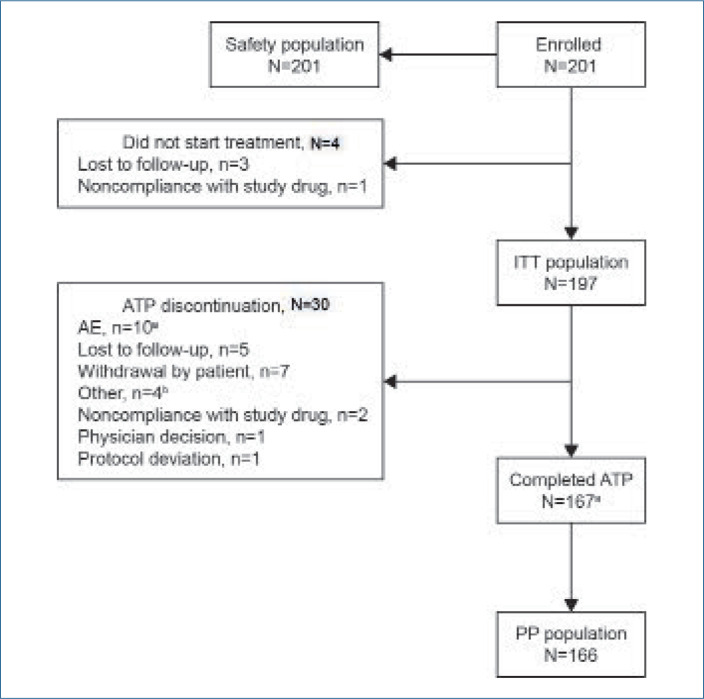
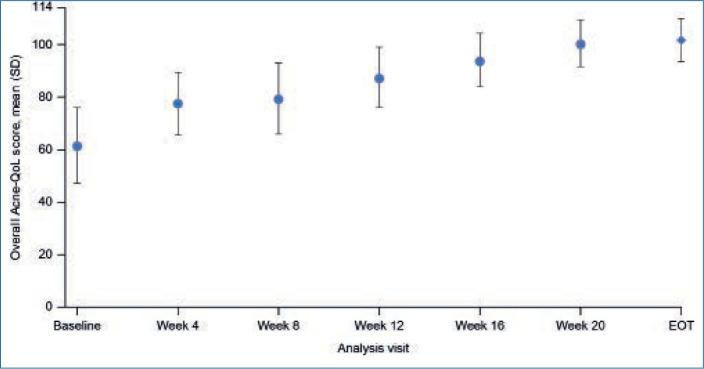
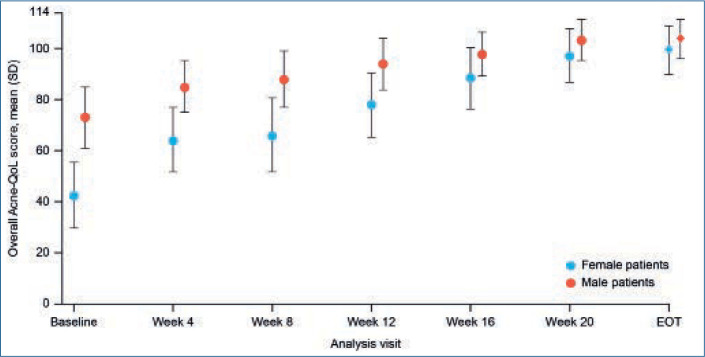
OBJECTIVE: We sought to assess the impact of Lidose-isotretinoin taken without food on patient quality of life (QoL) at baseline, monthly intervals, and end of study in patients with severe recalcitrant nodular acne. DESIGN: In this open-label, single-arm, multicenter study, 197 patients took twice-daily Lidose-isotretinoin without food for 20 weeks (120-150mg/kg cumulative dosage). Patient visits occurred at Weeks 2, 4, 8, 12, 16, and 20. At baseline and Weeks 4, 8, 12, 16, and 20, patients underwent QoL and acne severity assessments and lesion counts. SETTING: Participants were enrolled from 21 sites across the United States. PARTICIPANTS: Eligible participants were 12 to 45 years of age, weighing 40 to 110kg, and with e;5 facial nodules and no prior exposure to systemic retinoids, including isotretinoin. Female participants were nonpregnant and nonlactating. MEASUREMENTS: An acne-specific QoL questionnaire (Acne-QoL) was used to assess QoL. Efficacy endpoints were lesion counts and Investigator Global Assessment (IGA) of acne severity. Safety assessments included reported adverse events. RESULTS: Lidose-isotretinoin taken without food significantly improved mean (standard deviation) overall Acne-QoL score from baseline (61.6 [28.7]) to end of treatment (101.8 [16.9]; P<0.0001). Improvements were shown in both male and female patients. Significant improvements in patient QoL (overall and by questionnaire domain), lesion counts, and IGA scores were observed as early as Week 4 and continued to improve throughout treatment. CONCLUSION: Twice-daily Lidose-isotretinoin taken without food for 20 weeks significantly improved patient QoL from Week 4.
Keywords: Acne; Investigator Global Assessment; Lidose-isotretinoin; isotretinoin; lesions; quality of life.
Copyright © 2020. Matrix Medical Communications. All rights reserved.
Conflict of interest statement
FUNDING:The study was funded by Sun Pharmaceutical Industries, Inc., Princeton, New Jersey. DISCLOSURES:ALZ has received grants from, and/or served as a consultant/advisor and/or investigator for Abbvie, Allergan, Incyte, Innovaderm, Ortho Dermatologics, Pfizer, and Ranbaxy/Sun Pharmaceuticals. JS is an employee of Sun Pharmaceutical Industries, Inc. CD is a contracted consultant to Sun Pharma Advanced Research Company Ltd. JQD has received grants from, and/or served as a consultant/advisor, investigator, and/or speaker for Abbvie, Aclaris, Almirall, Athenex, BioPharmX, Botanix, Cassiopeia, Celgene, Cutanea (Biofrontera), Dermira, Encore, EPI Health, Ferndale, Foamix, Galderma, Genentech, LaRoche Posay, Leo Pharma, Menlo Therapeutics, Novan, Ortho Dermatologics, Pfizer, Promius, Regeneron, Sanofi/Genzyme, Sonoma (Intraderm), Sol Gel, Sun Pharmaceuticals, and Verrica.
Figures
References
-
- Ingram J, Grindlay D, Williams H. Management of acne vulgaris: an evidence-based update. Clin Exp Dermatol. 2010;35(4):351–354. - PubMed
-
- AAD site. Dermatologist evaluates latest isotretinoin developments for treatment of severe acne. 2014. https://www.aad.org/media/news-releases/dermatologist-evaluates-latest-i... Accessed 11 Aug 2020.
-
- Merritt B, Burkhart C, Morrell D. Use of isotretinoin for acne vulgaris. Pediatr Ann. 2009;38(6):311–320. - PubMed
-
- Marron S, Tomas-Aragones L, Boira S. Anxiety, depression, quality of life and patient satisfactions in acne patients treated with oral isotretinoin. Acta Derm Venereol. 2013;93:701–706. - PubMed
-
- ACCUTANE® (isotretinoin) capsules. Prescribing information. Roche Laboratories Inc. 2008.
LinkOut - more resources
Full Text Sources
Miscellaneous