Review
. 2020 Sep 29:8:579073.
doi: 10.3389/fcell.2020.579073. eCollection 2020.

Protrusion-Mediated Signaling Regulates Patterning of the Developing Nervous System

Affiliations
Review

Protrusion-Mediated Signaling Regulates Patterning of the Developing Nervous System

Rachel E Moore et al. Front Cell Dev Biol. .

Abstract

During brain development, the tissue pattern and specification are the foundation of neuronal circuit formation. Contact-mediated lateral inhibition is well known to play an important role in determining cell fate decisions in the nervous system by either regulating tissue boundary formation or the classical salt-and-pepper pattern of differentiation that results from direct neighboring cell contacts. In many systems, however, such as the Drosophila notum, Drosophila wing, zebrafish pigmented cells, and zebrafish spinal cord, the differentiation pattern occurs at multiple-cell diameter distances. In this review, we discuss the evidence and characteristics of long-distance patterning mechanisms mediated by cellular protrusions. In the nervous system, cellular protrusions deliver the Notch ligand Delta at long range to prevent cells from differentiating in their vicinity. By temporal control of protrusive activity, this mechanism can pattern differentiation in both space and time.

Keywords: long distance signaling; nervous system; neurogenesis; neuronal patterning; neuronal spacing; protrusion mediated signaling.


Figures

FIGURE 1
FIGURE 1
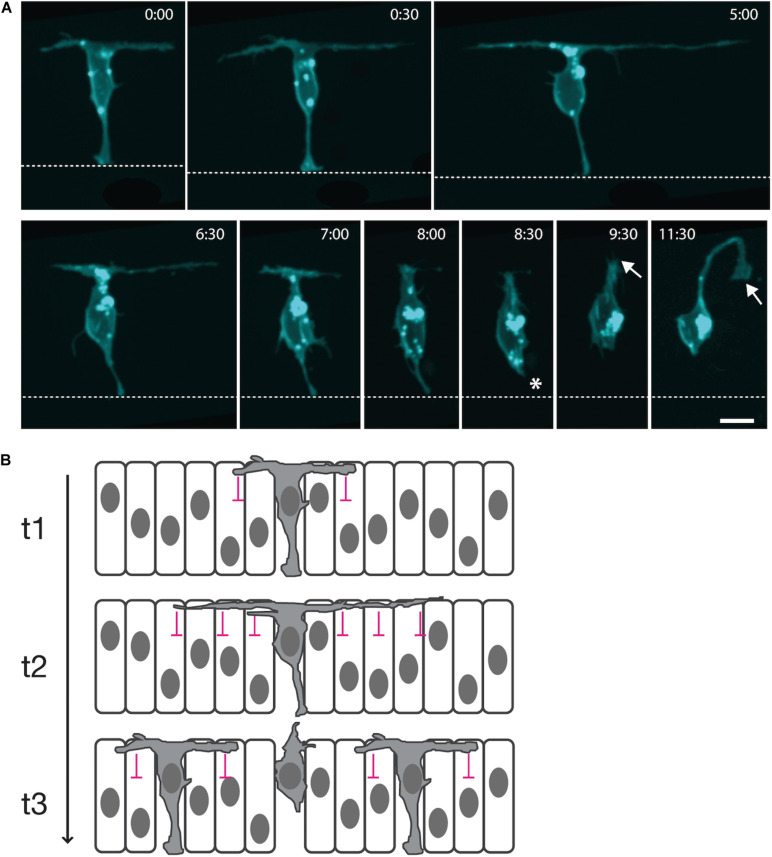
Long cellular protrusions play a role in the spatiotemporal patterning of zebrafish spinal neuron differentiation. (A) Live in vivo imaging in the zebrafish embryonic spinal cord of a single neuron labeled with a membrane marker. The cell body positions to the basal surface of the neuroepithelium while maintaining an attachment to the apical surface (dashed line; 0:00). The neuron extends two long protrusions along the basal surface, one anteriorly and one posteriorly (0:00–5:00). Each basal protrusion spans several-cell diameters. Both are retracted into the cell body (6:30–8:00), along with the apical attachment (asterisk; 8:30), before the neuron extends an axon (arrow; 9:30–11:30). (B) Diagrammatic working model of transient long-distance lateral inhibition delivered via basal protrusions. t1: A differentiating neuron expresses Delta (gray cytoplasm) and begins to extend basal protrusions. Delta signaling from the basal protrusions induces Notch signaling in the neighboring neuroepithelial cells that they contact, inhibiting their neuronal differentiation (lateral inhibition delivered by basal protrusions is represented by pink signs). t2: The basal protrusions grow to span several-cell diameters and inhibit the neuronal differentiation of neuroepithelial progenitors at a distance. t3: Retraction of the basal protrusions occurs before axon initiation, releasing the neuroepithelial cells that receive least contact with basal protrusions to differentiate.

References

    1. Batista M. F., Jacobstein J., Lewis K. E. (2008). Zebrafish V2 cells develop into excitatory CiD and Notch signalling dependent inhibitory VeLD interneurons. Dev. Biol. 322 263–275. 10.1016/j.ydbio.2008.07.015 - DOI - PubMed
    1. Briscoe J., Small S. (2015). Morphogen rules: design principles of gradient-mediated embryo patterning. Development 142 3996–4009. 10.1242/dev.129452 - DOI - PMC - PubMed
    1. Cayuso J., Xu Q., Wilkinson D. G. (2015). Mechanisms of boundary formation by Eph receptor and ephrin signaling. Dev. Biol. 401 122–131. 10.1016/j.ydbio.2014.11.013 - DOI - PubMed
    1. Chapouton P., Skupien P., Hesl B., Coolen M., Moore J. C., Madelaine R., et al. (2010). Notch activity levels control the balance between quiescence and recruitment of adult neural stem cells. J. Neurosci. 30 7961–7974. 10.1523/JNEUROSCI.6170-09.2010 - DOI - PMC - PubMed
    1. Cohen M., Georgiou M., Stevenson N. L., Miodownik M., Baum B. (2010). Dynamic filopodia transmit intermittent Delta-Notch signaling to drive pattern refinement during lateral inhibition. Dev. Cell 19 78–89. 10.1016/j.devcel.2010.06.006 - DOI - PubMed

LinkOut - more resources