


Increases in BMI and chronic pain for US adults in midlife, 1992 to 2016
- PMID: 33134473
- PMCID: PMC7585155
- DOI: 10.1016/j.ssmph.2020.100644
Increases in BMI and chronic pain for US adults in midlife, 1992 to 2016
Abstract
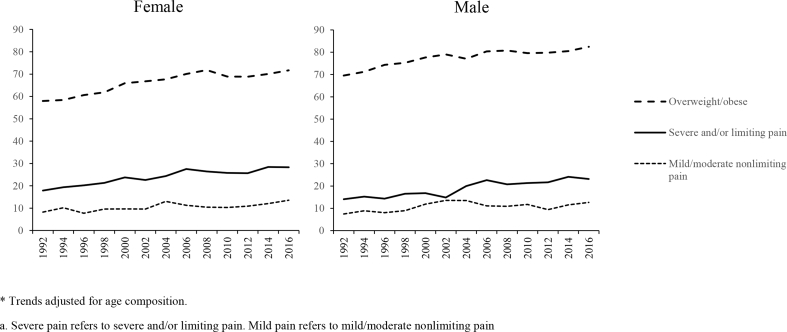
Recent unprecedented increases in mortality and morbidity during midlife are often ascribed to rising despair in the US population. An alternative and less often examined explanation is that these trends reflect, at least in part, the lagged effects of the obesity epidemic. Adults in midlife today are more likely to live with obesity and have a greater cumulative exposure to excess adiposity during their lifetime than any previous generation. Prior work has demonstrated a link between obesity and mortality risk at midlife, but the mechanisms remain unclear. Pain may represent one important pathway linking obesity to mortality trends. Pain is a debilitating condition that has increased significantly over recent decades and is associated with both morbidity and mortality, including suicide and opioid-related mortality. Evidence suggests obesity and pain may be linked, but there is little evidence of an association at the population level. In this paper, we examine to what extent increases in overweight and obesity explain the rising trends in chronic pain observed among middle-aged adults in the US from 1992 to 2016. We assess trends in both mild/moderate nonlimiting pain and severe and/or limiting pain. In doing so, we draw attention to one mechanism through which overweight/obesity may have contributed to recent population health trends. Our analysis found that increases in BMI from 1992 to 2016 may account for up to 20% of the upward trend in mild/moderate nonlimiting pain and 32% of the trend in severe and/or limiting pain for women, and 10% and 19% of the trends respectively for men.
Keywords: Activity limitations; Obesity; Pain; Trends.
© 2020 The Authors.
Figures
References
-
- Clark D.J., Schumacher M.A. America's opioid epidemic: Supply and demand considerations. Anesthesia & Analgesia. 2017;125(5) https://journals.lww.com/anesthesia-analgesia/Fulltext/2017/11000/Americ... - PubMed
Grants and funding
LinkOut - more resources
Full Text Sources
