


Genetic risk for Alzheimer disease predicts hippocampal volume through the human lifespan
- PMID: 33134508
- PMCID: PMC7577559
- DOI: 10.1212/NXG.0000000000000506
Genetic risk for Alzheimer disease predicts hippocampal volume through the human lifespan
Abstract
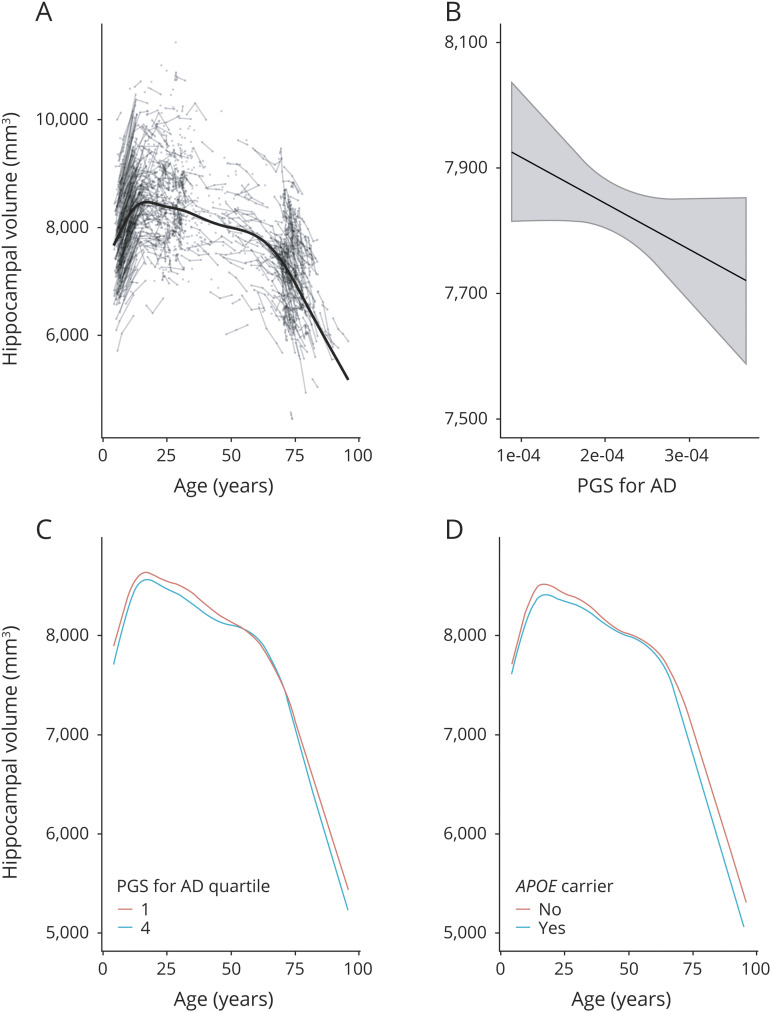
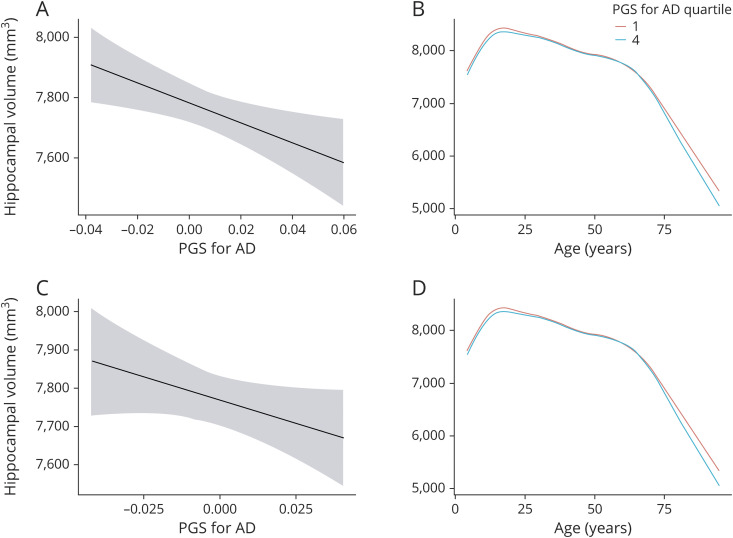
Objective: To test the hypothesis that genetic risk for Alzheimer disease (AD) may represent a stable influence on the brain from early in life, rather than being primarily age dependent, we investigated in a lifespan sample of 1,181 persons with a total of 2,690 brain scans, whether higher polygenic risk score (PGS) for AD and presence of APOE ε4 was associated with lower hippocampal volumes to begin with, as an offset effect, or possibly faster decline in older age.
Methods: Using general additive mixed models, we assessed the relations of PGS for AD, including variants in APOE with hippocampal volume and its change in a cognitively healthy longitudinal lifespan sample (age range: 4-95 years, mean visit age 39.7 years, SD 26.9 years), followed for up to 11 years.
Results: AD-PGS and APOE ε4 in isolation showed a significant negative effect on hippocampal volume. The effect of a 1 sample SD increase in AD-PGS on hippocampal volume was estimated to -36.4 mm3 (confidence interval [CI]: -71.8, -1.04) and the effect of carrying ε4 allele(s) -107.0 mm3 (CI: -182.0, -31.5). Offset effects of AD-PGS and APOE ε4 were present in hippocampal development, and interactions between age and genetic risk on volume change were not consistently observed.
Conclusions: Endophenotypic manifestation of polygenic risk for AD may be seen across the lifespan in cognitively healthy persons, not being confined to clinical populations or older age. This emphasizes that a broader population and age range may be relevant targets for attempts to prevent AD.
Copyright © 2020 The Author(s). Published by Wolters Kluwer Health, Inc. on behalf of the American Academy of Neurology.
Figures
References
-
- Chincarini A, Sensi F, Rei L, et al. Integrating longitudinal information in hippocampal volume measurements for the early detection of Alzheimer's disease. NeuroImage 2016;125:834–847. - PubMed
-
- Corder EH, Saunders AM, Strittmatter WJ, et al. Gene dose of apolipoprotein E type 4 allele and the risk of Alzheimer's disease in late onset families. Science 1993;261:921–923. - PubMed
LinkOut - more resources
Full Text Sources
Miscellaneous