


The Impact of a Comprehensive Risk Prediction Model for Colorectal Cancer on a Population Screening Program
- PMID: 33134836
- PMCID: PMC7583148
- DOI: 10.1093/jncics/pkaa062
The Impact of a Comprehensive Risk Prediction Model for Colorectal Cancer on a Population Screening Program
Abstract
Background: In many countries, population colorectal cancer (CRC) screening is based on age and family history, though more precise risk prediction could better target screening. We examined the impact of a CRC risk prediction model (incorporating age, sex, lifestyle, genomic, and family history factors) to target screening under several feasible screening scenarios.
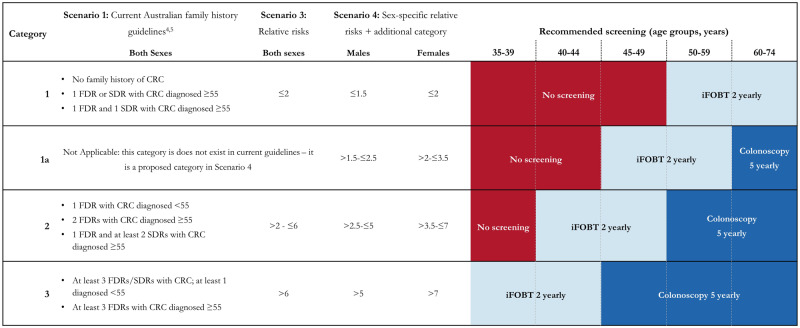
Methods: We estimated the model's predicted CRC risk distribution in the Australian population. Predicted CRC risks were categorized into screening recommendations under 3 proposed scenarios to compare with current recommendations: 1) highly tailored, 2) 3 risk categories, and 3) 4 sex-specific risk categories. Under each scenario, for 35- to 74-year-olds, we calculated the number of CRC screens by immunochemical fecal occult blood testing (iFOBT) and colonoscopy and the proportion of predicted CRCs over 10 years in each screening group.
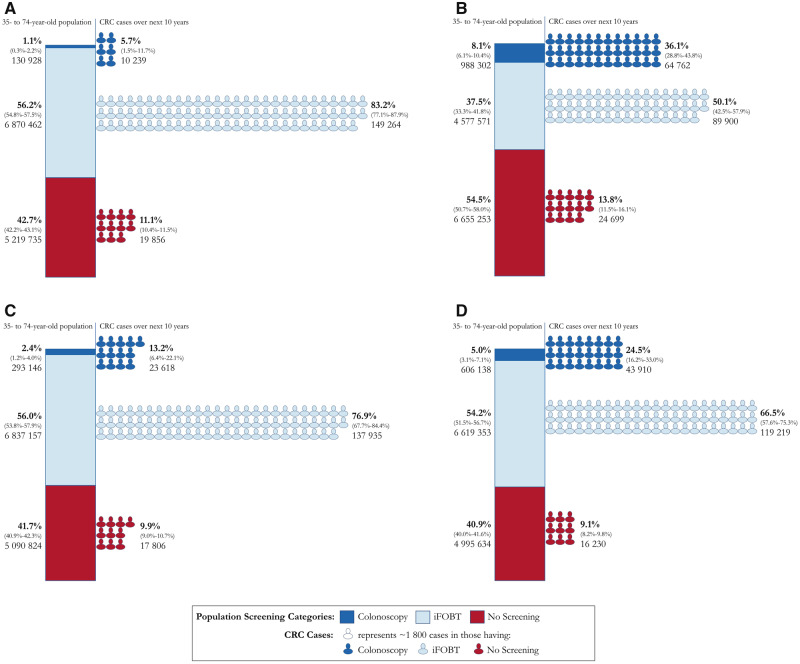
Results: Currently, 1.1% of 35- to 74-year-olds are recommended screening colonoscopy and 56.2% iFOBT, and 5.7% and 83.2% of CRCs over 10 years were predicted to occur in these groups, respectively. For the scenarios, 1) colonoscopy was recommended to 8.1% and iFOBT to 37.5%, with 36.1% and 50.1% of CRCs in each group; 2) colonoscopy was recommended to 2.4% and iFOBT to 56.0%, with 13.2% and 76.9% of cancers in each group; and 3) colonoscopy was recommended to 5.0% and iFOBT to 54.2%, with 24.5% and 66.5% of cancers in each group.
Conclusions: A highly tailored CRC screening scenario results in many fewer screens but more cancers in those unscreened. Category-based scenarios may provide a good balance between number of screens and cancers detected and are simpler to implement.
© The Author(s) 2020. Published by Oxford University Press.
Figures
References
-
- Malila N, Senore C, Armaroli P. European guidelines for quality assurance in colorectal cancer screening and diagnosis—organisation. Endoscopy. 2012;44(S 03):SE31–SE48. - PubMed
-
- Cancer Council Australia Colorectal Cancer Guidelines Working Party. Clinical Practice Guidelines for the Prevention, Early Detection and Management of Colorectal Cancer. Sydney, Australia: Colorectal Cancer in Australia; 2017.
-
- Jenkins MA, Ait Ouakrim D, Boussioutas A, et al.Revised Australian national guidelines for colorectal cancer screening: family history. Med J Aust. 2018;209(10):455–460. - PubMed
Grants and funding
LinkOut - more resources
Full Text Sources