


Is There a Role for Ultrasound in Hip Arthroscopy? A Systematic Review
- PMID: 33135007
- PMCID: PMC7588635
- DOI: 10.1016/j.asmr.2020.06.001
Is There a Role for Ultrasound in Hip Arthroscopy? A Systematic Review
Abstract
Purpose: The purpose of this study is to identify and summarize the current utility of intraoperative ultrasound (US) during hip arthroscopy.
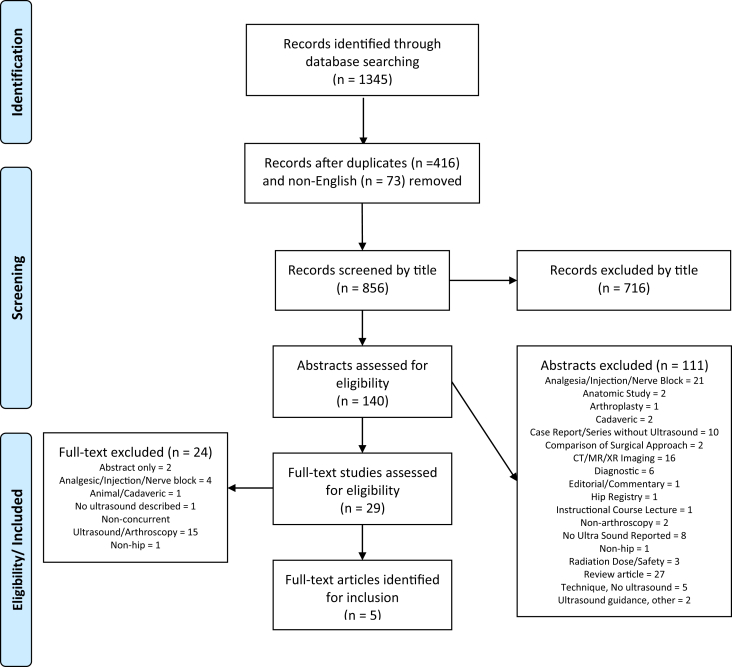
Methods: A systematic database query of the Cochrane Database of Systematic Reviews, the Cochrane Central Register of Controlled Trials, EMBASE, PubMed (1980 to 2019), and Ovid MEDLINE (1980 to 2019) was performed. After article identification, descriptions of the surgical procedure, use of intraoperative US, procedural complications, and conclusions from each article were recorded and summarized.
Results: Five studies met inclusion criteria, all of which were surgical techniques or technical notes. Four of the 5 studies described US used for placement of arthroscopic portals, and 1 described the use of an intraarticular US catheter for the assessment of an osteochondritis dissecans (OCD) lesion. Of the 4 studies using US for portal placement, 3 were performed supine and 1 was performed in the lateral decubitus position. All studies recognized the need for additional US training or the required assistance of a radiologist to incorporate US into a surgical practice.
Conclusion: Descriptions of intraoperative US during hip arthroscopy are limited in the literature. However, existing technique reports demonstrate the feasibility of US for both portal placement with superficial probes and limited evaluation of cartilage using intraarticular US catheters.
Level of evidence: V, systematic review.
© 2020 by the Arthroscopy Association of North America. Published by Elsevier Inc.
Figures
References
-
- Cvetanovich G.L., Chalmers P.N., Levy D.M., et al. Hip arthroscopy surgical volume trends and 30-day postoperative complications. Arthroscopy. 2016;32:1286–1292. - PubMed
-
- Bozic K.J., Chan V., Valone F.H., 3rd, Feeley B.T., Vail T.P. Trends in hip arthroscopy utilization in the United States. J Arthroplasty. 2013;28(8 suppl):140–143. - PubMed
-
- Smart L.R., Oetgen M., Noonan B., Medvecky M. Beginning hip arthroscopy: Indications, positioning, portals, basic techniques, and complications. Arthroscopy. 2007;23:1348–1353. - PubMed
-
- Glick J.M. Hip arthroscopy by the lateral approach. Instr Course Lect. 2006;55:317–323. - PubMed
-
- Kelly B.T., Weiland D.E., Schenker M.L., Philippon M.J. Arthroscopic labral repair in the hip: Surgical technique and review of the literature. Arthroscopy. 2005;21:1496–1504. - PubMed
Publication types
LinkOut - more resources
Full Text Sources
Research Materials
Miscellaneous
