. 2021 Apr;48(4):1040-1069.
doi: 10.1007/s00259-020-05046-9. Epub 2020 Nov 2.

EANM procedural guidelines for PET/CT quantitative myocardial perfusion imaging

Affiliations

EANM procedural guidelines for PET/CT quantitative myocardial perfusion imaging

Roberto Sciagrà et al. Eur J Nucl Med Mol Imaging. 2021 Apr.

Abstract

The use of cardiac PET, and in particular of quantitative myocardial perfusion PET, has been growing during the last years, because scanners are becoming widely available and because several studies have convincingly demonstrated the advantages of this imaging approach. Therefore, there is a need of determining the procedural modalities for performing high-quality studies and obtaining from this demanding technique the most in terms of both measurement reliability and clinical data. Although the field is rapidly evolving, with progresses in hardware and software, and the near perspective of new tracers, the EANM Cardiovascular Committee found it reasonable and useful to expose in an updated text the state of the art of quantitative myocardial perfusion PET, in order to establish an effective use of this modality and to help implementing it on a wider basis. Together with the many steps necessary for the correct execution of quantitative measurements, the importance of a multiparametric approach and of a comprehensive and clinically useful report have been stressed.

Keywords: Myocardial blood flow; Myocardial flow reserve; PET; Quantitative imaging.


Conflict of interest statement

Mark Lubberink is co-founder and part-time employee of MedTrace Pharma A/S. Fabien Hyafil is consultant for Naogen. Antti Saraste is supported by grants from the Finnish Cardiovascular Foundation and Academy of Finland, has received consulting fees from Astra Zeneca and Amgen, and has received speaker fees from Astra Zeneca, Abbott, Amgen, Bayer and Novartis. All the other authors declare that they have no conflict of interest.

Figures

Fig. 1
Fig. 1
Typical noise-equivalent count (NEC) rate curves. BGO = bismuth germanate, GSO = gadolinium oxyorthosilicate, LSO = lutetium oxyorthosilicate, LYSO = lutetium-yttrium oxyorthosilicate, PMT = photomultiplier, SIPM = silicon photomultiplier. a NEC rates. b NEC rates accounting for image quality improvements due to time of flight. Typical count rate ranges during the first pass of a dynamic acquisition over the heart, as well as during a routine whole-body [18F]FDG scan, are indicated. b The advantage of modern LYSO+SiPM scanners during first-pass imaging compared with BGO systems is clearly shown
Fig. 2
Fig. 2
Transport rate constant from plasma to tissue (K1) as function of MBF for [15O]water, [13N]NH3 [2] and 82Rb [29] compared with the SPECT tracer [99mTc]Tc-sestamibi [30]. For [13N]NH3, curves based on uptake rate (K1) and on retention, that is, the transport rate into the metabolically trapped compartment, are given
Fig. 3
Fig. 3
Protocols for rest–stress quantitative cardiac PET. The upper panel shows the sequence for tracers with short half-life ([15O]water, 82Rb). The lower panel shows the standard sequence for longer half-life tracers ([13N]NH3, [18F]flurpiridaz); however, using correction for residual activity, the shorter protocol can be adopted also for [13N]NH3
Fig. 4
Fig. 4
Effect of 15 mm PET/CT misalignment on absolute MBF for values measured from washout rate ([15O]water; left) and values measured from uptake rate (82Rb or [13N]NH3; right). Polar maps are based on the same simulated MBF scans for both cases. Misalignment results in a very slight increase in measured MBF for [15O]water and in a large anterior defect for 82Rb or [13N]NH3
Fig. 5
Fig. 5
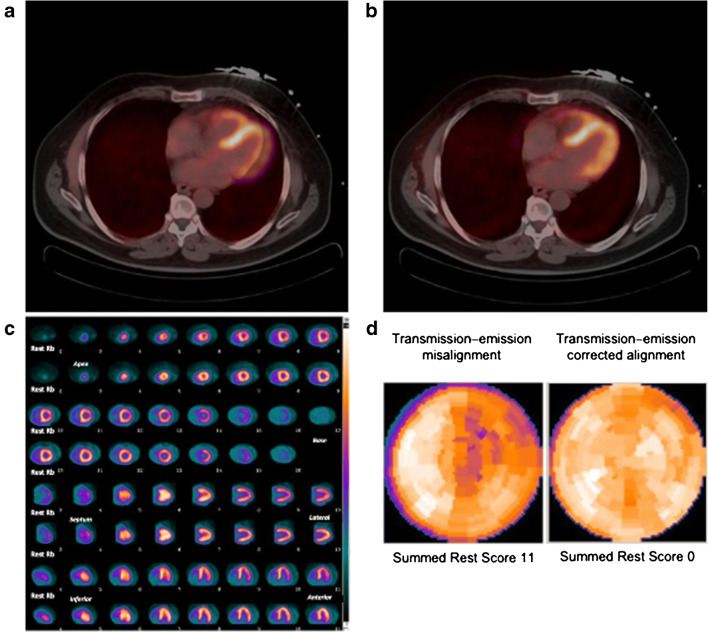
Transmission–emission misalignment example. Misalignment between CT transmission and rest 82Rb perfusion PET images (a) with correction of transmission–emission misalignment (b). Anterolateral perfusion defect on rest 82Rb perfusion images (c, upper rows) deriving from applying the incorrect attenuation coefficients during tomographic reconstruction to an area of LV myocardium overlying lung field on CT transmission scan, and normal rest perfusion study (c, lower rows) after correction, with relative polar maps (d)
Fig. 6
Fig. 6
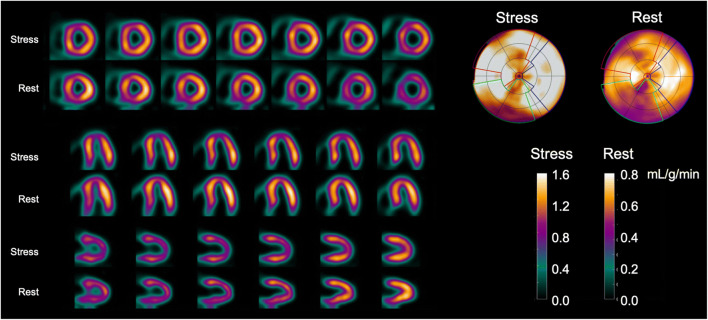
[15O]water parametric MBF images from a 65-year-old female with angina referred for assessment of ischaemia with PET. The images shown here are parametric MBF images based on 4-min dynamic [15O]water PET scans, with their corresponding polar maps. Note that colour scales of all images represent MBF in mL/g/min as seen in the colour bars. SPECT was negative. PET clearly shows balanced ischaemia with stress MBF far below the threshold of 2.3 mL/g/min
Fig. 7
Fig. 7
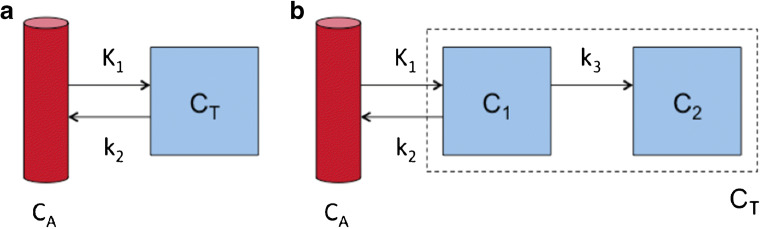
Compartment models: a single-tissue compartment model; b irreversible two-tissue compartment model. CA is the radioactivity concentration in arterial blood, CT the radioactivity concentration in tissue, with C1 and C2 describing free and internalised tracer in tissue, and K1, k2 and k3 are rate constants describing the transport rates of tracer between the different compartments
Fig. 8
Fig. 8
[13N]NH3 PET of a patient with three-vessel disease. The uptake images (left panel) show a stress-induced inferior wall perfusion defect (arrows), which is confirmed by quantitative PET analysis (right panel), demonstrating clearly reduced stress MBF and decreased coronary flow reserve (CFR = MFR) in the right coronary artery territory (RCA). However, mildly abnormal stress MBF and MFR are observed in the left anterior descending (LAD) and left circumflex (LCX) territories as well. In gated PET analysis, LVEF decreased from 54% at rest to 48% after stress, confirming the presence of diffuse ischaemia
Fig. 9
Fig. 9
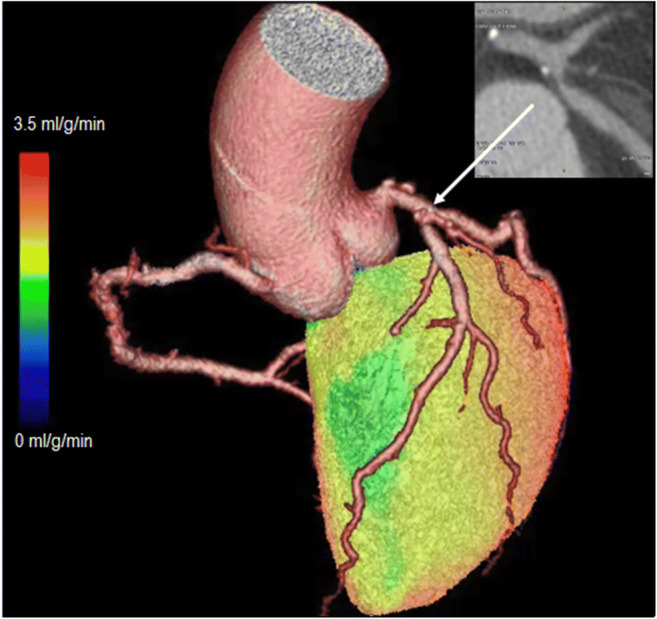
Hybrid PET/CT image demonstrating 3D reconstruction of coronary anatomy and MBF. CCTA shows a stenosis in the proximal left anterior descending coronary artery (insert), and [15O]water PET shows reduced MBF (green colour) in the myocardium subtended by the artery during adenosine stress

References

    1. Brunken RC, Schelbert HR. Positron emission tomography in clinical cardiology. Cardiol Clin. 1989;7:607–629. - PubMed
    1. Schelbert HR, Phelps ME, Huang SC, MacDonald NS, Hansen H, Selin C, et al. N-13 ammonia as an indicator of myocardial blood flow. Circulation. 1981;63:1259–1272. - PubMed
    1. Bergmann SR, Fox KA, Rand AL, McElvany KD, Welch MJ, Markham J, et al. Quantification of regional myocardial blood flow in vivo with H215O. Circulation. 1984;70:724–33. - PubMed
    1. Krivokapich J, Smith GT, Huang SC, Hoffman EJ, Ratib O, Phelps ME, et al. 13N ammonia myocardial imaging at rest and with exercise in normal volunteers: quantification of absolute myocardial perfusion with dynamic positron emission tomography. Circulation. 1989;80:1328–1337. - PubMed
    1. Huang SC, Williams BA, Krivokapich J, Araujo L, Phelps ME, Schelbert HR. Rabbit myocardial 82Rb kinetics and a compartmental model for blood flow estimation. Am J Phys. 1989;256(4 Pt 2):H1156–64. - PubMed

Publication types

LinkOut - more resources