


Playing With Fear: A Field Study in Recreational Horror
- PMID: 33137263
- PMCID: PMC7734554
- DOI: 10.1177/0956797620972116
Playing With Fear: A Field Study in Recreational Horror
Abstract
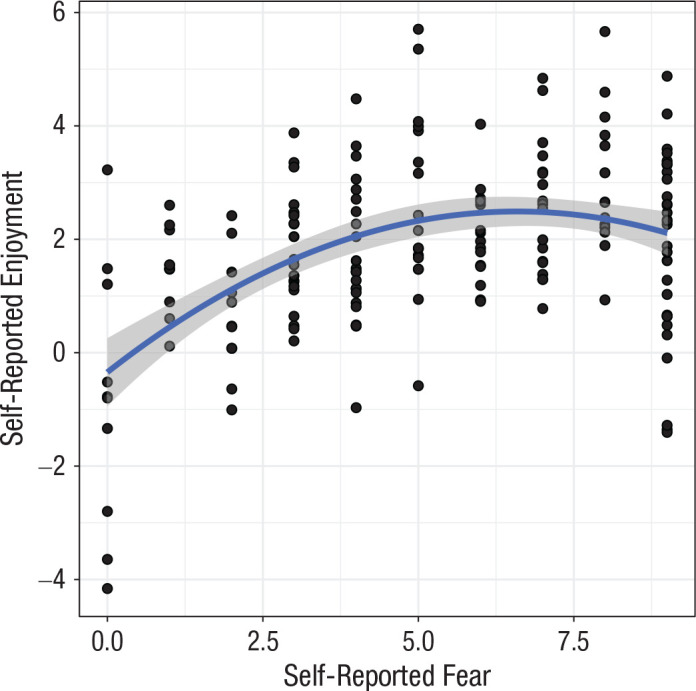
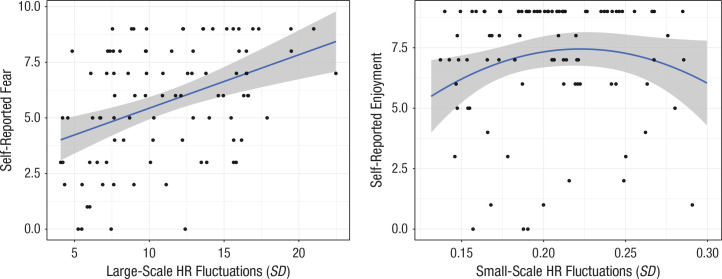
Haunted attractions are illustrative examples of recreational fear in which people voluntarily seek out frightening experiences in pursuit of enjoyment. We present findings from a field study at a haunted-house attraction where visitors between the ages of 12 and 57 years (N = 110) were equipped with heart rate monitors, video-recorded at peak scare points during the attraction, and asked to report on their experience. Our results show that enjoyment has an inverted-U-shaped relationship with fear across repeated self-reported measures. Moreover, results from physiological data demonstrate that the experience of being frightened is a linear function of large-scale heart rate fluctuations, whereas there is an inverted-U-shaped relationship between participant enjoyment and small-scale heart rate fluctuations. These results suggest that enjoyment is related to forms of arousal dynamics that are "just right." These findings shed light on how fear and enjoyment can coexist in recreational horror.
Keywords: arousal; enjoyment; fear; heart rate; horror; open data; open materials; play.
Conflict of interest statement
Figures

Comment in
-
The Paradox of Pleasurable Fear.Trends Cogn Sci. 2021 Feb;25(2):93-94. doi: 10.1016/j.tics.2020.12.001. Epub 2020 Dec 15. Trends Cogn Sci. 2021. PMID: 33339736
References
-
- Andersen M. M., Roepstorff A. (2020). Play in predictive minds. Manuscript submitted for publication.
-
- Bartsch A., Appel M., Storch D. (2010). Predicting emotions and meta-emotions at the movies: The role of the need for affect in audiences’ experience of horror and drama. Communication Research, 37, 167–190. doi: 10.1177/0093650209356441 - DOI
-
- Bates D., Mächler M., Bolker B., Walker S. (2015). Fitting linear mixed-effects models using lme4. Journal of Statistical Software, 67(1). doi: 10.18637/jss.v067.i01 - DOI
Publication types
MeSH terms
LinkOut - more resources
Full Text Sources
