


The Transcriptional Network in the Arabidopsis Circadian Clock System
- PMID: 33138078
- PMCID: PMC7692566
- DOI: 10.3390/genes11111284
The Transcriptional Network in the Arabidopsis Circadian Clock System
Abstract
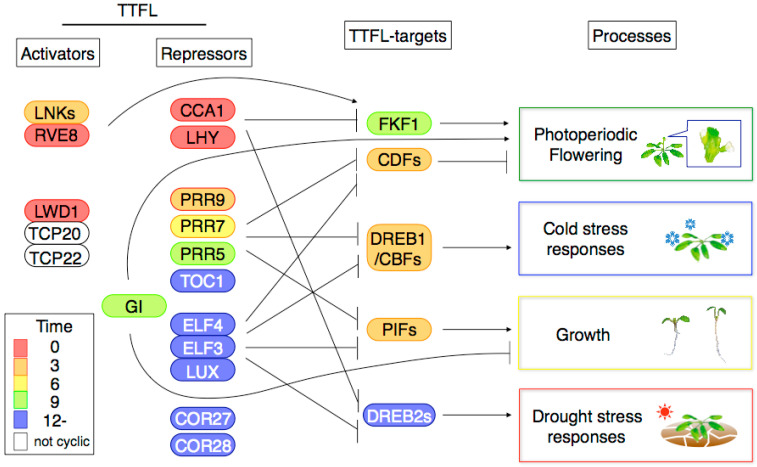
The circadian clock is the biological timekeeping system that governs the approximately 24-h rhythms of genetic, metabolic, physiological and behavioral processes in most organisms. This oscillation allows organisms to anticipate and adapt to day-night changes in the environment. Molecular studies have indicated that a transcription-translation feedback loop (TTFL), consisting of transcriptional repressors and activators, is essential for clock function in Arabidopsis thaliana (Arabidopsis). Omics studies using next-generation sequencers have further revealed that transcription factors in the TTFL directly regulate key genes implicated in clock-output pathways. In this review, the target genes of the Arabidopsis clock-associated transcription factors are summarized. The Arabidopsis clock transcriptional network is partly conserved among angiosperms. In addition, the clock-dependent transcriptional network structure is discussed in the context of plant behaviors for adapting to day-night cycles.
Keywords: arabidopsis; circadian clock; plant development; transcription factors; transcriptional network.
Conflict of interest statement
The author declares no conflict of interest. The funders had no role in the writing of the manuscript.
Figures
References
Publication types
MeSH terms
Substances
LinkOut - more resources
Full Text Sources
