


Polymorphisms in Processing and Antigen Presentation-Related Genes and Their Association with Host Susceptibility to Influenza A/H1N1 2009 Pandemic in a Mexican Mestizo Population
- PMID: 33138079
- PMCID: PMC7692058
- DOI: 10.3390/v12111224
Polymorphisms in Processing and Antigen Presentation-Related Genes and Their Association with Host Susceptibility to Influenza A/H1N1 2009 Pandemic in a Mexican Mestizo Population
Abstract
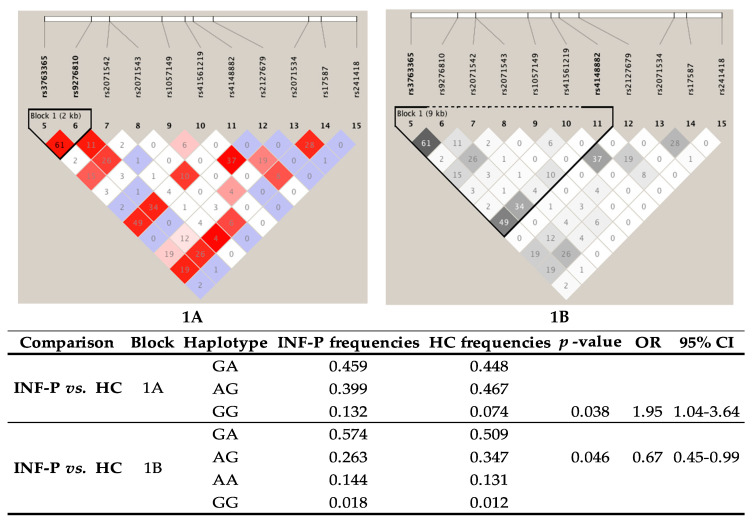
(1) Background: The influenza A/H1N1 pdm09 virus rapidly spread throughout the world. Despite the inflammatory and virus-degradation pathways described in the pathogenesis of influenza A virus (IAV) infection, little is known about the role of the single nucleotide polymorphisms (SNPs) in the genes involved in the processing and antigenic presentation-related mechanisms. (2) Methods: In this case-control study, we evaluated 17 SNPs in five genes (TAP1, TAP2, TAPBP, PSMB8, and PSMB9). One hundred and twenty-eight patients with influenza A/H1N1 infection (INF-P) and 111 healthy contacts (HC) were included; all of them are Mexican mestizo. (3) Results: In allele and genotype comparison, the rs241433/C allele (TAP2), as well as AG haplotype (rs3763365 and rs4148882), are associated with reduced risk for influenza A/H1N1 infection (p < 0.05). On the other hand, the rs2071888G allele (TAPBP) and GG haplotype (rs3763365 and rs9276810) are associated with a higher risk for influenza A/H1N1 infection. In addition, after adjustment for covariates, the association to a reduced risk for influenza A/H1N1 infection remains with rs241433/C allele (p < 0.0001, OR = 0.24, 95% CI = 0.13-0.43), and the association with TAPBP is also maintained with the G allele (p = 0.0095, OR = 1.89, 95% CI = 1.17-3.06) and GG genotype models (p < 0.05, OR = 2.18, 95% CI = 1.27-3.74). (4) Conclusion: The rs241433/C allele and AC genotype (TAP2) and the AG haplotype are associated with a reduced risk for influenza A/H1N1 infection. In addition, the rs2071888/G allele and GG genotype (TAPBP) and the GG haplotype are associated with a higher risk for developing influenza A/H1N1 infection in a Mexican mestizo population.
Keywords: PSMB8; TAP2; TAPBP; host susceptibility; influenza A/H1N1 pdm09.
Conflict of interest statement
The authors declare no competing interests for this project.
Figures
References
-
- Perez-Padilla R., De La Rosa-Zamboni D., De Leon S.P., Hernandez M., Quiñones-Falconi F., Bautista E., Ramirez-Venegas A., Rojas-Serrano J., Ormsby C.E., Corrales A., et al. Pneumonia and Respiratory Failure from Swine-Origin Influenza A (H1N1) in Mexico. N. Engl. J. Med. 2009;361:680–689. doi: 10.1056/NEJMoa0904252. - DOI - PubMed
-
- Echevarría-Zuno S., Mejía-Aranguré J.M., Mar-Obeso A.J., Grajales-Muñiz C., Robles-Pérez E., González-León M., Ortega-Alvarez M.C., Gonzalez-Bonilla C., Rascón-Pacheco R.A., Borja-Aburto V.H. Infection and death from influenza A H1N1 virus in Mexico: A retrospective analysis. Lancet. 2009;374:2072–2079. doi: 10.1016/S0140-6736(09)61638-X. - DOI - PubMed
-
- Fezeu L., Julia C., Henegar A., Bitu J., Hu F.B., Grobbee D.E., Kengne A.P., Hercberg S., Czernichow S. Obesity is associated with higher risk of intensive care unit admission and death in influenza A (H1N1) patients: A systematic review and meta-analysis. [(accessed on 12 July 2020)];Obes. Rev. 2011 12:653–659. doi: 10.1111/j.1467-789X.2011.00864.x. Available online: https://pubmed.ncbi.nlm.nih.gov/21457180/ - DOI - PubMed
Publication types
MeSH terms
LinkOut - more resources
Full Text Sources
Medical
Research Materials
