. 2021 Jan 1;268(Pt A):115691.
doi: 10.1016/j.envpol.2020.115691. Epub 2020 Oct 27.

Improved air quality and associated mortalities in India under COVID-19 lockdown

Affiliations

Improved air quality and associated mortalities in India under COVID-19 lockdown

Hasan Raja Naqvi et al. Environ Pollut. .

Abstract

India enforced stringent lockdown measures on March 24, 2020 to mitigate the spread of the Severe Acute Respiratory Syndrome Coronovirus-2 (SARS-CoV-2). Here, we examined the impact of lockdown on the air quality index (AQI) [including ambient particulate matter (PM10 and PM2.5), nitrogen dioxide (NO2), sulfur dioxide (SO2), carbon monoxide (CO), ozone (O3), and ammonia (NH3)] and tropospheric NO2 and O3 densities through Sentinel-5 satellite data approximately 1 d post-lockdown and one month pre-lockdown and post-lockdown. Our findings revealed a marked reduction in the ambient AQI (estimated mean reduction of 17.75% and 20.70%, respectively), tropospheric NO2 density, and land surface temperature (LST) during post-lockdown compared with the pre-lockdown period or corresponding months in 2019, except for a few sites with substantial coal mining and active power plants. We observed a modest increase in the O3 density post-lockdown, thereby indicating improved tropospheric air quality. As a favorable outcome of the COVID-19 lockdown, road accident-related mortalities declined by 72-folds. Cities with poor air quality correlate with higher COVID-19 cases and deaths (r = 0.504 and r = 0.590 for NO2; r = 0.744 and r = 0.435 for AQI). Conversely, low mortality was reported in cities with better air quality. These results show a correlation between the COVID-19 vulnerable regions and AQI hotspots, thereby suggesting that air pollution may exacerbate clinical manifestations of the disease. However, a prolonged lockdown may nullify the beneficial environmental outcomes by adversely affecting socioeconomic and health aspects.

Keywords: COVID-19; Ground AQI; India; Pandemic lockdown; Tropospheric pollutants.


Conflict of interest statement

Declaration of competing interest The authors declare that they have no known competing financial interests or personal relationships that could have appeared to influence the work reported in this paper.

Figures
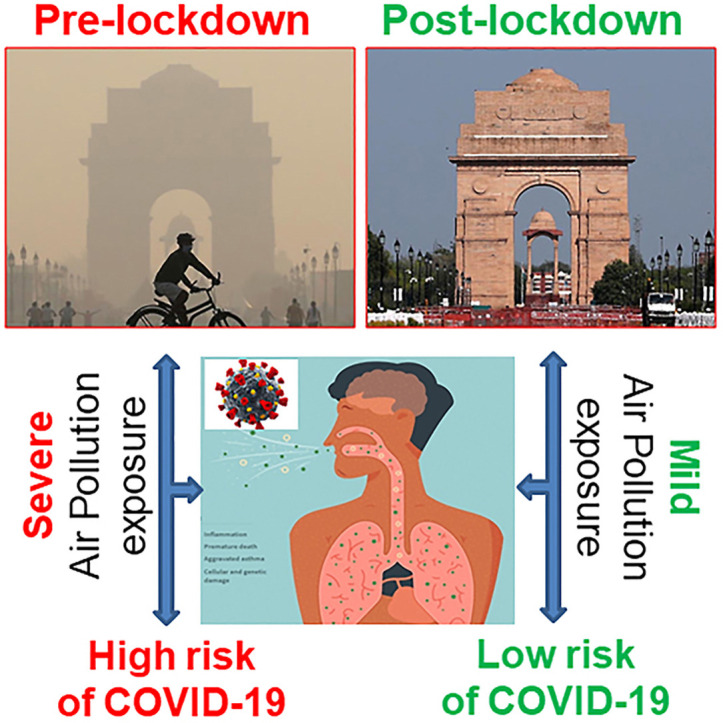
Image 1
Graphical abstract
Fig. 1
Fig. 1
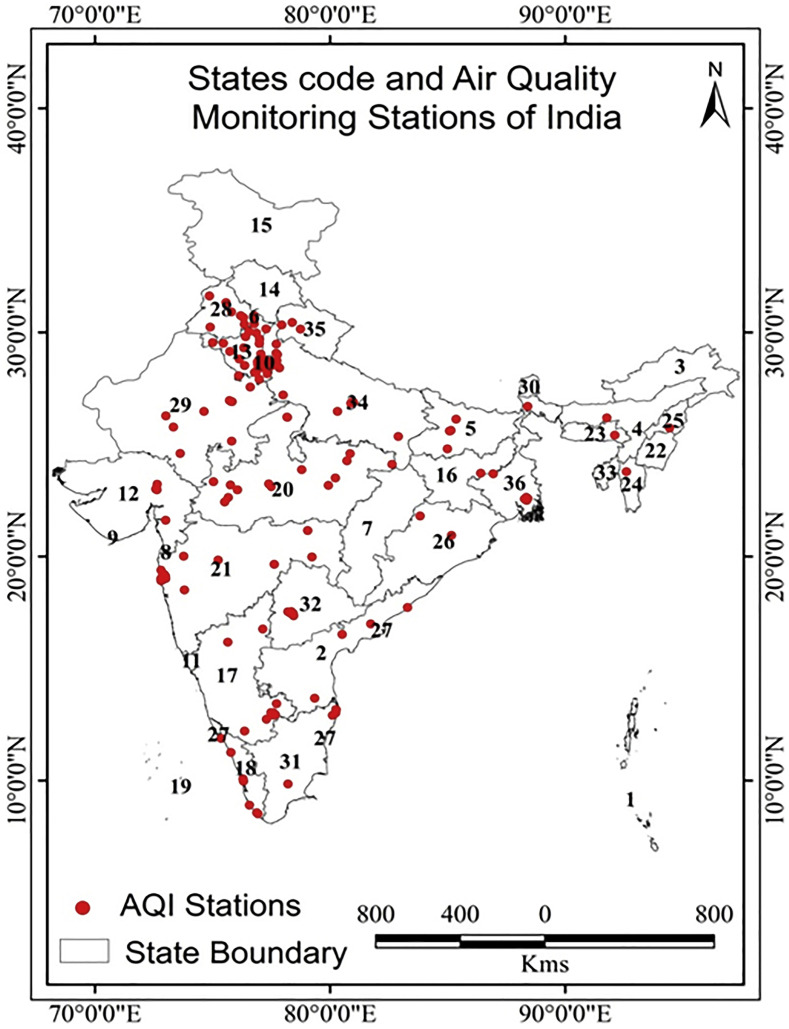
Study area. Spatial locations of Air Quality Index (AQI) ground monitoring stations in the different states of India.
Fig. 2
Fig. 2
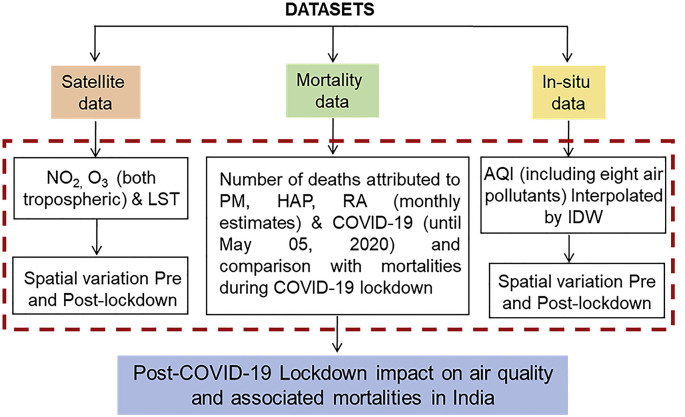
Datasets and methodology used for the study. Schematic depicting detailed data assimilation for ambient and tropospheric pollutants, PM-, HAP- and RA-attributed mortalities, and COVID-19 infections/mortalities.
Fig. 3
Fig. 3
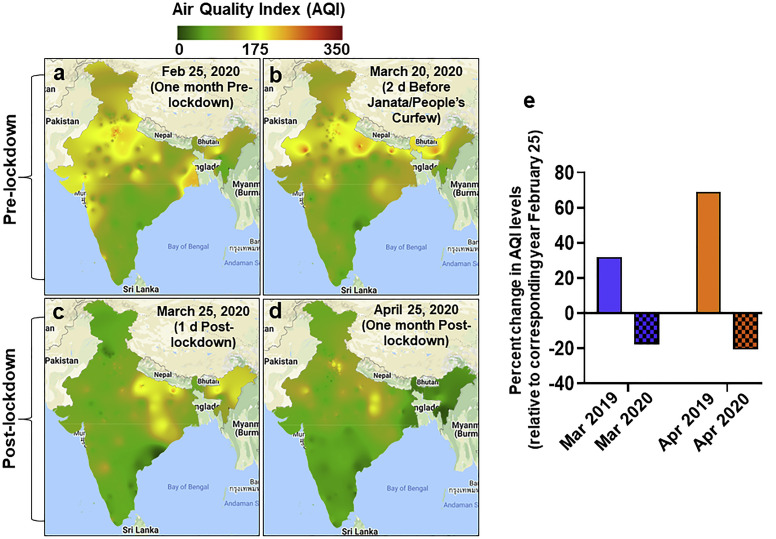
Improvement in air quality index (AQI) concentrations following the COVID-19 lockdown in India. Spatial variations in AQI a. one month pre-lockdown, b. 2 d before the Janata/People’s Curfew, c. 1 d post-lockdown, and d. one month post-lockdown. e. Histogram showing the percent change in mean AQI concentrations for March (1 d post-lockdown) and April (one month post-lockdown) relative to those in February (one month pre-lockdown). A similar analysis for the corresponding period in 2019 was also performed to compare the direct impact of the lockdown on air quality.
Fig. 4
Fig. 4
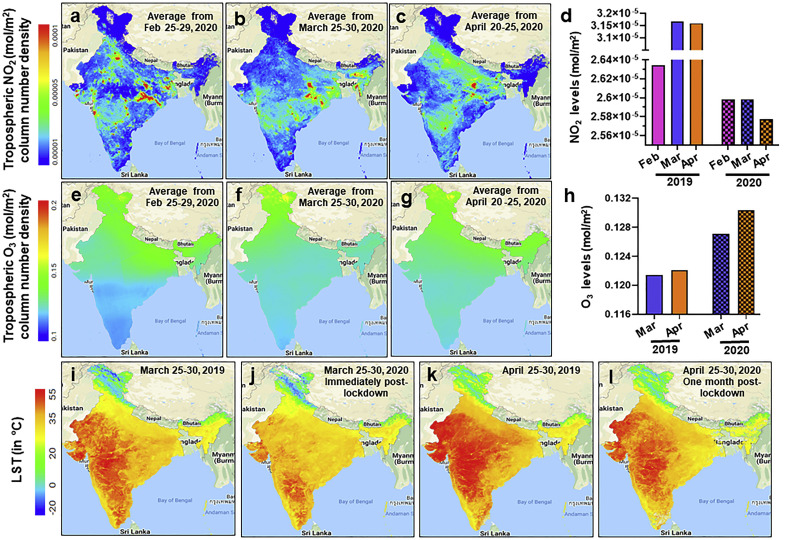
Restoration of NO2, O3, and land surface temperature (LST) post-COVID-19 lockdown. Spatial distribution and deviations in tropospheric a–c. NO2 and e–g. O3 concentrations over India derived from Sentinel-5 satellite data for the indicated period. Histograms showing improvement in tropospheric d. NO2 density and h. O3 density (5 d mean) one month post-lockdown compared with one month pre-lockdown or immediately post-lockdown. For comparison, the tropospheric densities of NO2 and O3 are included for the same period in 2019. i–l. Spatial distribution of LST (°C) immediately after lockdown and one month post-lockdown compared with that in the corresponding period in 2019.
Fig. 5
Fig. 5
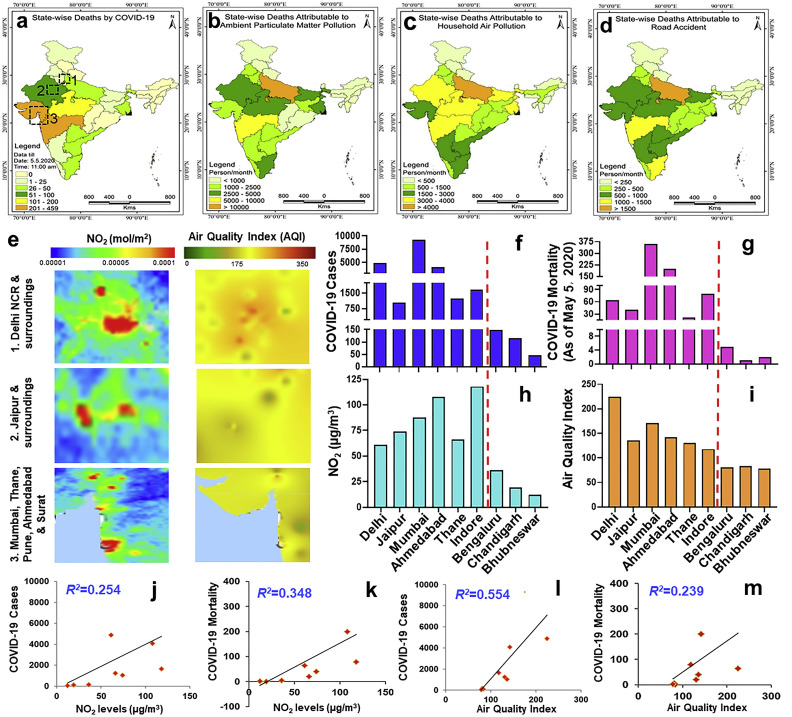
Decline in AP-attributed mortalities during COVID-19 lockdown and correlation of AP with COVID-19 cases/mortalities. Statewide estimation of monthly mortalities attributed to a. COVID-19, b. particulate matter, c. household air pollution, and d. road accidents. Regions (labelled 1, 2, and 3) with the highest COVID-19 mortalities (as of May 5, 2020) are highlighted in panel a. e. Spatial distribution of NO2 (tropospheric) and AQI in the COVID-19 vulnerable regions (highlighted in panel a). Histograms showing a comparison of f. COVID-19 cases, g. COVID-19 mortalities, h. ambient NO2, and i. AQI in metropolitan cities with severe or low air quality (separated by a dotted red line). Regression analysis of COVID-19 cases and mortalities with j. and k. NO2 (μg/m3) and l. and m. AQI, respectively. (For interpretation of the references to color in this figure legend, the reader is referred to the Web version of this article.)

References

    1. Balakrishnan K. The impact of air pollution on deaths, disease burden, and life expectancy across the states of India: the Global Burden of Disease Study 2017. Lancet Planet. Health. 2018;5196(18) 30261-30244. - PMC - PubMed
    1. Chen G., Zhang W., Li S., Williams G., Liu C., Morgan G.G., Jaakkola J.J.K., Guo Y. Is short-term exposure to ambient fine particles associated with measles incidence in China? A multi-city study. Environ. Res. 2017;156:306–311. - PubMed
    1. Chen H., Guo J., Wang C. Clinical characteristics and intrauterine vertical transmission potential of COVID-19 infection in nine pregnant women: a retrospective review of medical records. Lancet. 2020;395:809–815. doi: 10.1016/S0140-6736(20)30360-3. - DOI - PMC - PubMed
    1. Chen K. Air pollution reduction and mortality benefit during the COVID-19 outbreak in China. Lancet Planet Health. 2020 doi: 10.1016/S2542-5196(20)30107-8. - DOI - PMC - PubMed
    1. Cohen A.J. Estimates and 25-year trends of the global burden of disease attributable to ambient air pollution: an analysis of data from the Global Burden of Diseases Study 2015. Lancet. 2017;389:1907–1918. doi: 10.1016/S0140-6736(17)30505-6. - DOI - PMC - PubMed