


COVID-19 pandemic impacts on global inland fisheries
- PMID: 33139565
- PMCID: PMC7703588
- DOI: 10.1073/pnas.2014016117
COVID-19 pandemic impacts on global inland fisheries
Abstract
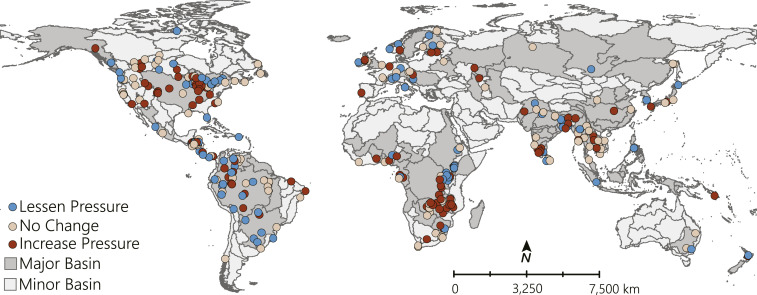
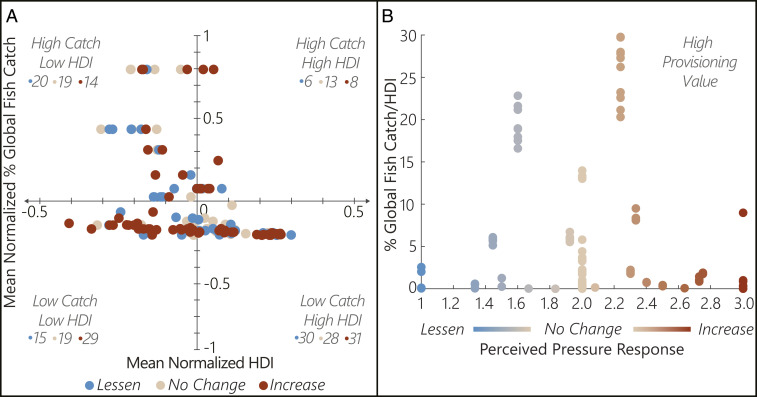
The COVID-19 pandemic has led to environmental recovery in some ecosystems from a global "anthropause," yet such evidence for natural resources with extraction or production value (e.g., fisheries) is limited. This brief report provides a data-driven global snapshot of expert-perceived impacts of COVID-19 on inland fisheries. We distributed an online survey assessing perceptions of inland fishery pressures in June and July 2020 to basin-level inland fishery experts (i.e., identified by the Food and Agriculture Organization of the United Nations across the global North and South); 437 respondents from 79 countries addressed 93 unique hydrological basins, accounting for 82.1% of global inland fish catch. Based on the responses analyzed against extrinsic fish catch and human development index data, pandemic impacts on inland fisheries 1) add gradation to the largely positive environmental narrative of the global pandemic and 2) identify that basins of higher provisioning value are perceived to experience greater fishery pressures but may have limited compensatory capacity to mitigate COVID-19 impacts along with negative pressures already present.
Keywords: coronavirus; food security; freshwater fish; livelihoods; recreation.
Copyright © 2020 the Author(s). Published by PNAS.
Conflict of interest statement
The authors declare no competing interest.
Figures
References
-
- Lynch A. J., et al. , The social, economic, and environmental importance of inland fish and fisheries. Environ. Rev. 24, 115–121 (2016).
-
- Kawarazuka N., Béné C., The potential role of small fish species in improving micronutrient deficiencies in developing countries: Building evidence. Public Health Nutr. 14, 1927–1938 (2011). - PubMed
-
- Rutz C., et al. , COVID-19 lockdown allows researchers to quantify the effects of human activity on wildlife. Nat. Ecol. Evol. 4, 1156–1159 (2020). - PubMed
Publication types
MeSH terms
LinkOut - more resources
Full Text Sources
Medical
