Clinical value of dual-phase F-18 sodium fluoride PET/CT for diagnosing bone metastasis in cancer patients with solitary bone lesion
- PMID: 33139990
- PMCID: PMC7547267
- DOI: 10.21037/qims-20-607
Clinical value of dual-phase F-18 sodium fluoride PET/CT for diagnosing bone metastasis in cancer patients with solitary bone lesion
Abstract
Background: The present study aimed to investigate whether dual-phase F-18 sodium-fluoride (NaF) positron emission tomography/computed tomography (PET/CT) could improve the diagnostic accuracy of detecting bone metastasis in cancer patients with a solitary bone lesion compared to conventional F-18 NaF PET/CT.
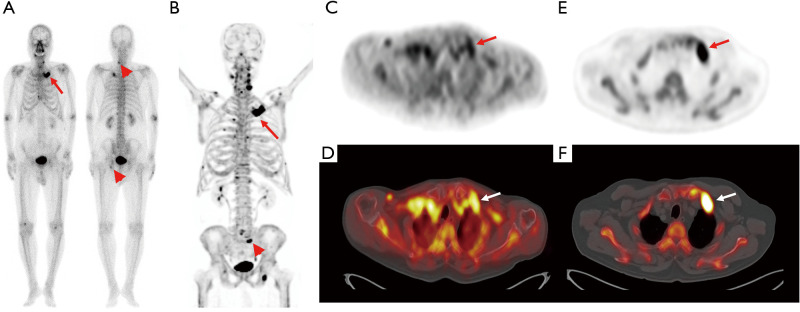
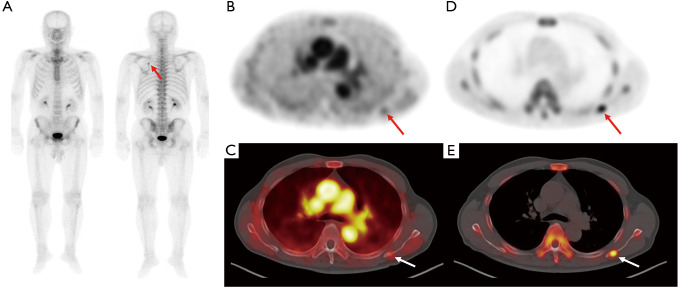
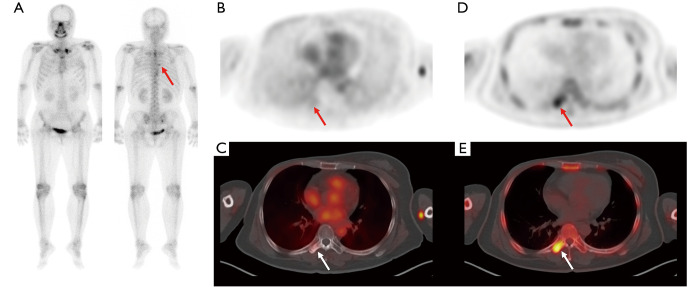
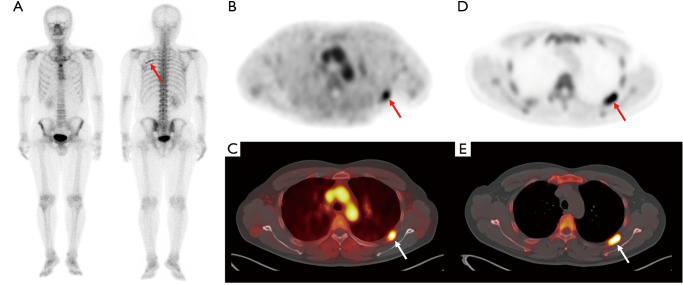
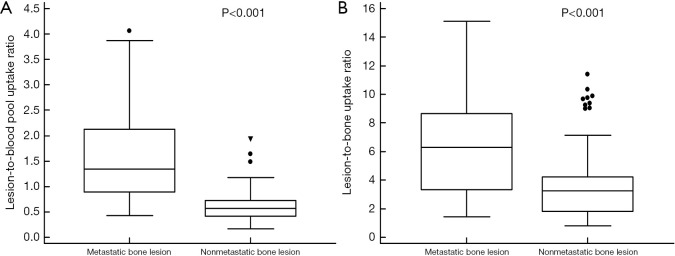
Methods: We retrospectively enrolled 113 cancer patients who underwent dual-phase F-18 NaF PET/CT for the differential diagnosis of a solitary bone lesion seen on bone scintigraphy. According to the dual-phase PET/CT protocol, an early-phase scan was acquired immediately after radiotracer injection and a conventional F-18 NaF PET/CT scan was performed. The diagnostic abilities of the visual analysis of conventional and dual-phase PET/CT scans and two quantitative parameters (lesion-to-blood pool uptake ratio on early-phase scan and lesion-to-bone uptake ratio on conventional scan) for detecting bone metastasis were compared. The final diagnosis of bone metastasis was made by histopathological confirmation or follow-up imaging studies.
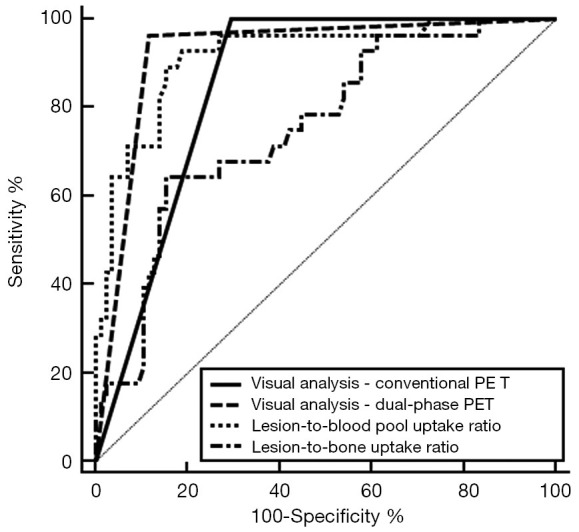
Results: A metastatic bone lesion was diagnosed in 28 patients (24.8%). The sensitivity, specificity, and accuracy were 100.0%, 70.6%, and 77.9%, respectively, for visual analysis of conventional F-18 NaF PET/CT, 92.9%, 42.4%, 54.9%, respectively, for lesion-to-bone uptake ratio, 96.4%, 88.2%, and 90.3%, respectively, for visual analysis of dual-phase PET/CT, and 92.9%, 81.2%, and 83.2%, respectively, for lesion-to-blood pool uptake ratio. Visual analysis of dual-phase PET/CT was shown to have the highest area under the receiver operating characteristic curve value (0.923; 95% CI, 0.858-0.965) among all parameters.
Conclusions: Dual-phase F-18 NaF PET/CT showed a high diagnostic ability for detecting bone metastasis with improved specificity and accuracy compared to conventional F-18 NaF PET/CT in cancer patients. Dual-phase F-18 NaF PET/CT might help diagnose bone metastasis in patients with malignancies who were shown to have a solitary bone lesion on bone scintigraphy.
Keywords: Bone; F-18 Sodium-fluoride (NaF); diagnosis; metastasis; positron emission tomography (PET).
2020 Quantitative Imaging in Medicine and Surgery. All rights reserved.
Conflict of interest statement
Conflicts of Interest: All authors have completed the ICMJE uniform disclosure form (available at http://dx.doi.org/10.21037/qims-20-607). The authors have no conflicts of interest to declare.
Figures
References
LinkOut - more resources
Full Text Sources