


Laparoscopic versus open right posterior sectionectomy: an international, multicenter, propensity score-matched evaluation
- PMID: 33140153
- PMCID: PMC8523385
- DOI: 10.1007/s00464-020-08109-y
Laparoscopic versus open right posterior sectionectomy: an international, multicenter, propensity score-matched evaluation
Abstract
Background: Although laparoscopic liver resection has become the standard for minor resections, evidence is lacking for more complex resections such as the right posterior sectionectomy (RPS). We aimed to compare surgical outcomes between laparoscopic (LRPS) and open right posterior sectionectomy (ORPS).
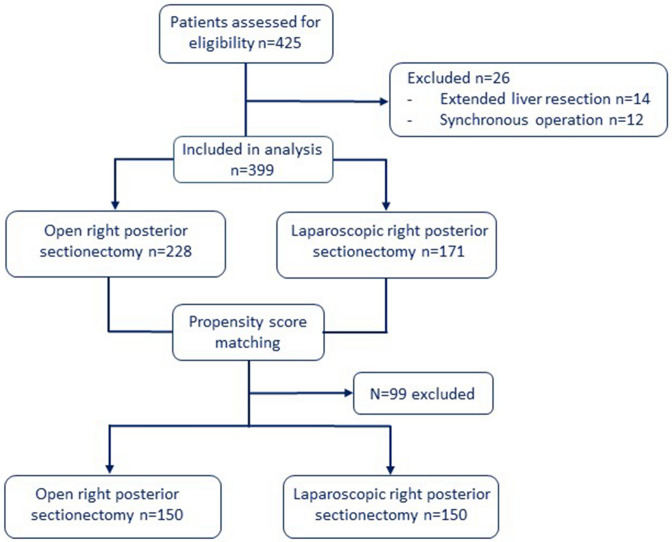
Methods: An international multicenter retrospective study comparing patients undergoing LRPS or ORPS (January 2007-December 2018) was performed. Patients were matched based on propensity scores in a 1:1 ratio. Primary endpoint was major complication rate defined as Accordion ≥ 3 grade. Secondary endpoints included blood loss, length of hospital stay (LOS) and resection status. A sensitivity analysis was done excluding the first 10 LRPS patients of each center to correct for the learning curve. Additionally, possible risk factors were explored for operative time, blood loss and LOS.
Results: Overall, 399 patients were included from 9 centers from 6 European countries of which 150 LRPS could be matched to 150 ORPS. LRPS was associated with a shorter operative time [235 (195-285) vs. 247 min (195-315) p = 0.004], less blood loss [260 (188-400) vs. 400 mL (280-550) p = 0.009] and a shorter LOS [5 (4-7) vs. 8 days (6-10), p = 0.002]. Major complication rate [n = 8 (5.3%) vs. n = 9 (6.0%) p = 1.00] and R0 resection rate [144 (96.0%) vs. 141 (94.0%), p = 0.607] did not differ between LRPS and ORPS, respectively. The sensitivity analysis showed similar findings in the previous mentioned outcomes. In multivariable regression analysis blood loss was significantly associated with the open approach, higher ASA classification and malignancy as diagnosis. For LOS this was the open approach and a malignancy.
Conclusion: This international multicenter propensity score-matched study showed an advantage in favor of LRPS in selected patients as compared to ORPS in terms of operative time, blood loss and LOS without differences in major complications and R0 resection rate.
Keywords: Laparoscopic surgery; Liver surgery; Minimally invasive surgery; Operative outcomes; Propensity score matching; Surgical procedure.
© 2020. The Author(s).
Conflict of interest statement
Drs. van der Heijde, Dr. Ratti, Prof. Aldrigetti, Dr. Benedetti Cacciaguerra, Prof. Can, Dr. D’Hondt, Dr. Di Benedetto, Dr. Ivanecz, Dr. Magistri, Dr. Menon, Dr. Papoulas, Dr. Vivarelli, Prof. Besselink, and prof. Abu Hilal have no conflicts of interest or financial ties to disclose.
References
-
- Reich H, McGlynn F, DeCaprio J, Budin R. Laparoscopic excision of benign liver lesions. Obstet Gynecol. 1991;78:956–958. - PubMed
-
- Landi F, De' Angelis N, Scatton O, Vidal X, Ayav A, Muscari F, Dokmak S, Torzilli G, Demartines N, Soubrane O, Cherqui D, Hardwigsen J, Laurent A. Short-term outcomes of laparoscopic vs. open liver resection for hepatocellular adenoma: a multicenter propensity score adjustment analysis by the AFC-HCA-2013 study group. Surg Endosc. 2017;31:4136–4144. doi: 10.1007/s00464-017-5466-4. - DOI - PubMed
-
- Fretland AA, Dagenborg VJ, Bjornelv GMW, Kazaryan AM, Kristiansen R, Fagerland MW, Hausken J, Tonnessen TI, Abildgaard A, Barkhatov L, Yaqub S, Rosok BI, Bjornbeth BA, Andersen MH, Flatmark K, Aas E, Edwin B. Laparoscopic versus open resection for colorectal liver metastases: the OSLO-COMET Randomized Controlled Trial. Ann Surg. 2018;267:199–207. doi: 10.1097/SLA.0000000000002353. - DOI - PubMed
Publication types
MeSH terms
LinkOut - more resources
Full Text Sources
Medical
