Association Between Industry Payments to Physicians and Device Selection in ICD Implantation
- PMID: 33141208
- PMCID: PMC7610190
- DOI: 10.1001/jama.2020.17436
Association Between Industry Payments to Physicians and Device Selection in ICD Implantation
Abstract
Importance: Little is known about the association between industry payments and medical device selection.
Objective: To examine the association between payments from device manufacturers to physicians and device selection for patients undergoing first-time implantation of a cardioverter-defibrillator (ICD) or cardiac resynchronization therapy-defibrillator (CRT-D).
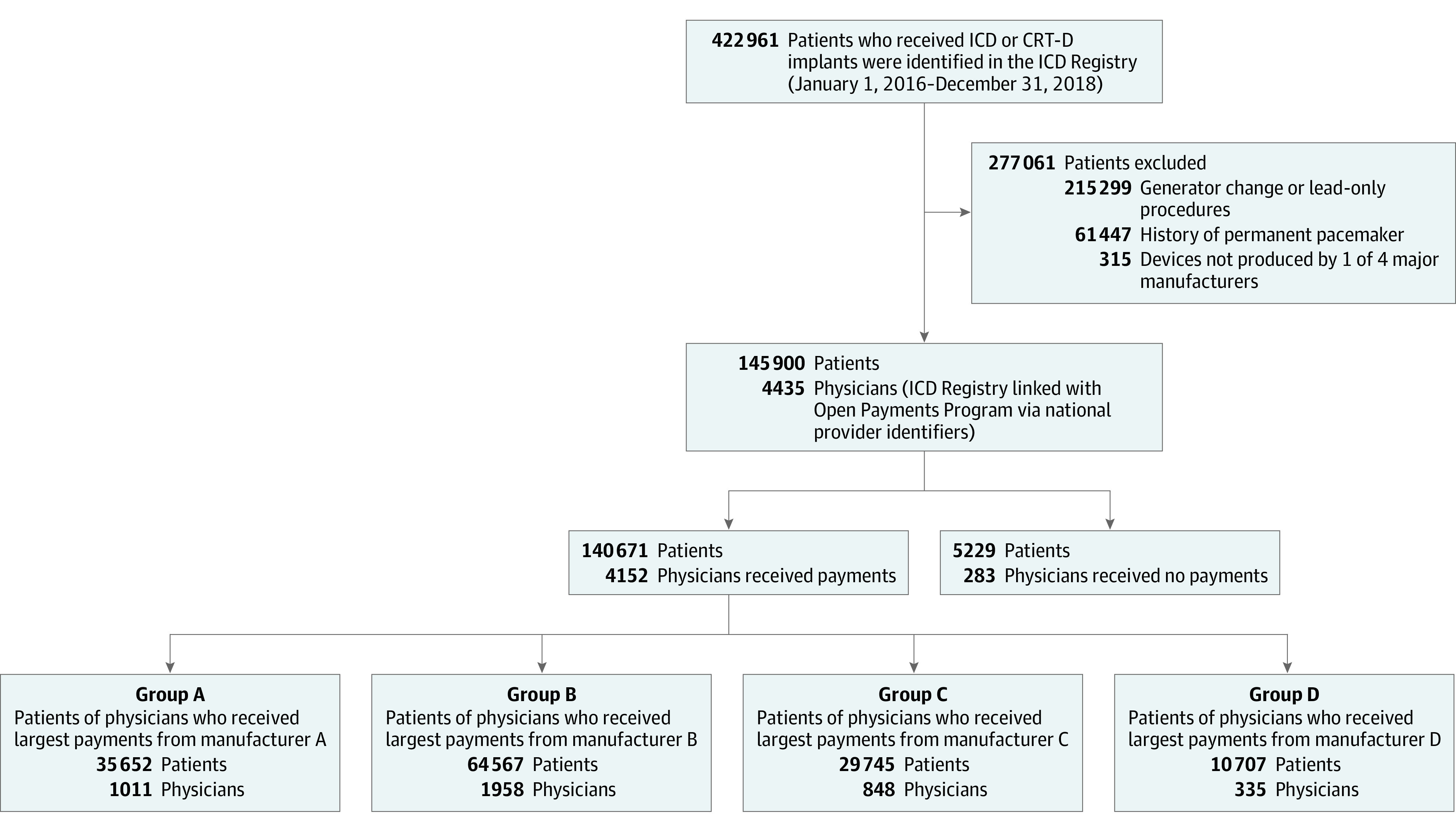
Design, setting, and participants: In this cross-sectional study, patients who received a first-time ICD or CRT-D device from any of the 4 major manufacturers (January 1, 2016-December 31, 2018) were identified. The data from the National Cardiovascular Data Registry ICD Registry was linked with the Open Payments Program's payment data. Patients were categorized into 4 groups (A, B, C, and D) corresponding to the manufacturer from which the physician who performed the implantation received the largest payment. For each patient group, the proportion of patients who received a device from the manufacturer that provided the largest payment to the physician who performed implantation was determined. Within each group, the absolute difference in proportional use of devices between the manufacturer that made the highest payment and the proportion of devices from the same manufacturer in the entire study cohort (expected prevalence) was calculated.
Exposures: Manufacturers' payments to physicians who performed an ICD or CRT-D implantation.
Main outcomes and measures: The primary outcome of the study was the manufacturer of the device used for the implantation.
Results: Over a 3-year period, 145 900 patients (median age, 65 years; 29.6% women) received ICD or CRT-D devices from the 4 manufacturers implanted by 4435 physicians at 1763 facilities. Among these physicians, 4152 (94%) received payments from device manufacturers ranging from $2 to $323 559 with a median payment of $1211 (interquartile range, $390-$3702). Between 38.5% and 54.7% of patients received devices from the manufacturers that had provided physicians with the largest payments. Patients were substantially more likely to receive devices made by the manufacturer that provided the largest payment to the physician who performed implantation than they were from each other individual manufacturer. The absolute differences in proportional use from the expected prevalence were 22.4% (95% CI, 21.9%-22.9%) for manufacturer A; 14.5% (95% CI, 14.0%-15.0%) for manufacturer B; 18.8% (95% CI, 18.2%-19.4%) for manufacturer C; and 30.6% (95% CI, 30.0%-31.2%) for manufacturer D.
Conclusions and relevance: In this cross-sectional study, a large proportion of ICD or CRT-D implantations were performed by physicians who received payments from device manufacturers. Patients were more likely to receive ICD or CRT-D devices from the manufacturer that provided the highest total payment to the physician who performed an ICD or CRT-D implantation than each other manufacturer individually.
Conflict of interest statement
Figures
Comment in
-
Reconsidering Health Care Fraud and Abuse Laws.JAMA. 2020 Nov 3;324(17):1735-1736. doi: 10.1001/jama.2020.19795. JAMA. 2020. PMID: 33141194 No abstract available.
References
Publication types
MeSH terms
Grants and funding
LinkOut - more resources
Full Text Sources
Other Literature Sources
Medical
Research Materials