Review
. 2021 Mar;78(5):1929-1941.
doi: 10.1007/s00018-020-03687-5. Epub 2020 Nov 3.

Regulation of peroxisomal trafficking and distribution

Affiliations
Review

Regulation of peroxisomal trafficking and distribution

Christian Covill-Cooke et al. Cell Mol Life Sci. 2021 Mar.

Abstract

Peroxisomes are organelles that perform a wide range of essential metabolic processes. To ensure that peroxisomes are optimally positioned in the cell, they must be transported by both long- and short-range trafficking events in response to cellular needs. Here, we review our current understanding of the mechanisms by which the cytoskeleton and organelle contact sites alter peroxisomal distribution. Though the focus of the review is peroxisomal transport in mammalian cells, findings from flies and fungi are used for comparison and to inform the gaps in our understanding. Attention is given to the apparent overlap in regulatory mechanisms for mitochondrial and peroxisomal trafficking, along with the recently discovered role of the mitochondrial Rho-GTPases, Miro, in peroxisomal dynamics. Moreover, we outline and discuss the known pathological and pharmacological conditions that perturb peroxisomal positioning. We conclude by highlighting several gaps in our current knowledge and suggest future directions that require attention.

Keywords: Actin; Disease; Dynein; Kinesin; Microtubule.


Conflict of interest statement

The authors declare no conflict of interest.

Figures
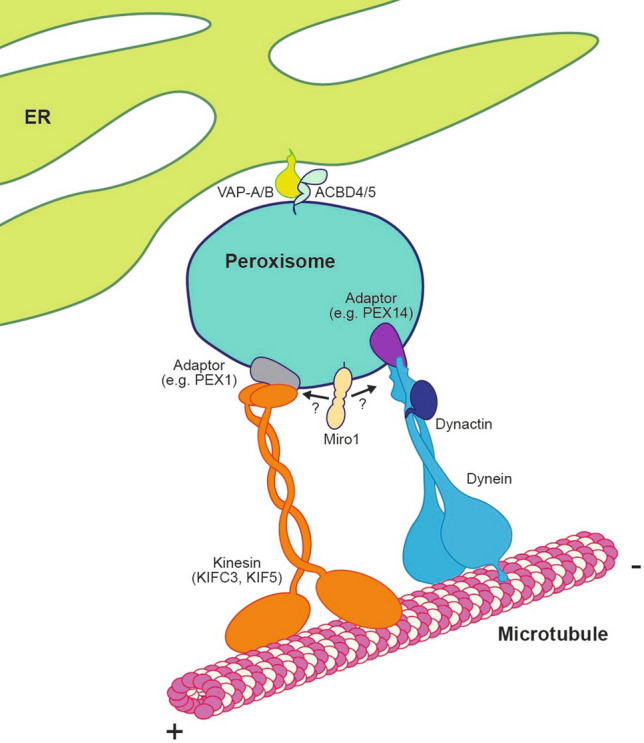
Fig. 1
Fig. 1
Peroxisomal trafficking machinery. Long-range trafficking is administered along the microtubules by the motor proteins dynein and kinesin (KIFC3, KIF5). The membrane protein PEX14, which is an essential part of the peroxisomal import machinery, allows the retrograde movement of peroxisomes along microtubules by interacting with dynein and its co-factor dynactin. Kinesins (KIFC3, KIF5) support the peroxisomal long-range trafficking towards the positive end of the microtubules by anchoring to the peroxisomal membrane using different adaptors (PEX1 for KIFC3). Miro1 is suggested to regulate peroxisomal trafficking by interacting with either the kinesin or dynein trafficking machinery. Oscillatory peroxisomal motility is dependent on tethering of the peroxisomes to the endoplasmic reticulum (ER) by the interaction of the ER membrane proteins VAP-A or VAP-B with the peroxisomal proteins ACBD4 or ACBD5
Fig. 2
Fig. 2
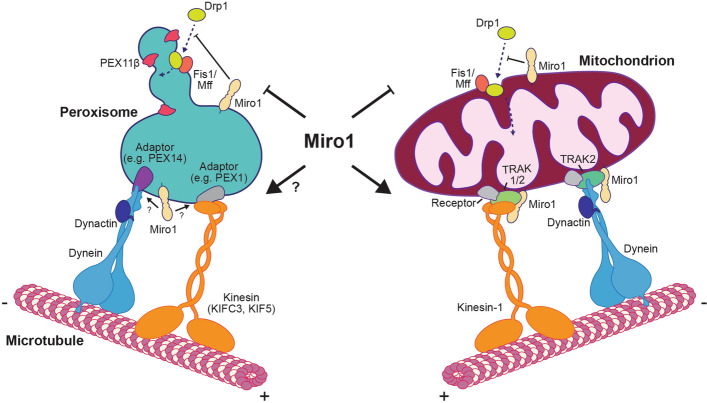
The role of Miro1 in peroxisomal and mitochondrial dynamics. Peroxisomes and mitochondria share a Drp1-dependent fission machinery, with the recruitment of Drp1 to either organelle being negatively regulated by Miro. Conversely, the microtubule-dependent transport of peroxisomes and mitochondria uses different machineries, thus it is currently unclear if the role of Miro1 on these processes is identical. Adaptors—unknown, likely PEX1 for KIFC3, TRAK2 for KIF5 and Pex14 for dynein; receptor—unknown, possibly mitofusins and Armcx1/3
Fig. 3
Fig. 3
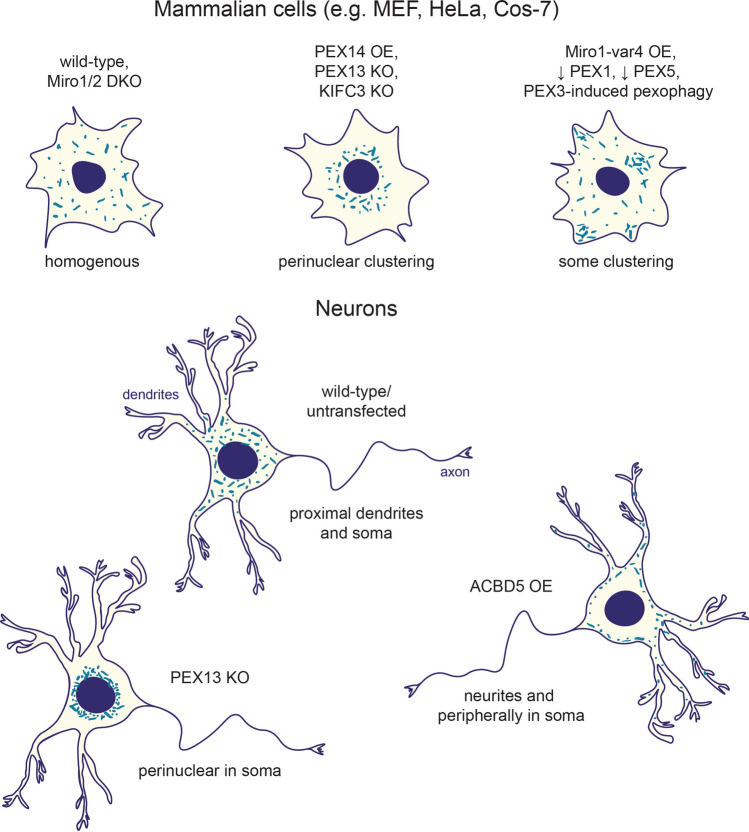
Factors affecting the distribution of peroxisomes in mammalian cells. Peroxisomes are distributed homogenously in several cell lines including Miro1/2 mouse embryonic fibroblasts. Depletion of members of the peroxisomal trafficking machinery (PEX14, KIFC3) causes a perinuclear positioning of peroxisomes, while changes in levels of other peroxisomal proteins lead to cytoplasmic clustering (e.g., overexpression of Miro1 variant 4, PEX1 or PEX5 deficiency, PEX3-induced pexophagy). In cultured neurons, peroxisomes are mainly found in the somata and proximal dendrites. Overexpression of ACBD5, however, leads to peroxisomal redistribution throughout the neurites and the periphery of somata. DKO, double knockout; OE, overexpression; KO, knockout; ↓, deficiency; var4, splice variant-4

References

    1. Agrawal G, Subramani S. De novo peroxisome biogenesis: Evolving concepts and conundrums. Biochim Biophys Acta. 2016;1863:892–901. doi: 10.1016/j.bbamcr.2015.09.014. - DOI - PMC - PubMed
    1. Fujiki Y, Okumoto K, Mukai S, et al. Peroxisome biogenesis in mammalian cells. Front Physiol. 2014;5:307. doi: 10.3389/fphys.2014.00307. - DOI - PMC - PubMed
    1. Costello JL, Schrader M. Unloosing the Gordian knot of peroxisome formation. Curr Opin Cell Biol. 2018;50:50–56. doi: 10.1016/j.ceb.2018.02.002. - DOI - PMC - PubMed
    1. Braverman NE, D’Agostino MD, Maclean GE. Peroxisome biogenesis disorders: biological, clinical and pathophysiological perspectives. Dev Disabil Res Rev. 2013;17:187–196. doi: 10.1002/ddrr.1113. - DOI - PubMed
    1. Klouwer FCC, Berendse K, Ferdinandusse S, et al. Zellweger spectrum disorders: clinical overview and management approach. Orphanet J Rare Dis. 2015;10:151. doi: 10.1186/s13023-015-0368-9. - DOI - PMC - PubMed

LinkOut - more resources