


Sexual violence and unmet need for contraception among married and cohabiting women in sub-Saharan Africa: Evidence from demographic and health surveys
- PMID: 33141830
- PMCID: PMC7608905
- DOI: 10.1371/journal.pone.0240556
Sexual violence and unmet need for contraception among married and cohabiting women in sub-Saharan Africa: Evidence from demographic and health surveys
Abstract
Introduction: Contraception plays a significant role in fertility regulation and determines the reproductive health rights of women. Studies in other parts of the world have found that sexual violence has negative effects on unmet need for contraception. There has not been any study on the association between these two phenomena in sub-Saharan Africa using current nationally-representative survey data. We investigated the association between sexual violence and unmet need for contraception among married and cohabiting women in sub-Saharan Africa.
Materials and methods: This study was based on secondary datasets from 26 sub-Saharan African countries' Demographic and Health Surveys conducted between 2010 and 2018. A sample of 101,968 women in sexual unions (married and cohabiting) with complete information on sexual violence and all the variables of interest were included in the analyses. Both bivariate and multilevel logistic regression analyses were carried out to examine the association between sexual violence and unmet need for contraception. Other individual and contextual level socio-economic and demographic variables were considered as covariates. Crude odds ratios [cOR] and adjusted odds ratios [aOR] with their corresponding 95% confidence intervals [CI], signifying precision, were presented. Level of statistical significance was declared at p<0.05.
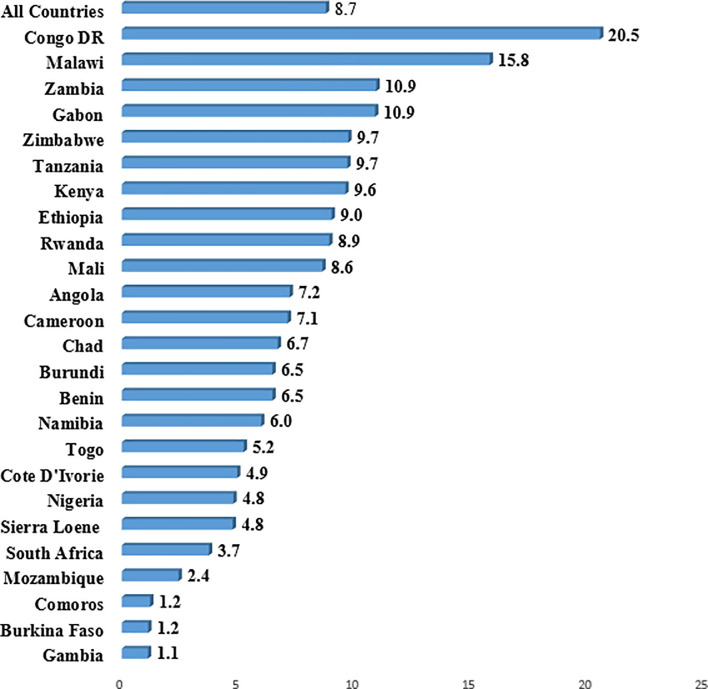
Results: The overall prevalence of sexual violence and unmet need for contraception in the 26 sub-Saharan African countries were 8.7% and 28.7% respectively. Experience of sexual violence within the last 12 months resulted in 10% increase in unmet need for contraception [OR = 1.10, CI = 1.03-1.14] and 5% increase in unmet need for contraception after controlling for individual and contextual level factors [aOR = 1.05, CI = 1.01-1.11]. With the individual level factors, women with 4 or more births [aOR = 4.85, CI = 4.41-5.33], those cohabiting [aOR = 1.43, CI = 1.37-1.47], those in female headed households [aOR = 1.22, CI = 1.18-1.27] and those who watched television at least once a week [aOR = 1.12, CI = 1.07-1.16] had higher odds of unmet need for family planning. However, those aged 30-34 [aOR = 0.56, CI = 0.52-0.61], those with secondary/higher level of education [AOR = 0.80, CI = 0.77-0.84], those who read newspaper less than once a week [aOR = 0.75, CI = 0.71-0.79] and those who listened to radio at least once a week [aOR = 0.94, CI = 0.90-0.97] had lower odds of unmet need for contraception. In terms of the contextual factors, women in rural areas [aOR = 0.87, CI = 0.84-0.91] and those in the richest wealth quintile households [aOR = 0.80, CI = 0.75-0.85] had lower odds of unmet need for contraception.
Conclusion: Our study has shown an association between sexual violence and unmet need for contraception in sub-Saharan Africa. Experiencing sexual violence increases the likelihood of unmet need for contraception in sub-Saharan Africa. It is also worthy to note that having four or more children, cohabiting with a male partner, and living in female-headed households are some of the key variables associated with unmet need for contraception in sub-Saharan Africa. Our study recommends that, successful contraceptive initiatives should focus on reducing sexual violence, while taking into consideration other significant factors that increase unmet need for contraception. Meanwhile, in doing this, contextual factors ought to be prioritised.
Conflict of interest statement
The authors have declared that no competing interests exist.
Figures

Similar articles
-
Socio-economic and demographic predictors of unmet need for contraception among young women in sub-Saharan Africa: evidence from cross-sectional surveys.Reprod Health. 2020 Oct 23;17(1):163. doi: 10.1186/s12978-020-01018-2. Reprod Health. 2020. PMID: 33097088 Free PMC article.
-
Predictors of unmet need for contraception among adolescent girls and young women in selected high fertility countries in sub-Saharan Africa: A multilevel mixed effects analysis.PLoS One. 2020 Aug 6;15(8):e0236352. doi: 10.1371/journal.pone.0236352. eCollection 2020. PLoS One. 2020. PMID: 32760153 Free PMC article.
-
What has women's reproductive health decision-making capacity and other factors got to do with pregnancy termination in sub-Saharan Africa? evidence from 27 cross-sectional surveys.PLoS One. 2020 Jul 23;15(7):e0235329. doi: 10.1371/journal.pone.0235329. eCollection 2020. PLoS One. 2020. PMID: 32702035 Free PMC article.
-
[Current status of the female condom in Africa].Sante. 1997 Nov-Dec;7(6):405-15. Sante. 1997. PMID: 9503499 Review. French.
-
Improving the sexual health of women with disabilities in sub-Saharan Africa: a scoping review of published studies.Reprod Health. 2024 Aug 6;21(1):116. doi: 10.1186/s12978-024-01859-1. Reprod Health. 2024. PMID: 39107772 Free PMC article.
Cited by
-
Unmet need for contraception among women in Benin: a cross-sectional analysis of the Demographic and Health Survey.Int Health. 2024 May 1;16(3):302-312. doi: 10.1093/inthealth/ihad049. Int Health. 2024. PMID: 37440422 Free PMC article.
-
Sexual violence against ever-married reproductive-age women in East Africa: further analysis of recent demographic and health surveys.BMC Public Health. 2024 Sep 29;24(1):2662. doi: 10.1186/s12889-024-20132-5. BMC Public Health. 2024. PMID: 39343897 Free PMC article.
-
Women's healthcare decision-making and unmet need for contraception in Mali.Reprod Health. 2022 Aug 20;19(1):183. doi: 10.1186/s12978-022-01484-w. Reprod Health. 2022. PMID: 35987680 Free PMC article.
-
Effects of a clinic-based reproductive empowerment intervention on proximal outcomes of contraceptive use, self-efficacy, attitudes, and awareness and use of survivor services: a cluster-controlled trial in Nairobi, Kenya.Sex Reprod Health Matters. 2023 Dec;31(1):2227371. doi: 10.1080/26410397.2023.2227371. Sex Reprod Health Matters. 2023. PMID: 37594312 Free PMC article. Clinical Trial.
-
Assessment of socio demographic factors on termination of pregnancy in Ghana.Nurs Open. 2024 Apr;11(4):e2152. doi: 10.1002/nop2.2152. Nurs Open. 2024. PMID: 38581161 Free PMC article.
References
-
- World Health Organization. Unmet need for family planning.2018. Retrieved from http://www.who.int/ reproductivehealth/topics/family_planning/unmet_need_fp/en/
MeSH terms
LinkOut - more resources
Full Text Sources
Medical
