


Atogepant Is Not Associated With Clinically Meaningful Alanine Aminotransferase Elevations in Healthy Adults
- PMID: 33142014
- PMCID: PMC7993278
- DOI: 10.1111/cts.12917
Atogepant Is Not Associated With Clinically Meaningful Alanine Aminotransferase Elevations in Healthy Adults
Abstract
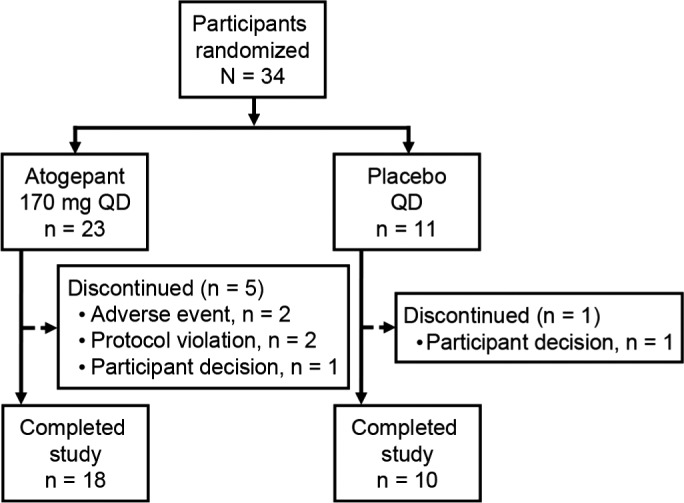
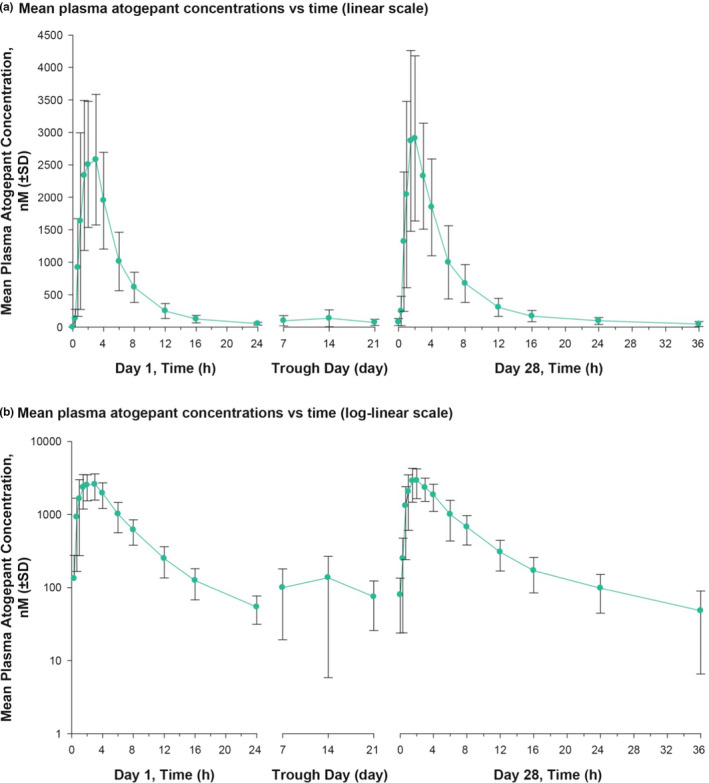
Atogepant is a potent, selective, oral calcitonin gene-related peptide (CGRP) receptor antagonist in development for migraine prevention. The chemical structure of atogepant is distinct from previous CGRP receptor antagonists, which were associated with elevated serum alanine aminotransferase (ALT) in clinical trials. Here, we report the safety, tolerability, and pharmacokinetics (PKs) of a once-daily supratherapeutic dose (170 mg) of atogepant for 28 days from a randomized, double-blind, placebo-controlled phase I trial in healthy participants. Overall safety, hepatic safety, and plasma PK parameters were evaluated. Thirty-four participants aged 23-55 years enrolled; 28 (82.4%) completed the study in accordance with the protocol. Multiple doses of 170 mg atogepant for 28 consecutive days were generally well-tolerated. All adverse events (AEs; reported in 87.0% of the atogepant group; 72.7%, placebo) were mild in severity except one serious AE of subarachnoid hemorrhage due to a bicycle accident and not considered related to treatment. There were two discontinuations due to AEs, both with atogepant, one considered possibly related to treatment. Over 28 days of treatment, no participant receiving atogepant had an ALT elevation above 1.5 × upper limit of normal. Change from baseline in serum ALT levels was not different between atogepant and placebo. Atogepant is rapidly absorbed (median time to maximum plasma concentration, ~ 2 hours) with an apparent terminal half-life of ~ 11 hours, and no evidence of accumulation after once-daily dosing. Overall, atogepant at a high oral dose is safe and well-tolerated in healthy participants with no clinically meaningful elevations in ALT.
Trial registration: ClinicalTrials.gov NCT03700320 NCT03777059 NCT03855137 NCT03939312.
© 2020 Merck Sharp & Dohme Corp., a subsidiary of Merck & Co., Inc. Clinical and Translational Science published by Wiley Periodicals LLC on behalf of the American Society for Clinical Pharmacology and Therapeutics.
Conflict of interest statement
K.C.M., J.X., and L.M. were employees of Merck Sharp & Dohme Corp., a subsidiary of Merck & Co., Inc., Kenilworth, NJ, USA, with stock in Merck & Co., Inc., Kenilworth, NJ, USA, at the time of this study. W.K.K. served as a consultant to Merck in 2019 for a topic unrelated to atogepant. P.B., F.C.‐G., W.L., D.P., M.F.D., and C.Z.M. are employees of Merck Sharp & Dohme Corp., a subsidiary of Merck & Co., Inc., Kenilworth, NJ, USA, with stock in Merck & Co., Inc., Kenilworth, NJ, USA. R.B. is an employee of AbbVie, and may hold AbbVie stock.
Figures

References
-
- Pietrobon, D. & Moskowitz, M.A. Pathophysiology of migraine. Annu. Rev. Physiol. 75, 365–391 (2013). - PubMed
-
- Burch, R.C. , Buse, D.C. & Lipton, R.B. Migraine: epidemiology, burden, and comorbidity. Neurol. Clin. 37, 631–649 (2019). - PubMed
-
- GBD 2016 Disease and Injury Incidence and Prevalence Collaborators . Global, regional, and national incidence, prevalence, and years lived with disability for 328 diseases and injuries for 195 countries, 1990–2016: a systematic analysis for the Global Burden of Disease Study 2016. Lancet 390, 1211–1259 (2017). - PMC - PubMed
-
- Lipton, R.B. , Bigal, M.E. , Diamond, M. , Freitag, F. , Reed, M.L. & Stewart, W.F. Migraine prevalence, disease burden, and the need for preventive therapy. Neurology 68, 343–349 (2007). - PubMed
Publication types
MeSH terms
Substances
Associated data
LinkOut - more resources
Full Text Sources
Medical
Research Materials
Miscellaneous
