


Lifestyle, Quality of Life, and Health Promotion Needs in Mexican University Students: Important Differences by Sex and Academic Discipline
- PMID: 33142666
- PMCID: PMC7663378
- DOI: 10.3390/ijerph17218024
Lifestyle, Quality of Life, and Health Promotion Needs in Mexican University Students: Important Differences by Sex and Academic Discipline
Abstract
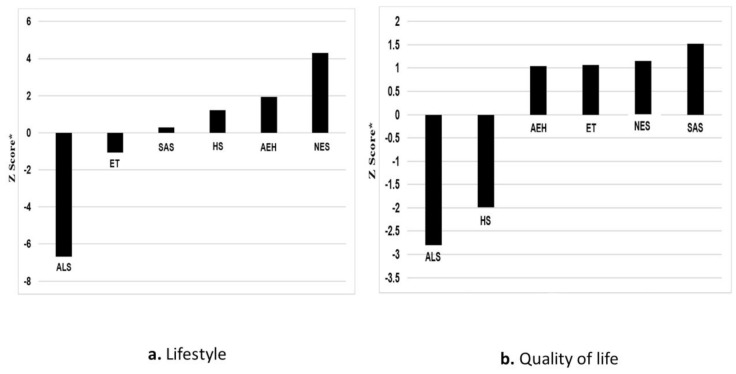
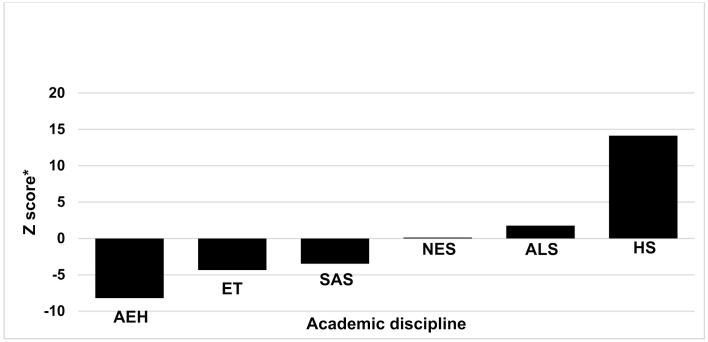
Few studies have evaluated and contrasted the lifestyles and quality of life of university students by academic discipline. We compared university students' lifestyle and quality of life, and schools' compliance with health promotion guidelines. Then, needs were ranked and prioritized. This was a cross-sectional study carried out in a public university in Northeastern Mexico. Higher education students with no visual or hearing impairment from six different academic disciplines were included (N = 5443). A self-administered and anonymous questionnaire was applied that included the HPLP (Health-Promoting Lifestyle Profile) and SF-12 scales. A check list was employed for measuring 26 on-site schools' compliance with health promotion guidelines, and needs were ranked using Z-scores. The mean lifestyle was 53.9 ± 14.8 and the mean quality of life was 69.7 ± 5. Men had healthier lifestyles with more exercise and better stress management. The mean compliance with health promotion guidelines was 58.7%. Agricultural Sciences students had the highest need for improving both lifestyle and quality of life. Arts, Education, and Humanities, Engineering and Technology, and Social and Administrative Sciences schools ranked first in need for health promotion actions. The methodology used allowed hierarchization of areas requiring planning and implementation of specific actions, and the results indicated that healthy lifestyles and quality of life should be a priority.
Keywords: Mexico; health promotion; lifestyle; quality of life; university students.
Conflict of interest statement
The authors declare no conflict of interest.
Figures
References
-
- Rivera J.A., Pedraza L.S., Aburto T.C., Batis C., Sánchez-Pimienta T.G., González de Cosío T., López-Olmedo N., Pedroza-Tobías A. Overview of the Dietary Intakes of the Mexican Population: Results from the National Health and Nutrition Survey 2012. J. Nutr. 2016;146:1851S–1855S. doi: 10.3945/jn.115.221275. - DOI - PubMed
-
- National Institute of Statistic and Geography Sports Practice and Physical Exercise Module (MOPRADEF) [(accessed on 28 April 2020)]; Available online: https://www.inegi.org.mx/programas/mopradef/ (In Spanish)
-
- Gutiérrez-Salmeán G., Meaney A., Ocharán M.E., Araujo J.M., Ramírez-Sánchez I., Olivares-Corichi I.M., García-Sánchez R., Castillo G., Méndez-Bolaina E., Meaney E., et al. Anthropometric traits, blood pressure, and dietary and physical exercise habits in health sciences students; the obesity observatory project. Nutr. Hosp. 2013;28:194–201. doi: 10.3305/nh.2013.28.1.6185. - DOI - PubMed
-
- Salazar C., Feu S., Vizuete M., de la Cruz-Sánchez E. IMC y actividad física de los estudiantes de la Universidad de Colima. Rev. Int. Med. Cienc. Ac. 2013;13:569–584.
-
- Chávez Valenzuela M., Salazar C., Hoyos Ruíz G., Bautista Jacobo A., González Lomelí D., Ogarrio Perkins C. Physical activity and chronic non-transmissible diseases in Mexican students by gender. Retos. 2018;33:169–174.
Publication types
MeSH terms
LinkOut - more resources
Full Text Sources
