Review
. 2020 Oct 30;21(21):8118.
doi: 10.3390/ijms21218118.

Ischemic Heart Disease Pathophysiology Paradigms Overview: From Plaque Activation to Microvascular Dysfunction

Affiliations
Review

Ischemic Heart Disease Pathophysiology Paradigms Overview: From Plaque Activation to Microvascular Dysfunction

Paolo Severino et al. Int J Mol Sci. .

Abstract

Ischemic heart disease still represents a large burden on individuals and health care resources worldwide. By conventions, it is equated with atherosclerotic plaque due to flow-limiting obstruction in large-medium sized coronary arteries. However, clinical, angiographic and autoptic findings suggest a multifaceted pathophysiology for ischemic heart disease and just some cases are caused by severe or complicated atherosclerotic plaques. Currently there is no well-defined assessment of ischemic heart disease pathophysiology that satisfies all the observations and sometimes the underlying mechanism to everyday ischemic heart disease ward cases is misleading. In order to better examine this complicated disease and to provide future perspectives, it is important to know and analyze the pathophysiological mechanisms that underline it, because ischemic heart disease is not always determined by atherosclerotic plaque complication. Therefore, in order to have a more complete comprehension of ischemic heart disease we propose an overview of the available pathophysiological paradigms, from plaque activation to microvascular dysfunction.

Keywords: atherosclerosis; coronary blood flow; ion channels; ischemic heart disease; microcirculation; myocardial infarction.


Conflict of interest statement

The authors declare no conflict of interest.

Figures
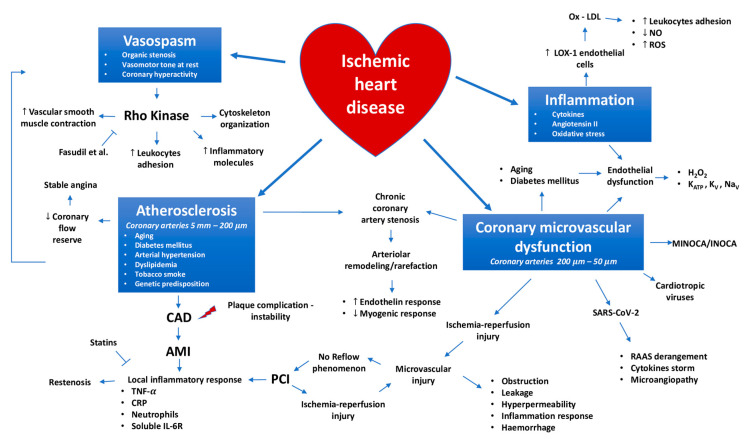
Figure 1
Figure 1
Schematic representation of pathophysiological mechanisms involved in ischemic heart disease. Ischemic heart disease is determined by an imbalance of the cross talk between myocardial energy state and coronary blood flow. This is due to several conditions. In particular, atherosclerosis, coronary microvascular dysfunction, inflammation and vasospasm contribute to the multifaceted and complex pathophysiology of ischemic heart disease. CAD: coronary artery disease; AMI: acute myocardial infarction; PCI: percutaneous coronary intervention; TNFα: tumor necrosis factor alpha; CRP: C-reactive protein; IL-6R: interleukin-6 receptor; SARS-CoV-2: severe acute respiratory syndrome coronavirus 2; RAAS: renin–angiotensin–aldosterone system; MINOCA: myocardial infarction with non-obstructive coronary arteries; INOCA: ischemia with non-obstructive coronary arteries; H2O2: hydrogen peroxide; KATP: ATP-sensitive potassium channel; Kv: voltage-gated potassium channel; Nav: voltage-gated sodium channel; LOX-1: oxidized low-density lipoprotein receptor 1; Ox-LDL: oxidized low-density lipoprotein; ROS: reactive oxygen species; NO: nitric oxide; ↑: increase; ↓: decrease.
Figure 2
Figure 2
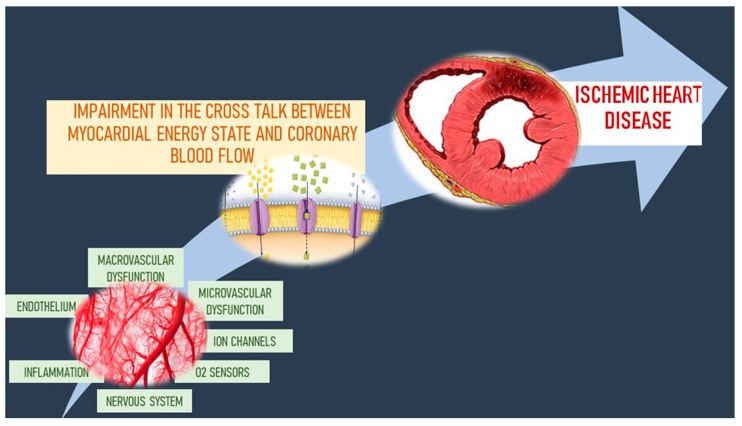
Mechanisms involved in ischemic heart disease pathophysiology and coronary ion channels role. Ischemic heart disease hides a multifaceted and complex pathophysiological paradigm. Several pathways are involved in the ischemic heart disease pathophysiology (i.e., micro and macrovascular dysfunction, atherosclerotic plaque rupture, inflammation, endothelium dependent and independent dysfunction, ion channels and nervous system impairment). In particular, coronary ion channels, represented in the central part of the figure, are the final effectors of coronary blood flow regulation mechanisms, playing a pivotal role in the coupling between myocardial metabolism and coronary circulation. Their activity dysregulation may occur during coronary microvascular dysfunction and other pathological conditions. It causes the impairment in the cross talk between myocardial energy state and coronary blood flow, leading to ischemic heart disease.

References

    1. Moran A.E., Forouzanfar M.H., Roth G.A., Mensah G.A., Ezzati M., Murray C.J., Naghavi M. Temporal trends in ischemic heart disease mortality in 21 world regions, 1980 to 2010: The Global Burden of Disease 2010 study. Circulation. 2014;129:1483–1492. doi: 10.1161/CIRCULATIONAHA.113.004042. - DOI - PMC - PubMed
    1. Tiefenbacher C.P., Chilian W.M. Heterogeneity of coronary vasomotion. Basic Res. Cardiol. 1998;93:446–454. doi: 10.1007/s003950050114. - DOI - PubMed
    1. Wolin M.S., Ahmad M., Gupte S.A. Oxidant and redox signaling in vascular oxygen sensing mechanisms: Basic concepts, current controversies, and potential importance of cytosolic NADPH. Am. J. Physiol. Lung Cell Mol. Physiol. 2005;289:159–173. doi: 10.1152/ajplung.00060.2005. - DOI - PubMed
    1. Tune J.D. Withdrawal of vasoconstrictor influences in local metabolic coronary vasodilation. Am. J. Physiol. Heart Circ. Physiol. 2006;291:2044–2046. doi: 10.1152/ajpheart.00653.2006. - DOI - PubMed
    1. Dzeja P.P., Bast P., Pucar D., Wieringa B., Terzic A. Defective metabolic signaling in adenylate kinase AK1 gene knock-out hearts compromises post-ischemic coronary reflow. J. Biol. Chem. 2007;282:31366–31372. doi: 10.1074/jbc.M705268200. - DOI - PMC - PubMed

MeSH terms